 MineArchive
Totternhoe Stone Mines
| Location | Totternhoe, near Dunstable, Bedfordshire — 51.8977, -0.6098 (approximate) |
|---|---|
| Commodity | Chalk |
| Type | Stone |
| Worked | Worked from the Roman period–Around 1925 |
| Maximum depth | Shallow horizontal adits driven into the hillside; no significant vertical depth |
| Operators | H G Clarke (1925–?) |
Overview
A hard chalk known as clunch, worked at Totternhoe since Roman times and increasingly through horizontal underground galleries driven beneath Totternhoe Castle from the medieval period onward — supplying stone for Westminster Abbey and Windsor Castle, and continuing underground until 1925.
History
Totternhoe has supplied building stone since the Roman period, quarried from a locally hard band within the Lower Chalk known as Totternhoe Stone or clunch. Stone was originally worked from open surface pits, but during the medieval period quarrymen began driving horizontal galleries, or adits, directly into the hillside beneath Totternhoe Castle, continuing to extract stone from underground for centuries. Totternhoe Stone travelled well beyond Bedfordshire, used in buildings ranging from local churches to Westminster Abbey and Windsor Castle. Underground working continued until around 1925; the last recorded access to the galleries was in the 1970s, by members of the Dunstable and Derbyshire caving clubs. Opencast quarrying for lime and cement in the industrial era destroyed parts of the earlier underground network, and the branch railway that once served the quarries closed in 1965. Small-scale surface extraction continues today, carried out by the local firm H G Clarke.
Geology
Totternhoe Stone is a relatively hard band within the Lower Chalk of the Chiltern Hills, harder and more workable than ordinary chalk, which made it prized as a freestone-like building material despite technically being a variety of chalk rather than limestone.
Workings
Stone was originally worked from open pits at the surface before medieval quarrymen switched to driving horizontal adits directly into the hillside beneath Totternhoe Castle, following the workable clunch band underground rather than stripping it from above.
Closure
Underground working ended around 1925, and the last recorded access to the galleries came in the 1970s, when members of the Dunstable and Derbyshire caving clubs explored the remaining passages; the site's branch railway closed in 1965.
What remains
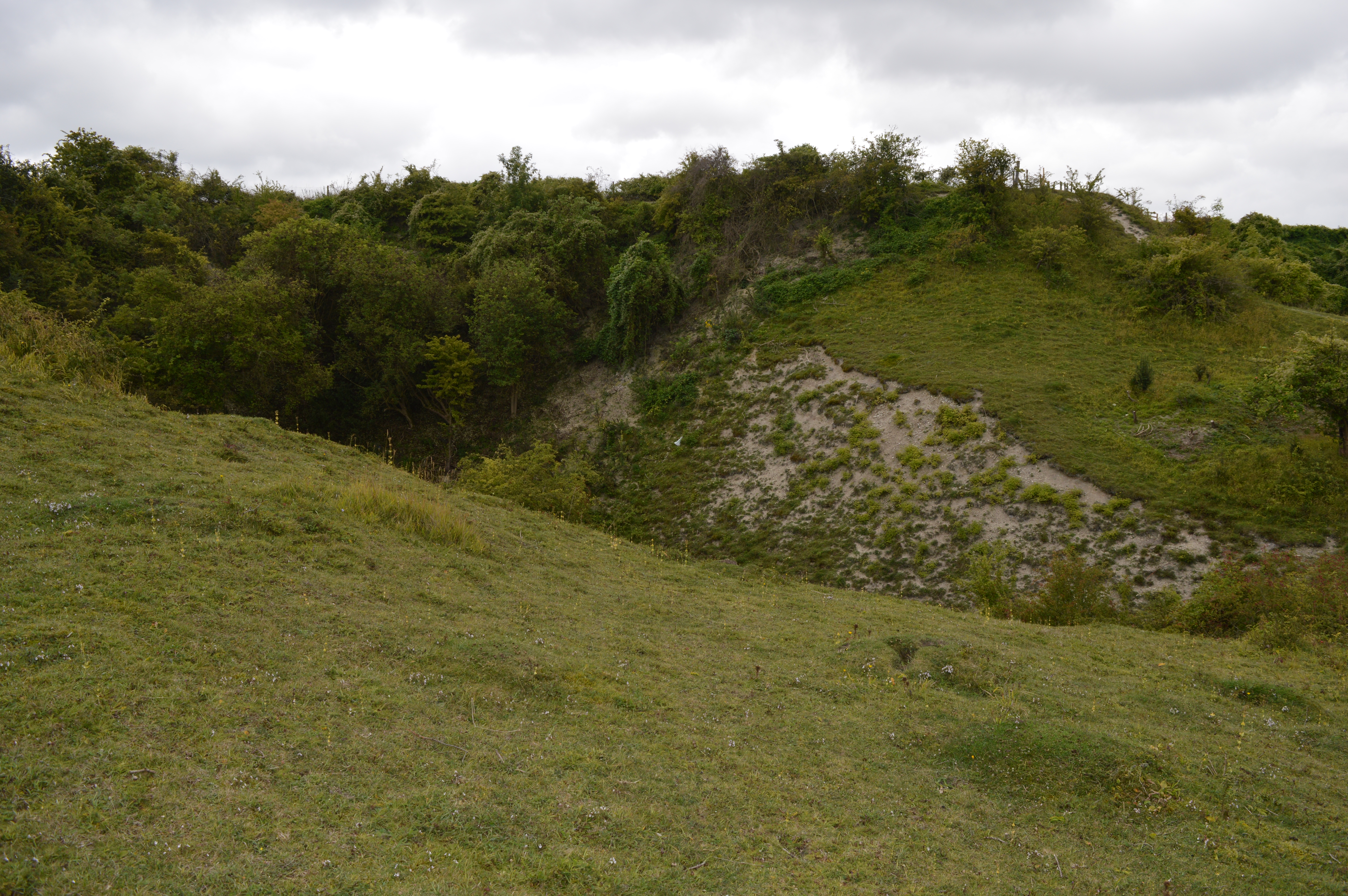
Much of the site is now Totternhoe Knolls, a National Nature Reserve formed from the quarries' extensive spoil heaps, though small-scale surface stone extraction continues today by the local firm H G Clarke; the underground galleries themselves are largely inaccessible and in an uncertain state of preservation.
The spoil heaps forming Totternhoe Knolls are the most visible legacy of the quarrying, alongside the earthworks of Totternhoe Castle itself, built directly above the underground workings.
Nearby mines
- Leighton Buzzard Sand Quarries — 2.9 miles (4.7 km) NW
- Double Arches Pit — 4.0 miles (6.5 km) N
- Kensworth Chalk Pit — 4.5 miles (7.3 km) SE
- Pitstone Chalk Quarry and Cement Works — 4.6 miles (7.4 km) S, Buckinghamshire
Straight-line distance, within 9 miles (15 km). Show on the map.
Recorded claims
Individual factual claims, each attached to the source(s) that support it below. Where sources disagree, both are kept.
- Underground galleries were driven into the hillside beneath Totternhoe Castle from the medieval period onward, supplying stone for buildings including Westminster Abbey and Windsor Castle. 1,2
- Underground working continued until around 1925; the last recorded access to the underground galleries was in the 1970s, by members of the Dunstable and Derbyshire caving clubs. 1
- Opencast quarrying for lime and cement in the industrial era destroyed parts of the earlier underground network. 1
- Small-scale surface stone extraction continues today by the local firm H G Clarke, nearly 2,000 years after Totternhoe stone was first worked. 3
Sources
- (secondary) Totternhoe Stone Quarries — Subterranea Britannica
- (secondary) Totternhoe Stone — Wikipedia
- (secondary) Totternhoe Stone — Bedfordshire Geology Group
- (primary) Totternhoe Quarries: Section of Stone Mine — BGS Mine Plans
Record created: 22 August 2026 · Last researched: 22 August 2026