 MineArchive
Sandstone
| Category | Commodities |
|---|---|
| Commodity page | Sandstone → |
A sedimentary rock formed from compacted and cemented sand-sized grains — chiefly quartz — that splits and dresses well, making it Britain's most widely used building stone.
Historical usage
Sandstone quarrying on a substantial scale was already underway in medieval Britain, supplying the dressed stone for major building projects such as the Border abbeys. The industry grew hugely through the 19th century as the railway network let quarries supply distant markets rather than just their own locality — the Permian sandstone quarry at Locharbriggs, Dumfriesshire, alone employed around 260 workers by 1900 — and around 850 quarries were supplying building sandstone across Britain at the industry's mid-19th-century peak.
How it worked
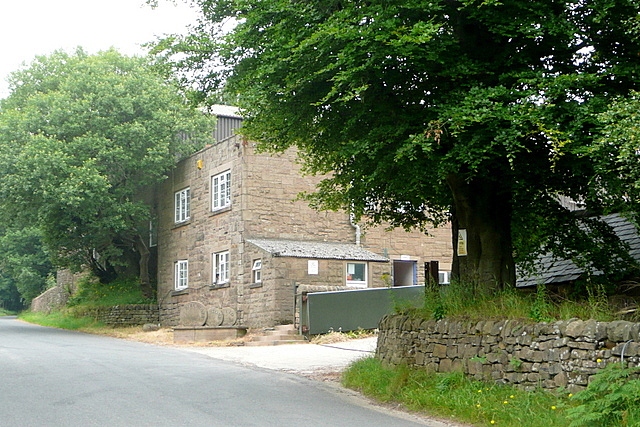
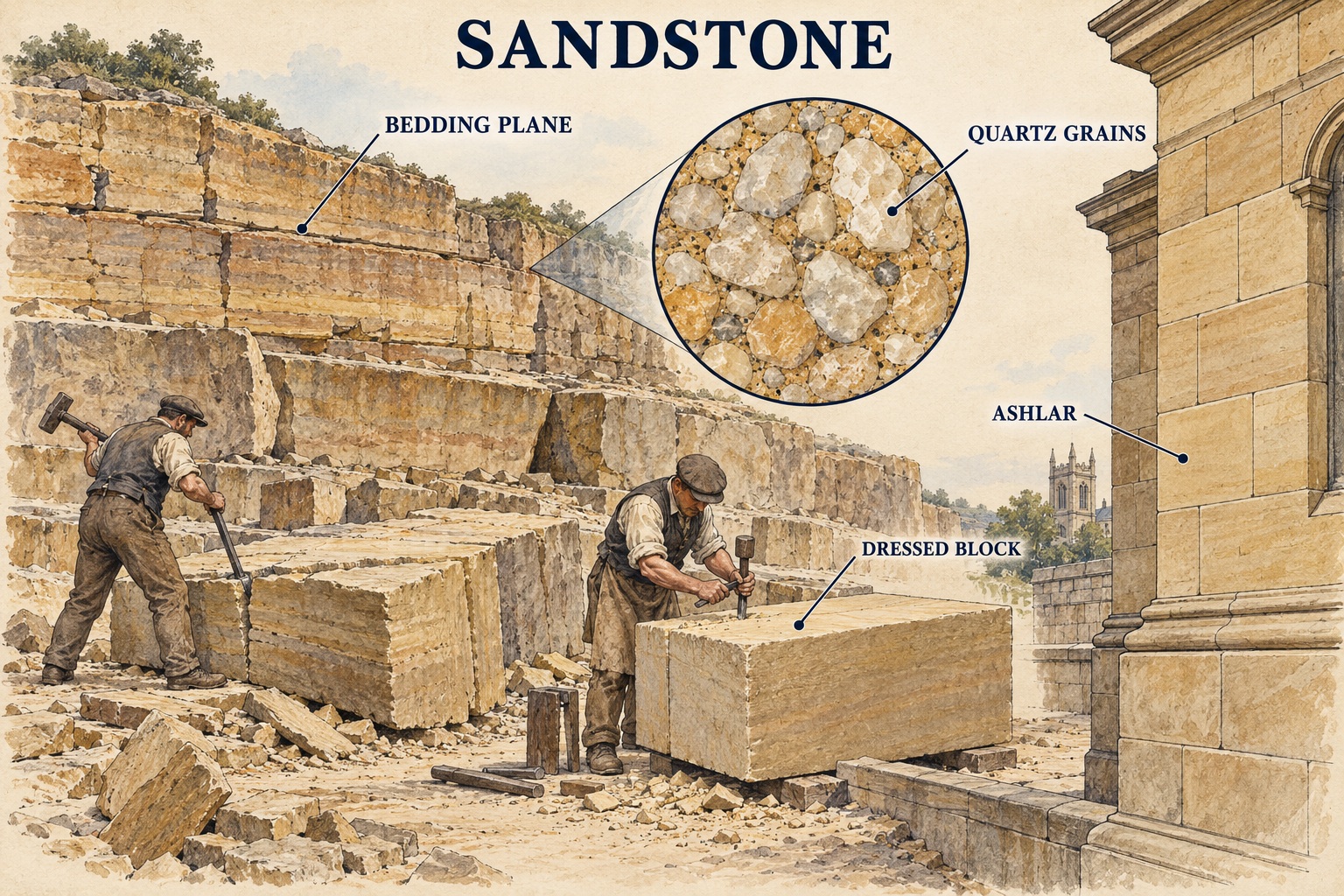
Sandstone was worked from open quarries at outcrop, with blocks split along natural bedding planes and dressed by hand or, later, machine. Where the rock lacked a regular joint pattern — true of many older Lower Palaeozoic sandstones — walling had to be built from irregular rubble bonded with lime mortar instead of neatly squared blocks.
Why it was used
Its durability, workability and, in most districts, local abundance made sandstone the obvious choice for everything from cottage walls to cathedrals, and its physical variety in colour, hardness and grain let each region build in a stone that suited both its geology and its architectural taste.
Value over time
Demand for quarried sandstone rose through the 19th century as railways opened national and export markets, then fell through the 20th as brick, concrete and imported stone displaced it from ordinary building work — production is now heavily weighted toward small-volume, high-value conservation and restoration work rather than new construction, reflected in the shrinking number of working quarries rather than in the price of any single well-known stone.
Hazards & challenges
As with other hard-rock quarrying, cutting and dressing sandstone generates fine silica dust; prolonged, poorly-controlled exposure carries the standard hard-rock risk of silicosis.
Risks & limitations
Quarry closures have sharply narrowed the choice of British building sandstone: roughly 200 quarries remain open today against some 850 in the mid-19th century, and famous historic sources such as Edinburgh's Craigleith Sandstone have been built over and are no longer available at all. Conservation work increasingly has to use whatever sandstone is currently quarried rather than a close match for a building's original stone, risking new stone that weathers differently from, or is physically incompatible with, the fabric it repairs.
Regional variation
England draws on Devonian sandstones in Herefordshire, Carboniferous stone from the Pennines, Permo-Triassic stone in the Midlands, Jurassic stone in Yorkshire and Cretaceous stone in the south; Wales has its own Carboniferous Pennant Sandstone; Scotland ranges from Devonian Caithness flagstone through Carboniferous Midland Valley stone to the bright red Permian sandstones of Dumfries and Lochmaben, and Northern Ireland draws on Silurian, Carboniferous and Permo-Triassic sources.
Related terminology
Flagstone, Freestone, Sarsen Stone
Mines associated with this term
5 examples chosen from 19 linked records — the term page is not an index.
- Bramley Fall Quarry — West Yorkshire (well documented example)
Named 3 times in this record, first in the summary: “…since at least the 12th century, whose famously shock-resistant sandstone supplied Leeds Town Hall and Kirkstall Abbey at home and, further…” - Corncockle Quarry — Dumfries and Galloway (well documented example)
Named 4 times in this record, first in the summary: “A large Permian sandstone quarry near Templand in Annandale, still worked today, whose stone…” - Aislaby Quarry — North Yorkshire (well documented example)
Named 7 times in this record, first in the summary: “Sandstone workings four miles west of Whitby, quarried since at least the…” - Bolehill Quarry — Derbyshire (well documented example)
Named in this record’s geology: “…Grit on the eastern edges of the Peak — the coarse siliceous sandstone that gave the formation its name, because for six centuries this is…” - Burtersett Flag Stone Mine — North Yorkshire (well documented example)
Named 8 times in this record, first in the summary: “…near Hawes, driven into the hillside to win flagstone from a sandstone bed between limestones. It employed fifty-four people in 1896,…”
See every mine that worked sandstone →
Sources
- (primary) Building stone resources, Southern Uplands — British Geological Survey (Earthwise)
- (secondary) The Sands of Time: Britain's Building Sandstones — The Building Conservation Directory
Record created: 27 August 2026 · Last researched: 27 August 2026