 MineArchive
Aislaby Quarry
| Also known as | Aislaby Quarries, Galley Hill Quarry |
|---|---|
| Location | Aislaby, near Whitby, North Yorkshire — 54.4670, -0.6890 (exact) |
| Commodity | Sandstone |
| Type | Stone |
| Worked | By the 11th century–Still active |
| Maximum depth | Not applicable: surface quarrying. |
| Operators | Eskdale Stone (2002–?) |
Overview
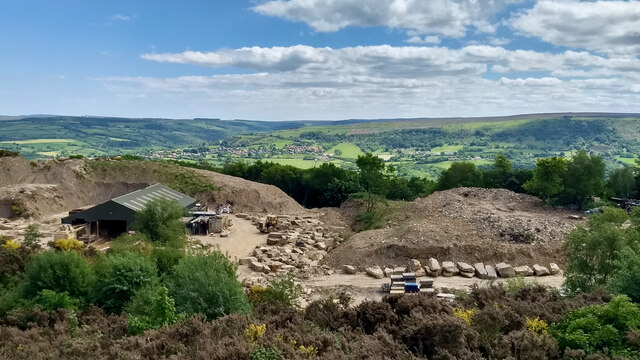
Sandstone workings four miles west of Whitby, quarried since at least the eleventh century and still worked. Aislaby stone built most of Whitby Abbey, faced the town's piers in six-tonne blocks, went by sea to Covent Garden and the foundations of Waterloo Bridge, and was shipped as far as the harbour at Tangier.
History
The quarries at Aislaby were in existence by the eleventh century: the greater part of Whitby Abbey was built of stone from this ground, and they went on supplying it into the fourteenth. The stone was cut for decorative work as well as building, and the Easby Cross of the early ninth century has been matched to the medium-grained deltaic sandstone traditionally produced at Aislaby — which, if right, means pack horses carried worked sections of it west to the valley of the Swale, though who paid for the cross is unknown. Aislaby stone appears in churches at Lythe, Lastingham and Hovingham, and in Guisborough Priory.
What the quarries are chiefly known for is harbour and civic work, and that depended on Whitby: the stone went out by sea. The West and East Piers at Whitby were faced with six-tonne blocks of it. High-quality stone was exported to London for Covent Garden and for Waterloo and London bridges — the foundations of the Strand bridge that preceded Waterloo among them — and as pierstone or blockstone for the harbours at Saltwick, Ramsgate, Margate and Tangier. It was used in road and railway bridges and railway stations across the North York Moors, and in the domestic and civic buildings of Whitby itself. Blockstone was returned from the Whitby pier in 1964.
The stone is still worked at Aislaby. The quarry reopened in 2002 and trades as Eskdale Stone; the English Heritage and British Geological Survey study of north-east Yorkshire's building stones records a plaque at the site commemorating the quarrying and use of Aislaby stone.
Geology
The quarries work the Saltwick Formation of the Middle Jurassic Ravenscar Group — buff, yellow and brown, medium to coarse-grained sandstone laid down in a delta, known locally as Aislaby Stone and elsewhere as Bilsdale Stone, Fairhead Stone, Lower Estuarine Sandstone, Great Sandrock, Saltwick Sandstone or pierstone. The thicker sandstones form laterally impersistent beds and crags along the escarpment of the northern moors, and were quarried locally for freestone and ashlar wherever they came out. The building-stone study notes that Ravenscar Group sandstones, Aislaby stone among them, are prone to weathering and spalling over time.
Geological setting: Sedimentary Beds and Seams (well documented example)
Workings
Surface quarrying along the escarpment. The building-stone study calls Galley Hill at Aislaby the most productive of the large quarries here, which places the main workings on the hill north of the village. Nothing of the internal layout is recorded. A local account reports that the remains of jet mines were accessible in the area in the 1970s, but the ground has since been reworked.
Closure
Not closed: the stone is still worked at Aislaby, the quarry having reopened in 2002.
What remains
A working quarry, trading as Eskdale Stone, with offices at the site. A plaque at Aislaby commemorates the quarrying and use of the stone.
Not applicable: the quarry is in production.
Redevelopment
None; the site is still extractive.
Nearby mines
- Whitby Jet Workings — 3.0 miles (4.9 km) NE
- Egton Quarry — 3.5 miles (5.6 km) SW
- Goldsborough Ironstone Mine — 3.5 miles (5.6 km) N
- Woodsmith Mine — 3.5 miles (5.7 km) SE
- Sil Howe Whinstone Mine — 3.8 miles (6.1 km) S
Straight-line distance, within 9 miles (15 km). Show on the map.
Recorded claims
Individual factual claims, each attached to the source(s) that support it below. Where sources disagree, both are kept.
- The quarry workings at Aislaby, four miles west of Whitby, were in existence by the eleventh century, the majority of Whitby Abbey having been built of stone from the area. 1
- The most productive of the large quarries here, at Galley Hill, supplied many domestic and civic buildings in and around Whitby including the abbey; high-quality stone was exported to London for Covent Garden and Waterloo and London bridges, and used as pierstone or blockstone for the harbours at Whitby, Saltwick, Ramsgate, Margate and Tangier, as well as in Guisborough Priory, road and railway bridges and railway stations. 2
- Aislaby Stone is a buff, yellow and brown medium to coarse-grained Middle Jurassic sandstone of the Saltwick Formation, Ravenscar Group, known locally also as Bilsdale or Fairhead Stone, and it is prone to weathering and spalling over time. 2
- The West and East Piers at Whitby were faced with six-tonne blocks of Aislaby stone, and blockstone was returned from the Whitby pier in 1964. 1,3
- The Easby Cross, of the early ninth century, has been matched to the medium-grained deltaic sandstone traditionally produced in the Aislaby quarries of Eskdale near Whitby; it is theorised that pack horses carried sections west to the valley of the Swale, and it is unknown who paid for it. 1
Photographs & further reading
English Heritage and the British Geological Survey on the Ravenscar Group sandstones, Aislaby stone among them — where it was quarried, what it was used for and how it weathers.
View sourceSources
- (secondary) Aislaby Quarry — Wikipedia
- (primary) Strategic Stone Study: A Building Stone Atlas of North-East Yorkshire (2012) — English Heritage and the British Geological Survey
- (observational) Aislaby Stone and Quarry — Hidden Teesside
Record created: 9 September 2026 · Last researched: 9 September 2026