 MineArchive
Sil Howe Whinstone Mine
| Location | Goathland Moor, above Beck Hole, North Yorkshire — 54.4132, -0.7070 (exact) |
|---|---|
| Commodity | Whinstone |
| Type | Stone |
| Worked | By 1899 (datestone)–By 1951 |
| Maximum depth | About 150 feet below the quarry floor |
Overview
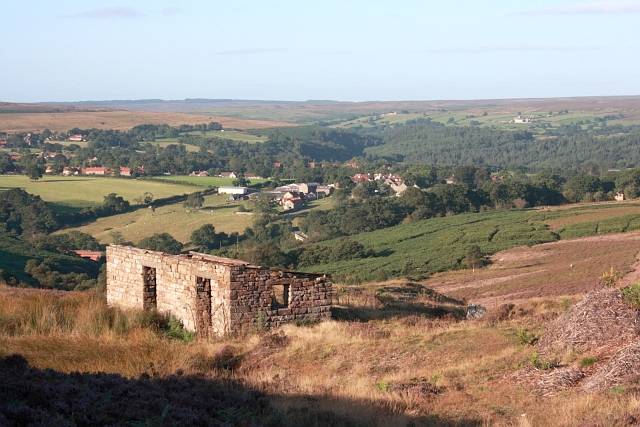
A whinstone mine on Goathland Moor that went at the Cleveland Dyke from underneath: an adit driven 1,770 feet through the moor to meet the dyke some 140 feet below the floor of the Sil Howe quarries, which stand a kilometre to the north. Loaded trucks ran out by gravity on a 42-inch tramway and horses hauled the empties back; the stone went on to a steam crusher above Goathland station. The ruined offices carry the date 1899 and the motto 'Lead thou me on'; the drift mouth is dated 1940, rebuilt after a bomb fell beside it.
History
Whinstone had been worked near Beck Hole since the early 1800s, mostly for roadstone though some went into building. At Sil Howe the quarries cut into the Cleveland Dyke where it crosses the moor, and this mine took the same stone from below. The adit runs 1,770 feet from the moorland south of the dyke and meets it where the workings lie some 140 to 150 feet beneath the quarry floor, with a working called Tinkers End to the left at the end of the drift and Sillars to the right. The ruined mine offices beside the entrance carry the date 1899 and, cut into the stone beneath a window, the motto 'LEAD THOU ME ON'. The drift mouth itself is dated 1940, and the round crater beside the buildings, now full of water, is a bomb crater: decoy fires were lit on these moors in wartime to draw bombers away from the industry of Teesside. Working had ceased by 1951. The mine stayed open to anyone who walked in until the 1980s, and a 1970s application to use it for recreation was refused; the quarry entrance was blocked after closure and the upper entrance in the dyke, known locally as the scar, was later filled by the landowner. Parts of it are large enough to drive a double-decker bus through. The fullest account of the mine, its owners and its men is Peter Wainright's booklet on the mines and miners of Goathland, Beck Hole and Green End.
Geology
The mine worked the Cleveland Dyke, a near-vertical wall of hard basaltic rock intruded across the North York Moors and traceable some thirty-one miles, from the Tees near Eaglescliffe to Fylingdales Moor above Robin Hood's Bay, with quarried outcrops at Great Ayton, Kildale, Castleton, Lealholm, Glaisdale, Egton Bridge and here. At Sil Howe the dyke is thirty to forty feet wide and bounded by three to six feet of sandstone baked hard by the intrusion, which the miners called China rock for its whiteness. The intrusion is dated to about fifty-eight million years ago; accounts differ over whether the magma came from a volcanic source near Mull or near Arran. Its common name, whinstone, comes from the gorse or whin that grows where the rock outcrops.
Geological setting: Faults and Fractures (well documented example)
Workings
An adit 1,770 feet long, driven from the moor south of the dyke to reach the whinstone about 140 to 150 feet below the floor of the quarries, with two named ends, Tinkers End and Sillars. A 42-inch gauge track was laid through the tunnel and graded so that loaded trucks ran out under gravity, horses hauling the empties back in; the track carried on to a crushing plant above Goathland station, driven by a steam engine for most of the mine's working life. A second entrance stood higher up in the dyke itself. Beyond the drift the workings open out into large chambers on more than one level, much of it since collapsed.
Closure
Working had ceased by 1951. The quarry entrance was blocked soon after, and the upper entrance in the dyke was filled in later by the landowner.
What remains
Shut. The drift is blocked about five metres inside the gate and the upper entrance in the dyke has been filled, so the workings cannot be entered; a vertical access shaft made by cavers is capped with a locked lid. The ruined mine building and the water-filled bomb crater still stand beside the drift mouth.
The ruined mine offices with their 1899 datestone and carved motto, the drift portal dated 1940, the water-filled bomb crater beside it, the whinstone quarries in the dyke a kilometre to the north, and the site of the crushing plant above Goathland station, where steps were built in recent years.
Redevelopment
None; the site remains open moorland.
Related mines
- Goathland Whinstone Mine — Both worked the Cleveland Dyke underground within three kilometres of each other on the same stretch of moor — this one by an adit from Goathland Moor, the other the Schofields' mine at Grosmont. They are separate workings, and the Geograph photographs of Sil Howe are the ones the Grosmont record had to leave unused.
- Langbaurgh Whinstone Mine — Both worked the Cleveland Dyke, the same named intrusion, underground for roadstone — Langbaurgh at the western end at Great Ayton, Sil Howe near the eastern end above Goathland, some thirty miles apart along its length.
Nearby mines
- Goathland Whinstone Mine — 3.1 km SW
- Egton Quarry — 4.1 km NW
- Woodsmith Mine — 5.7 km E
- Aislaby Quarry — 6.1 km N
- Glaisdale Ironstone Mine — 6.6 km NW
Straight-line distance, within 15 km. Show on the map.
Recorded claims
Individual factual claims, each attached to the source(s) that support it below. Where sources disagree, both are kept.
- An adit 1,770 feet long reached the Cleveland Dyke about 140 feet below the floor of the Sil Howe quarries. 1,2
- The mine building is dated 1899 and the drift entrance 1940. 1,2
- Working had ceased by 1951. 2
- Stone was taken out on a 42-inch gauge tramway, loaded trucks running down by gravity and horses hauling the empties back, to a steam-driven crusher above Goathland station. 2
- The adit served the Sil Howe whinstone quarries a kilometre to the north. 3
- The mine was open to entry until the 1980s and a 1970s application to use it for recreation was refused. 1
- At Sil Howe the dyke is thirty to forty feet wide, bounded by three to six feet of sandstone metamorphosed by the intrusion, which the miners called China rock. 2
- The Cleveland Dyke runs some thirty-one miles across the North York Moors and was quarried wherever it outcrops, at Great Ayton, Kildale, Castleton, Lealholm, Glaisdale, Egton Bridge, Sil Howe and Blea Hill Rigg. 4
Photographs & further reading
A 2008 visit to the drift mouth and the ruined mine building, with the named ends of the workings and the state of the entrance.
View sourceThe fullest account online, drawing on Peter Wainright's booklet, with the tramway, the crusher, the motto and a photograph of the mine in 1920.
View sourceSources
- (observational) Sil Howe Whinstone Mine, Goathland — Hidden Teesside
- (secondary) Sil Howe: abandoned whinstone mine — Out On Ye! (Underground Whitby)
- (observational) Sil Howe Whinstone Mine (shared description and photographs) — Geograph Britain and Ireland
- (observational) The Cleveland Dyke — Out & About (Fhithich)
Record created: 24 September 2026 · Last researched: 24 September 2026