 MineArchive
Whinstone
| Category | Commodities |
|---|---|
| Commodity page | Whinstone → |
A provincial British quarrying name for any hard, dark, fine-grained igneous rock -- typically dolerite or basalt -- rather than a single specific mineral or geological formation.
Historical usage
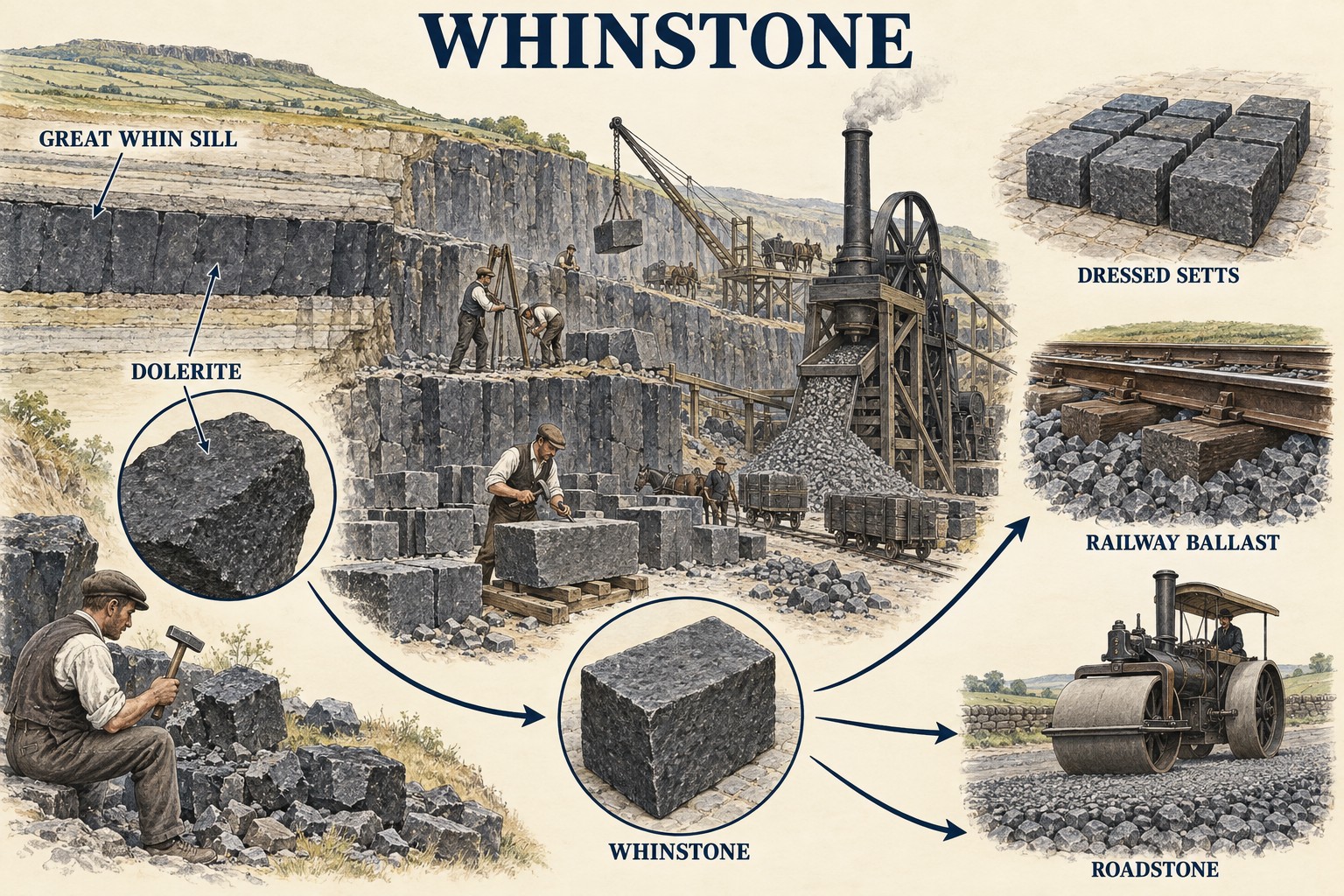
The name is old: 'whin' has been used in Scottish and northern English quarrying since at least the 16th century, reputedly coined by quarrymen for the sharp, ringing sound the dense rock makes under steel tools. Whinstone's exceptional hardness and wear resistance made it the preferred choice for paving setts, kerbstones, railway ballast and impermeable rubble walling across Scotland and northern England for centuries, with small local quarries serving local roads long before large-scale exploitation began. The arrival of the railways transformed the trade by making it economic to export whinstone well beyond its immediate district: the Northumberland Whinstone Company Ltd, formed in 1876, was quarrying at Longhoughton by 1887 and by 1902 employed 100 men under a named manager, supplying dressed setts and crushed stone to local authorities as far away as Ashington by 1914. Large-scale quarrying of Britain's whinstone sills continues today -- County Durham's Force Garth Quarry, opened in 1932 on the Great Whin Sill, still produces 250,000-300,000 tonnes of roadstone a year.
Value over time
Whinstone's value has always rested on durability rather than rarity: as an extremely hard, wear-resistant stone it commanded a premium for paving setts and kerbs over softer local alternatives, and railway connections let quarries like Longhoughton's turn what had been a local-roads material into an exportable commodity from the 1880s onward. That same hardness kept whinstone competitive for crushed roadstone and railway ballast even as cheaper materials displaced softer dressed stone elsewhere, and large-scale quarrying of Britain's whinstone sills for aggregate continues today for exactly that reason.
Hazards & challenges
No hazard specific to whinstone is separately documented; as with any hard-rock quarrying, the generic risk is airborne respirable crystalline silica dust produced when the stone is drilled, cut or crushed, carrying a risk of silicosis without proper dust control -- a risk whinstone's own exceptional hardness, the quality that made it valuable, if anything worsens in practice.
Related terminology
Roadstone, Sett (Paving Block)
Mines associated with this term
5 examples chosen from 16 linked records — the term page is not an index.
- Prestonhill Quarry — Fife (well documented example)
Named in this record’s geology: “…dark, fine-grained intrusive igneous rock, the same material called whinstone in the Scottish and northern English quarrying trade, valued for…” - Barrasford Quarry — Northumberland (well documented example)
Named 4 times in this record, first in the summary: “A working whinstone quarry on the Whin Sill in the North Tyne valley, opened after the…” - Cliff Rigg Quarry — North Yorkshire (well documented example)
Named 6 times in this record, first in the summary: “…ridge above Great Ayton, under Roseberry Topping. The stone is whinstone — a very hard volcanic rock cutting through the softer sedimentary…” - Divethill Quarry — Northumberland (well documented example)
Named 4 times in this record, first in the summary: “A working whinstone quarry on the Great Whin Sill in south-central Northumberland, one…” - Egton Quarry — North Yorkshire (well documented example)
Named 5 times in this record, first in the summary: “…up as a lofty wall over the water, and it is that hard basalt — whinstone — that was quarried, here as at every other place along the…”
See every mine that worked whinstone →
Sources
- (secondary) Force Garth Quarry, Forest and Frith, County Durham — Mindat
- (secondary) From Volcanic Roots to Modern Streets: 300 Million Years of Scottish Whinstone — Tradstocks
- (secondary) Longhoughton's Limestone and Whinstone Tramways — Alnwick & District Local History Society
Record created: 29 August 2026 · Last researched: 29 August 2026