 MineArchive
Cliff Rigg Quarry
| Also known as | Cliff Ridge Quarry, Cliff Rigg & Slacks, Cliffe Rigg Quarry |
|---|---|
| Location | Cliff Ridge, Great Ayton, North Yorkshire — 54.4900, -1.1200 (approximate) |
| Commodity | Whinstone |
| Type | Quarry |
| Worked | By late 17th century–About 1918 |
| Maximum depth | Unknown. |
| Operators | William Winn (?–1888), Gribdale Mining Company Ltd |
Overview
Cliff Rigg Quarry worked the Cleveland Dyke where it forms the modest ridge above Great Ayton, under Roseberry Topping. The stone is whinstone — a very hard volcanic rock cutting through the softer sedimentary beds around it — and it was cut into setts and cobbles for the streets of Leeds and crushed for road making. Quarrying at Great Ayton was established by the late seventeenth century; this quarry closed about 1918, saw further extraction in the 1970s, and is now abandoned and reverting to nature, its faces used by nesting kestrels.
History
The Cleveland Dyke was formed 58 million years ago from a volcano near the Isle of Mull, and can be traced between there and Whitby. Wherever it outcropped it was quarried, principally for road building, and its common name of whinstone comes from the gorse — whin — that grows readily where the rock breaks surface.
Quarrying at Great Ayton was firmly established by the late seventeenth century. The Cliff Ridge quarry was operated by Messrs. Winn, with the whinstone cut into setts or cobbles for the streets of Leeds; during the late nineteenth century Leeds Corporation itself operated quarries at Cliff Rigg. The Middlesbrough to Whitby railway runs just beneath the quarry, which made it possible to load the stone and ship it to Leeds by rail.
The statutory returns catch both phases of ownership. In 1888 the Whinstone Mines list enters Cliff Rigg & Slacks at Great Ayton with W. Winn as manager and William Winn of Great Ayton as owner. By 1914 the York, North Riding list records Cliff Rigg Quarry at Great Ayton under the Gribdale Mining Co. Ltd., working whinstone with seventeen men underground and one at surface — a striking split, and a reminder that a whinstone 'quarry' here could be worked into the hillside rather than purely from an open face.
The quarry closed around 1918, but in the 1970s further extraction took place, the stone being crushed for road surfacing.
Geology
The Cleveland Dyke is a tholeiitic intrusion of Palaeogene age, emplaced about 58 million years ago from the volcanic centre near Mull and traceable across northern England to the Yorkshire coast at Whitby. It is a sheet of very hard igneous rock driven up through much softer sedimentary strata, and it stands out in relief wherever erosion has stripped the country around it — Cliff Ridge is one such outcrop. Its hardness is exactly what made it valuable, and also what made it awkward: the dyke is narrow, so working it meant following a thin, steeply-inclined band of stone rather than opening a broad face, with the soft shales on either side always ready to come in.
Geological setting: Faults and Fractures (well documented example)
Workings
The quarry followed the dyke along Cliff Ridge. A narrow strip of the stone, called a plug, was usually left standing as shoring to stop the softer shales on either side collapsing into the working, and a rock column left in the quarry is the remains of such a plug. The 1914 return's seventeen men underground against one at surface indicates working driven into the ridge rather than open quarrying alone. The Middlesbrough to Whitby railway passes immediately below, and was how the stone left.
Closure
The quarry closed around 1918. In the 1970s further extraction took place, the stone being crushed for road surfacing rather than dressed into setts — the trade in hand-cut paving setts having long since given way to tarmacadam. No source gives a date for the end of that later phase.
What remains
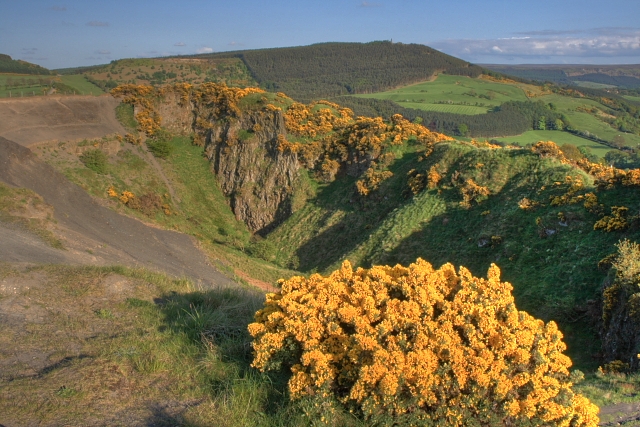
Abandoned and reverting to nature. The quarry still retains clear evidence of how the stone was extracted, including the remains of a plug left as shoring, and its faces are used by nesting kestrels. From the edge of the workings there is a view south to the Cleveland Hills, and Captain Cook's Monument stands on Easby Moor beyond.
The quarry faces along Cliff Ridge, a rock column that is the remains of a plug left as shoring between the workings and the softer shales, and the general form of the excavation along the line of the dyke.
Related mines
- Egton Quarry — Two quarries on the same intrusion, the Cleveland Dyke, worked for the same whinstone at opposite ends of its run across the North York Moors — Cliff Rigg under Roseberry Topping where the dyke is fifteen metres thick, Egton where it stands as a wall over the Esk. Both appear in the 1914 York North Riding return.
- Langbaurgh Whinstone Mine — Both were worked by the Gribdale Mining Company on the Cleveland Dyke, the same narrow intrusion of whinstone traced across the North York Moors — a shared operator working the same stone, not merely two quarries that happen to sit on one geological feature.
Nearby mines
- Langbaurgh Whinstone Mine — 1.2 miles (1.9 km) NW
- Roseberry Mine — 1.2 miles (1.9 km) NE
- Warren Moor Mine — 3.6 miles (5.8 km) E
- Belmont Mine — 3.7 miles (5.9 km) NE
- Belman Bank Alum Works — 4.2 miles (6.8 km) E
Straight-line distance, within 9 miles (15 km). Show on the map.
Recorded claims
Individual factual claims, each attached to the source(s) that support it below. Where sources disagree, both are kept.
- The 1888 Whinstone Mines list records Cliff Rigg & Slacks at Great Ayton with W. Winn as manager and William Winn of Great Ayton as owner. 1
- The 1914 List of Mines records Cliff Rigg Quarry at Great Ayton under the Gribdale Mining Co. Ltd., working whinstone, with 17 employed underground and 1 at surface. 2
- The Cleveland Dyke was formed 58 million years ago from a volcano near the Isle of Mull and can be traced between there and Whitby; wherever it outcrops it was quarried, and its common name of whinstone comes from the gorse or whin that grows where the rock outcrops. 3
- Quarrying at Great Ayton was firmly established by the late 17th century, and the Cliff Ridge quarry was operated by Messrs. Winn with the whinstone being cut into setts or cobbles for the streets of Leeds. 3
- A narrow strip of the stone called a plug was usually left as shoring to stop the softer shales collapsing, and a rock column in the quarry is the remains of such a plug. 3
- The quarry closed around 1918, but in the seventies further extraction took place with the stone being crushed for road surfacing. 3
- The quarry is abandoned and reverting to nature, with Captain Cook's monument on Easby Moor visible from it. 4
Photographs & further reading
A local account of the quarry with a photograph of the surviving plug — the strip of whinstone deliberately left standing to hold back the soft shales — and the history of the Winn family's trade in setts for Leeds.
View sourceSources
- (primary) 1888 List of Mines under the Metalliferous Mines Act: Whinstone Mines — Mines Department, via the Durham Mining Museum
- (primary) 1914 List of Mines under the Metalliferous Mines Act: York, North Riding — Durham Mining Museum
- (observational) Cliff Ridge Quarry — Out & About (Fhithich)
- (observational) Cliff Rigg Quarry (photograph) — Geograph Britain and Ireland
Record created: 5 September 2026 · Last researched: 5 September 2026