 MineArchive
Roseberry Mine
| Location | South side of Roseberry Topping, near Great Ayton, North Yorkshire — 54.5020, -1.1000 (approximate) |
|---|---|
| Commodity | Iron |
| Type | Ironstone |
| Worked | 1870 (worked 1871-87, 1906-26)–1924 (machinery removed by 1931) |
| Operators | Norton Iron Company (1871–1875), Tees Furnace Company (1906–1921) |
Overview
Roseberry Mine, the largest of three ironstone workings on the flanks of Roseberry Topping, was once blamed for the 1912 collapse that gave the landmark its distinctive lopsided shape -- a verdict modern geology has since overturned.
History
Roseberry Mine was developed from 1870 by the Norton Iron Company on the south side of Roseberry Topping, near Great Ayton in North Yorkshire, the largest of three ironstone mines working the hill. It passed through six operators across a working life spanning 1871 to 1926: the Norton Iron Company (1871-75), the Roseberry Ironstone Company (1875-82), Stevenson, Jacques and Company (1882-87), then, after a gap of some two decades, the Tees Furnace Company (1906-21), Burton and Sons (1922-25) and finally the Gribdale Mining Company (1925-26). The mine worked a seam 5 feet 5 inches thick with an iron content of 26-28%, output peaking in 1917 at 204,000 tonnes with over 380 men employed; during the First World War it despatched three trainloads of ore daily to smelters on Teesside. In May 1912 the northern slope of Roseberry Topping collapsed, transforming the hill from its original conical shape into its present distinctive, lopsided profile -- widely blamed at the time on the mine's workings beneath it, though modern geological investigation attributes the collapse instead to the underlying softer sandstones failing under extreme weather, with mining considered to have had, at most, a contributory effect. Mining ceased in 1924, with machinery removed by 1931.
Geology
Ironstone of the Cleveland field, worked into the flanks of Roseberry Topping — the working was blamed for the hill's 1912 collapse.
Workings
Worked a 5 ft 5 in ironstone seam (26-28% iron content) into the south side of Roseberry Topping, using tramways to connect with the railway line north of Great Ayton in both its operating periods.
Closure
Mining ceased in 1924 and the machinery had been removed by 1931.
What remains
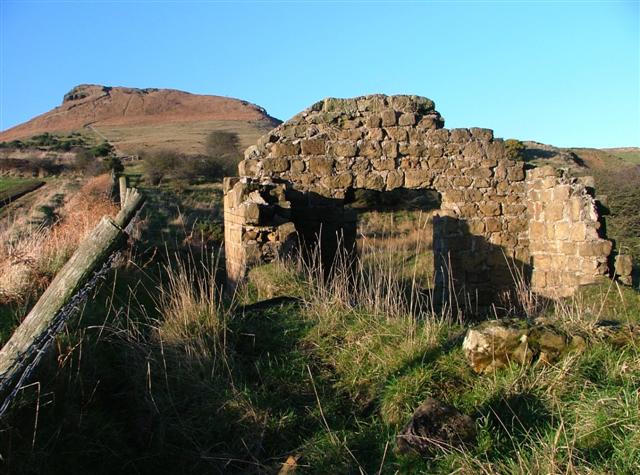
Evidence of mining subsidence remains visible in the surrounding landscape; the ruins of the mine's powder magazine, built of local sandstone and set apart from the main workings, survive.
The ruined powder magazine survives, built from local sandstone and surrounded by a protective barrier of mine waste to limit blast damage; it stood around 200 metres from the main workings, connected to them by tramway.
Nearby mines
- Cliff Rigg Quarry — 1.2 miles (1.9 km) SW
- Langbaurgh Whinstone Mine — 1.6 miles (2.6 km) W
- Belmont Mine — 2.5 miles (4.1 km) NE
- Belman Bank Alum Works — 3.2 miles (5.2 km) E
- Warren Moor Mine — 3.3 miles (5.3 km) SE
Straight-line distance, within 9 miles (15 km). Show on the map.
Recorded claims
Individual factual claims, each attached to the source(s) that support it below. Where sources disagree, both are kept.
- Output peaked in 1917 at 204,000 tonnes, with over 380 men employed and three trainloads of ore despatched daily to Teesside smelters during the First World War; the mine worked a seam 5 feet 5 inches thick with an iron content of 26-28%. 1
- The May 1912 collapse of Roseberry Topping's northern slope, which gave the hill its present lopsided shape, was widely blamed at the time on the mine's underground workings; modern geological investigation instead attributes the collapse to softer underlying sandstones failing under extreme weather, with mining considered at most a contributory factor. 1
- The mine passed through six operators across its working life: the Norton Iron Company (1871-75), the Roseberry Ironstone Company (1875-82), Stevenson, Jacques and Company (1882-87), the Tees Furnace Company (1906-21), Burton and Sons (1922-25) and the Gribdale Mining Company (1925-26). 1
- Three mine plan records survive in the BGS/Mining Remediation Authority catalogue under the name Roseberry, independent confirmation of the mine as a formally catalogued working. 2
Photographs & further reading
A fuller account of the mine's six operators, output figures and the 1912 Roseberry Topping collapse.
View sourceSources
- (secondary) Roseberry Mine — Wikipedia
- (primary) Roseberry Mine (mine plan) — BGS / Mining Remediation Authority mine plans catalogue
Record created: 2 September 2026 · Last researched: 2 September 2026