 MineArchive
Belmont Mine
| Also known as | Belmont Ironstone Mine |
|---|---|
| Location | Belmangate, Guisborough, North Yorkshire — 54.5207, -1.0475 (exact) |
| Commodity | Ironstone |
| Type | Ironstone |
| Worked | 1853 (lease)–1921 (production) |
| Maximum depth | Drift mine; no depth figure is recorded. |
| Operators | Tow Law Coal & Iron Company (1853–1866, lessee) Weardale Iron and Coal Company (1867–1887, lessee) Bolckow, Vaughan and Company (1907–1929, lessee) Dorman, Long and Company (1929–1933, lessee) |
Overview
An ironstone mine in the Belmont royalty above Guisborough, leased from the Chaloner family in 1853 and worked until trade collapsed in 1886. It lay idle for twenty years, was reopened by Bolckow Vaughan in 1907-08 and electrified, and finished under Dorman Long, having raised no ore at all in its last decade. Its drift mouth, sub-station and powder house survive above the town.
History
The Weardale Iron and Coal Company, whose Charles Atwood is the name attached to it, leased the Belmont royalty from the Chaloner family in 1853 and held it until 1886. Production began in 1855, at first from surface quarries, and the first drift was driven between Belmangate and Butt Lane, with an incline running down to the railway. In 1861 part of the royalty was sub-leased to the North of England Industrial Company and worked as South Belmont, an arrangement that lasted until 1877 — the year Belmont's own production ended, though the Weardale lease ran on to 1886. The Buddlepit database, drawn from Northern Mine Research Society data, gives a different chain of lessees for these years, with Tow Law Coal & Iron from 1853 and the Weardale companies only from 1867; the two accounts are not reconciled here.
The second working began when Bolckow, Vaughan & Co. took the lease in 1907 and moved operations to a new site at Hunters Hill, about 600 metres west of the first drift. Production restarted in 1909, and this phase was much the larger: 268 employed in 1910, 295 in 1915 and 463 in 1921, the mine's peak. In 1914 a picking belt and an aerial ropeway were built to carry away the waste shale, and an electric Sirocco fan replaced ventilation by furnace — the older method of lighting a fire at the bottom of a shaft so that the heated air rose and drew fresh air through the workings. The brick sub-station behind the drift mouth belongs to that work. Then production stopped, in 1921. The returns afterwards show eleven men, then seven, ten, eight and four, the mine recorded idle in 1929 and 1930. Dorman, Long & Co. took the lease with the rest of Bolckow Vaughan's holdings in 1929 and held it to 1931, but no further ironstone was ever produced. Two deaths are recorded by name: William Gardner, fourteen, crushed by tubs while coupling them in 1875, and William Watson, a miner of thirty-three, in 1911.
Geology
The mine worked the Cleveland ironstone, the bedded Jurassic ore of the Lias that runs through the Cleveland Hills, here in the escarpment above Guisborough at about 138 metres.
Geological setting: Sedimentary Beds and Seams (well documented example)
Workings
Drift mining into the escarpment rather than shaft sinking. The first working drove in between Belmangate and Butt Lane; the second, from 1907-08, entered about 600 metres further west. Ventilation was originally by furnace, a fire at the bottom of a shaft drawing air through the workings, and was replaced by an electric Sirocco fan, probably in 1914.
Closure
Production ended twice. The first working stopped in 1877 and the Weardale lease ran on until 1886; the second, from the Hunters Hill site, ended in 1921. Dorman Long held the lease from 1929 to 1931 and raised nothing. The Durham Mining Museum gives the mine as closed in 1933 and Buddlepit as worked to 1929, both of which are lease dates rather than working ones.
What remains
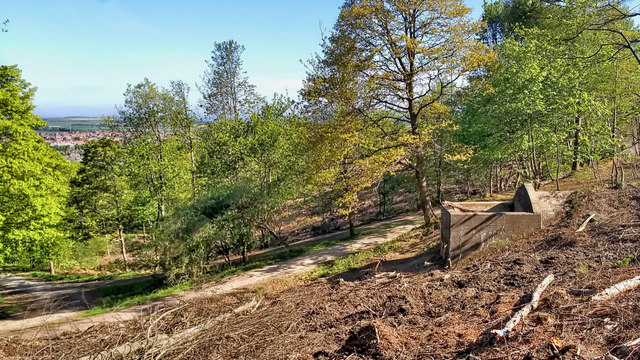
The drift entrance of the second working has been deliberately blocked for public safety, with the brick electrical sub-station standing behind it and the remains of ceramic insulators still in its back wall. Above it the mine's powder house survives, a heavily reinforced concrete structure that the clear felling of Guisborough Wood has newly exposed. Hunters Hill Farm occupies the 1907 site, a large range of buildings that were the mine's stables and workshops, with further mining remains in the woodland around it, and close to the road a concrete wall survives that carried one end of the tipping gantry where railway wagons were loaded. The original 1853 site at the top of Belmangate is now almost entirely obscured by a lake, though the tell-tale rusty colour of the water can still be seen. The ventilation fanhouse was demolished in the 1970s. The site is private land.
The blocked drift mouth and its electrical sub-station, the reinforced concrete powder house, the foundations of the 1914 aerial ropeway, the stables and workshops now at Hunters Hill Farm, and the concrete abutment of the loading gantry. The mineral railway that linked the site to the main line near Hutton Lane can be traced across the fields. Of the first site at Belmangate, a lake and rust-coloured water.
Related mines
- Spa Wood Mine — Spa Wood and Belmont were leased together from the Gisborough estate in 1853 by the Weardale company, and passed through several of the same lessees afterwards.
Nearby mines
- Belman Bank Alum Works — 1.2 miles (1.9 km) SE
- Spa Wood Mine — 1.5 miles (2.4 km) NE
- Spa Mine — 1.6 miles (2.6 km) NE
- Slapewath Ironstone Mine — 1.8 miles (2.9 km) NE
- Waterfall Mine — 1.9 miles (3.0 km) N
Straight-line distance, within 9 miles (15 km). Show on the map.
What's uncertain
Points where sources disagree or the record could not be settled; both accounts are kept. All open questions in the archive.
- The Durham Mining Museum gives the mine as closed in 1933; Buddlepit records Dorman, Long & Co. holding it from 1929 to 1933 and the mine as worked from 1853 to 1929; and a site account gives the second working as 1907-1931 with no ore extracted after 1921. (disputed) 1,4,2
Recorded claims
Individual factual claims, each attached to the source(s) that support it below. Where sources disagree, both are kept.
- The Weardale Iron and Coal Company leased the Belmont royalty from the Chaloner family in 1853 and worked it until a downturn in trade closed the mine in 1886. 1,2
- A second phase began in 1907-08 from a drift about 600 metres west of the first, under Bolckow, Vaughan & Co., with an electric Sirocco fan probably installed in 1914 to replace furnace ventilation. 3,2
- The Lists of Mines give 157 employed in 1883, 268 in 1910, 295 in 1915 and 463 in 1921, falling to eleven in 1923 and four by 1929, with the mine recorded idle in 1929 and 1930. 1
- The Durham Mining Museum gives the mine as closed in 1933; Buddlepit records Dorman, Long & Co. holding it from 1929 to 1933 and the mine as worked from 1853 to 1929; and a site account gives the second working as 1907-1931 with no ore extracted after 1921. (disputed) 1,4,2
- The Weardale Iron and Coal Company held the Belmont royalty from 1853 to 1886, sub-leasing part of it to the North of England Industrial Company from 1861 to 1877, worked as South Belmont; Bolckow, Vaughan took the lease from 1907 to 1929 and Dorman Long from 1929 to 1931. 5
- Production began in 1855 from surface quarries and ended in 1877; it restarted in 1909 after Bolckow Vaughan relocated to Hunters Hill in 1907, and ended in 1921. No ironstone was produced under Dorman Long's lease. 5
- A picking belt and an aerial ropeway to carry away waste shale were built in 1914, and an electric Sirocco fan replaced furnace ventilation in the same year. 5
Photographs & further reading
Opening and closing years, the owners by decade, employment from 1883 to 1930, the abandonment note of 1886 and the two named fatalities.
View sourceA photographic visit to the surviving remains: the collapsed drift entrance and its sub-station, the powder house, the stables and workshops at Hunters Hill Farm and the gantry abutment.
View sourceAn account of the blocked drift mouth and sub-station, the 1914 Sirocco fan that replaced furnace ventilation, the Chaloner royalty and the position of the 1853 drift.
View sourceThe fullest account of the mine: lease holders from 1853 to 1931, a dated timeline of both working periods, the 1914 picking belt, ropeway and Sirocco fan, and photographs of the ropeway foundations and the demolished fanhouse.
View sourceSources
- (primary) Belmont (Ironstone) — Durham Mining Museum
- (observational) Belmont Ironstone Mine — Out & About (fhithich.uk)
- (observational) Belmont Ironstone Mine — Hidden Teesside
- (secondary) Belmont Mine — Buddlepit Mine Database (from Northern Mine Research Society data)
- (secondary) Belmont Ironstone Mine — East Cleveland's Industrial Heartland
Record created: 11 September 2026 · Last researched: 12 September 2026