 MineArchive
Sett (Paving Block)
| Also known as | Granite Sett, Paving Sett, Street Sett, Stone Sett, Cassie (Scottish), Belgian Block |
|---|---|
| Category | Commodities |
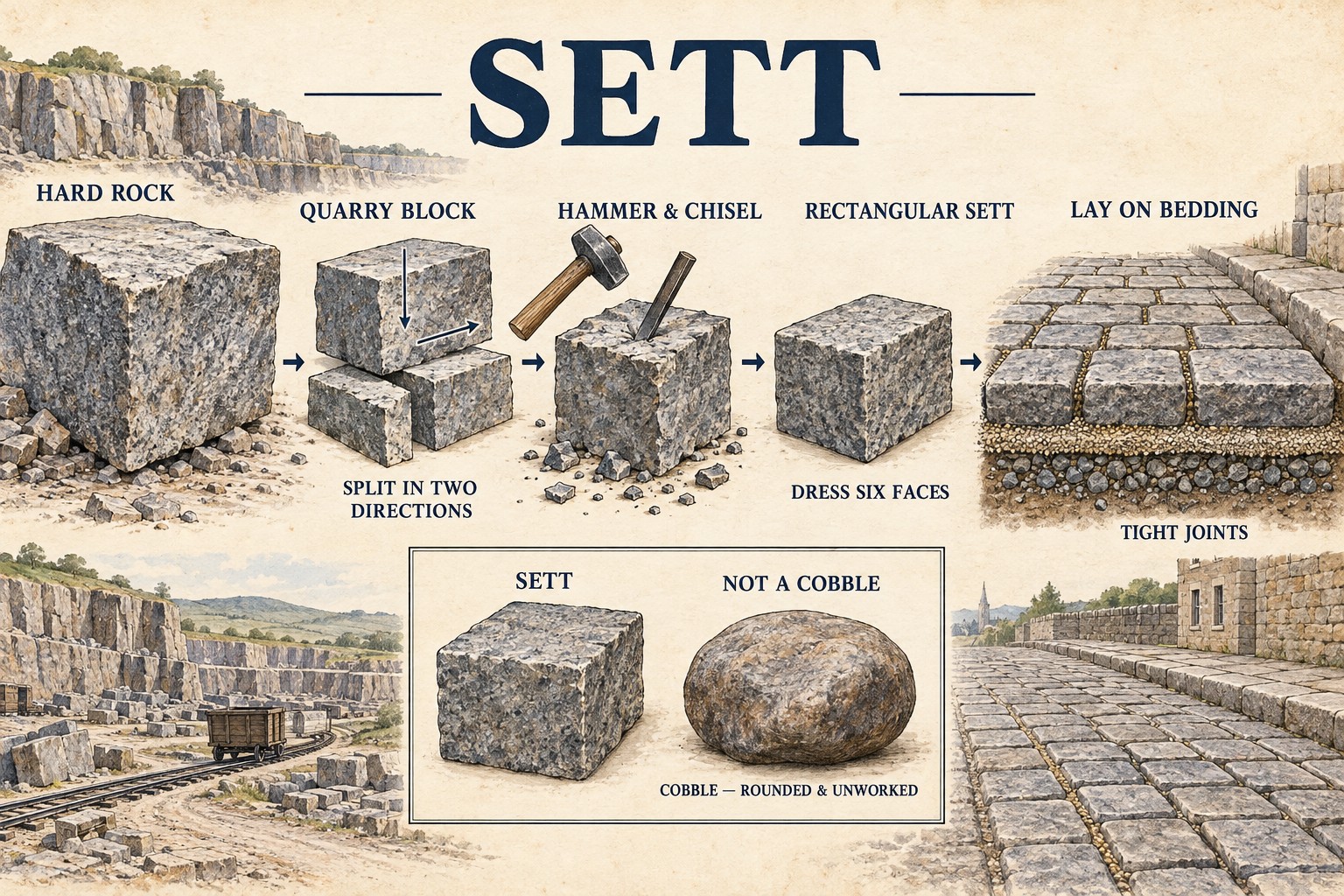
A small rectangular block of dressed stone laid to surface a street. A sett has six identifiable faces, which is what separates it from a cobble — a rounded stone with no worked sides at all. The modern standard puts a sett between 50 and 300 mm in plan with a thickness of at least 50 mm, and neither plan dimension usually more than twice the thickness; a cube is simply a sett whose three dimensions are roughly equal.
Historical usage
Setts were the reason a great many British hard-rock quarries existed at all. As the industrial towns grew through the nineteenth century they needed street surfaces that would take iron-tyred wheels and horseshoes without rutting, and the answer was hand-dressed stone blocks in enormous quantity. Aberdeen sent granite to London for paving from 1764 and became a world-scale producer; Kemnay quarry worked building stone, setts and kerbs from the mid-nineteenth century, and Guernsey hornblende granite went to London for roadmaking and paving from the 1820s. In Wales the trade built whole settlements: setts were produced from the Graig Llwyd quarry at Penmaenmawr, and the quarries in Nant Gwrtheyrn opened from 1851 purely to cut them. In Ireland, Newry granite provided setts, and Dalkey granite had been exported to London for paving since 1680. It was a trade with its own workforce and its own union. The Settmakers’ Union of Great Britain and Ireland merged with the National Union of Quarrymen in 1914 to form the Amalgamated National Union of Quarryworkers and Settmakers, 4,378 members strong at its formation, based at Leicester with half its membership in North Wales and the English Midlands and a full-time branch secretary on Guernsey.
How it worked
Setts were split and dressed by hand. A block was won from the face, reduced above ground into manageable pieces, then worked with hammer and chisel into rectangular blocks — at Denner Hill the sequence ran from the raised block, to blocks divided above ground, to a final stage producing setts, kerbstones and building blocks. Sett makers worked at their own bankers, often in small movable shelters beside the quarry, and were paid by the block. A stone had to split cleanly in two directions to make the work possible at all, which is why granites, whinstones and the harder gritstones dominated the trade. Sizes were conventional rather than exact: Longhoughton quarry was supplying six-inch by three-inch setts to Ashington Urban District Council as late as 1914.
Why it was used
A dressed stone block gave a hard, durable, drainable surface with enough texture for hooves and iron tyres to grip, and it could be lifted and relaid over a repaired service trench without being destroyed. Some of the setts still in British and Irish streets have been in continuous use for more than two hundred years. Igneous stone was preferred where the traffic was heaviest, being dense, crystalline and largely free of the cleavage planes that make a sedimentary block split under load.
Risks & limitations
The trade died with the technology that replaced it. Tarmacadam gave a cheaper, quieter, faster-laid surface that needed no skilled hand dressing, and demand for setts collapsed between the wars: the settmakers’ union was in long-term decline through the 1930s and merged into the National Union of General and Municipal Workers at the start of 1934. Quarries that survived did so by turning to crushed stone — the same rock, sold by the tonne as roadstone and ballast instead of dressed by hand. Setts are still made and still laid, but mostly as reclaimed stone or for civic and decorative paving, and a growing share of new hand-hewn setts is imported from countries where labour is cheaper.
Regional variation
The vocabulary varies more than the object does. Setts are cassies or nidgers in Scotland and Belgian block in parts of southern England, and the general public commonly calls them cobbles — which properly means a rounded, unworked stone. The stone itself is regional too: Aberdeenshire, Kirkcudbrightshire, Cornwall, Devon, the Ross of Mull, Shap in Cumbria and the North Wales granites supplied the igneous trade, the Pennine gritstones the sedimentary one, and the Cleveland and Northumberland whinstone dykes their own.
Related terminology
Mines associated with this term
5 examples chosen from 11 linked records — the term page is not an index.
- Nant Gwrtheyrn Quarries — Gwynedd (well documented example)
Named twice in this record, first in the history: “…The expanding cities of Lancashire needed hard road surfaces, and granite setts — rectangular blocks dressed by hand — were in heavy demand. The…” - Trefor Granite Quarry — Gwynedd (well documented example)
Named in this record’s summary: “…of Yr Eifl on the Llyn peninsula, opened in 1850 and worked for paving setts on a scale that made it one of the largest granite quarries in the…” - Aspen Colliery — Lancashire (well documented example)
Named in this record’s workings: “…southern shaft the stone-lined canal basin survives, with original stone setts paving the ground east of it.” - Cliff Rigg Quarry — North Yorkshire (well documented example)
Named in this record’s closure notes: “…surfacing rather than dressed into setts — the trade in hand-cut paving setts having long since given way to tarmacadam. No source read for this…” - Cliffe Hill Quarry — Leicestershire (well documented example)
Named in this record’s history: “…Mr Jones and Mr Fitzmaurice, developed the site to supply street setts and kerb stones, but the venture closed between 1881 and 1891; J. R.…”
Sources
- (secondary) Amalgamated National Union of Quarryworkers and Settmakers — Wikipedia
- (secondary) British Granite — The Building Conservation Directory
- (secondary) Setts, Cubes and Cobbles — Pavingexpert (Tony McCormack)
Record created: 8 September 2026 · Last researched: 8 September 2026