 MineArchive
Aspen Colliery
| Also known as | Fairy Caves, Aspen Colliery Coke Ovens |
|---|---|
| Location | Oswaldtwistle, near Church, Hyndburn, Lancashire — 53.7523, -2.3998 (approximate) |
| Commodity | Coal |
| Type | Coal |
| Worked | Early 19th century–1930 |
| Maximum depth | No depth figure has yet been located. |
Overview
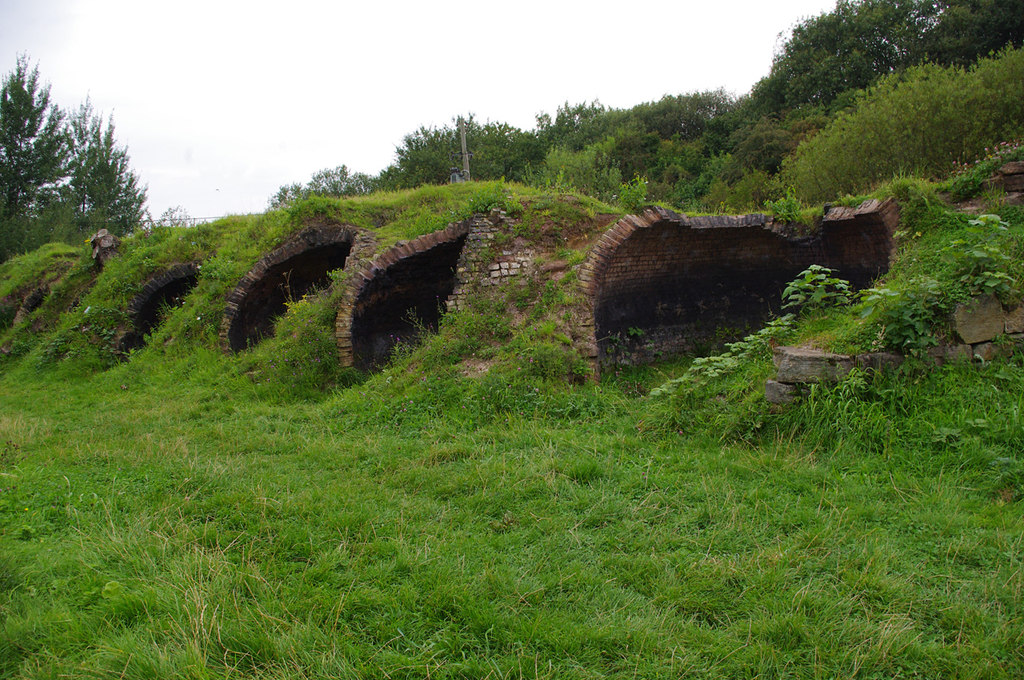
A colliery on the north bank of the Leeds and Liverpool Canal at Oswaldtwistle, worked from the early 19th century until 1930, whose coal was coked on the spot in three banks of beehive ovens and shipped from its own canal basin. The 24 ovens, known locally as the Fairy Caves, are the most complete 19th-century group in the North West and, with Vobster Breach in Somerset, the only ones in the country still standing beside their parent colliery and its transport.
History
Coal mining at Aspen is thought to have begun in the early 19th century, the canal beside it having opened in 1810, and the colliery ran until it closed in 1930. Its coal went into beehive coking ovens on the canal bank: the central and eastern rows are the earliest, and a third, western row was added between 1893 and 1910, making 24 ovens in three back-to-back banks with central brick flues. A stone-lined basin about 30 m by 8 m, opening directly off the canal, took the coke away by water. A postcard of 1908 shows the colliery at work. The ovens went cold with the pit in 1930 and were scheduled in 1977, but nothing was done to preserve them and they decayed and were vandalised until Historic England, judging the site a rare survival, approached Growth Lancashire to get it off the Heritage at Risk Register; a condition survey, a grant from WREN's FCC Heritage Action Fund and a section 17 management agreement with Hyndburn Council paid for the ovens to be stabilised and repaired. In 1909 a boy was killed and two dozen men were shut in underground for three hours before they were got out (see Disasters, below).
Geology
The colliery worked the Lower Coal Measures of the Burnley coalfield at Oswaldtwistle. Which seams it raised is not known.
Workings
Two capped mineshafts lie in the eastern part of the site and two stone-built engine beds in the northern part. West of them the three banks of coking ovens, of brick encased in masonry, stand back to back with their central brick flue systems; a stone wall on the canal side served both as retaining wall and as the boundary of the works. Between the ovens and the southern shaft the stone-lined canal basin survives, with original stone setts paving the ground east of it.
Closure
The colliery closed in 1930 and the coke ovens were not used again. The reason for the closure is not known.
What remains
The upstanding and buried remains are a scheduled monument. The ovens, badly decayed and vandalised for decades after their 1977 scheduling, have been stabilised and repaired under the Growth Lancashire project and the site has been taken off the Heritage at Risk Register; the bank nearest the basin was always the best preserved. The site is open ground beside the canal towpath.
24 beehive coke ovens in three banks, the canal-side retaining wall, the stone-lined canal basin and its setts, two engine beds and two capped shafts.
Redevelopment
None beyond the conservation of the ovens; the ground is open space by the canal.
Nearby mines
- Moorfield Colliery — 3.8 km NE
- Hapton Valley Colliery — 6.1 km NE
- Habergham Colliery — 8.6 km NE
- Gannow Colliery — 9.0 km NE
- Bank Hall Colliery — 12.0 km NE
Straight-line distance, within 15 km. Show on the map.
Recorded claims
Individual factual claims, each attached to the source(s) that support it below. Where sources disagree, both are kept.
- Coal mining at Aspen is thought to have commenced in the early 19th century and continued until the colliery closed in 1930. 1
- The 24 beehive coking ovens stand back to back in three banks with central brick flues; the central and eastern rows are the earliest and the western row was added between 1893 and 1910. 1
- Historic England's research found the Aspen ovens the most complete 19th-century example in the North West and one of only eleven surviving in the country, and, with Vobster Breach, the only ones surviving with parts of their parent colliery and canal-side setting. 2,3
- The ovens were scheduled in 1977 but left to deteriorate and were vandalised; they have since been repaired with a WREN FCC Heritage Action Fund grant and removed from the Heritage at Risk Register. 2,4
Photographs & further reading
The account of the conservation project, with Historic England's findings on the site's rarity, a 1908 postcard of the colliery and before-and-after photographs of the ovens.
View sourceSources
- (primary) Remains of Aspen Colliery, associated beehive coking ovens and canal basin (List entry 1016943) — Historic England
- (secondary) Aspen Colliery and Coke ovens — Growth Lancashire
- (observational) Aspen Coke Ovens Walk — South Pennine Archaeology Group
- (observational) Aspen Colliery Coke Ovens — Derelict Manchester
- (primary) Abandoned mine plan catalogue entry: ASPEN / STANHILL / TOWN BENT — British Geological Survey
Record created: 22 September 2026 · Last researched: 22 September 2026