 MineArchive
Moorfield Colliery
| Also known as | Altham Colliery, Moorside Pit, Altham Collieries |
|---|---|
| Location | Altham, between Accrington and Clayton-le-Moors, Lancashire — 53.7756, -2.3572 (approximate) |
| Commodity | Coal |
| Type | Coal |
| Worked | c. 1881–21 January 1949 |
| Maximum depth | 293 yards (268 m) to a seam 24 to 26 inches thick |
| Operators | Altham Colliery Company |
Overview
One of the two Altham Collieries between Accrington and Clayton-le-Moors, sunk on the most up-to-date principles and in operation only two and a half years when an explosion on 7 November 1883 killed sixty-eight men and boys (see Disasters, below).
History
Moorfield was one of two pits owned and worked by Alderman Barlow for the Altham Colliery Company; the other, Whinney Hill, had been going twelve years. Moorfield itself had been in operation only two and a half years when the disaster came. It had been sunk to 293 yards to a seam between 24 and 26 inches thick — a low working even by the standards of the Lancashire coalfield — and laid out to modern practice, with one shaft serving two main drifts, one running east on an incline and one north on a decline. The main chain way was in the east section and ran about 180 yards, and coal was wound by double cages bringing eight tubs to the surface at once.
The explosion came at ten minutes to nine on the morning of Wednesday 7 November 1883, killing sixty-eight men and boys (see Disasters, below).
The colliery is returned to the Mines Inspectors under Altham rather than Moorfield, and its later history runs on well past the explosion. The owners were the Altham Colliery Co. under G. W. McAlpine, then the Altham Colliery Co. Ltd, then Hargreaves Collieries Ltd, and the National Coal Board from 1947. Coking, household and manufacturing coal came out of it along with fireclay, all from the Lower Mountain seam. Employment ran at 374 in 1894 and 380 in 1896, jumped to 678 by 1900, held between five and six hundred through to the First World War, and peaked at 1,201 in 1923 before falling back to 980 in 1933 and 688 in 1940. At nationalisation the Moorfield pit employed 456 and turned out 99,000 tons. The 1954 return records it as closed except for pumping from 21 January 1949.
Geology
The Lancashire coalfield. The seam Moorfield worked was between twenty-four and twenty-six inches thick at 293 yards — a thin working that had to pay by mechanised haulage rather than by the height of the coal. Gas was the hazard that mattered, and the inquest jury attributed the 1883 explosion to a sudden outburst of it.
Geological setting: Sedimentary Beds and Seams (well documented example)
Workings
A single shaft 293 yards deep serving two main drifts, one driven east on an incline and one north on a decline. The main chain haulage way was in the east section and extended about 180 yards. Coal was wound in double cages carrying eight tubs at a time. The pit was described at the time as having been sunk on the most up-to-date principles.
Closure
The closure date is not known for Moorfield; the colliery is remembered principally for the 1883 disaster.
What remains
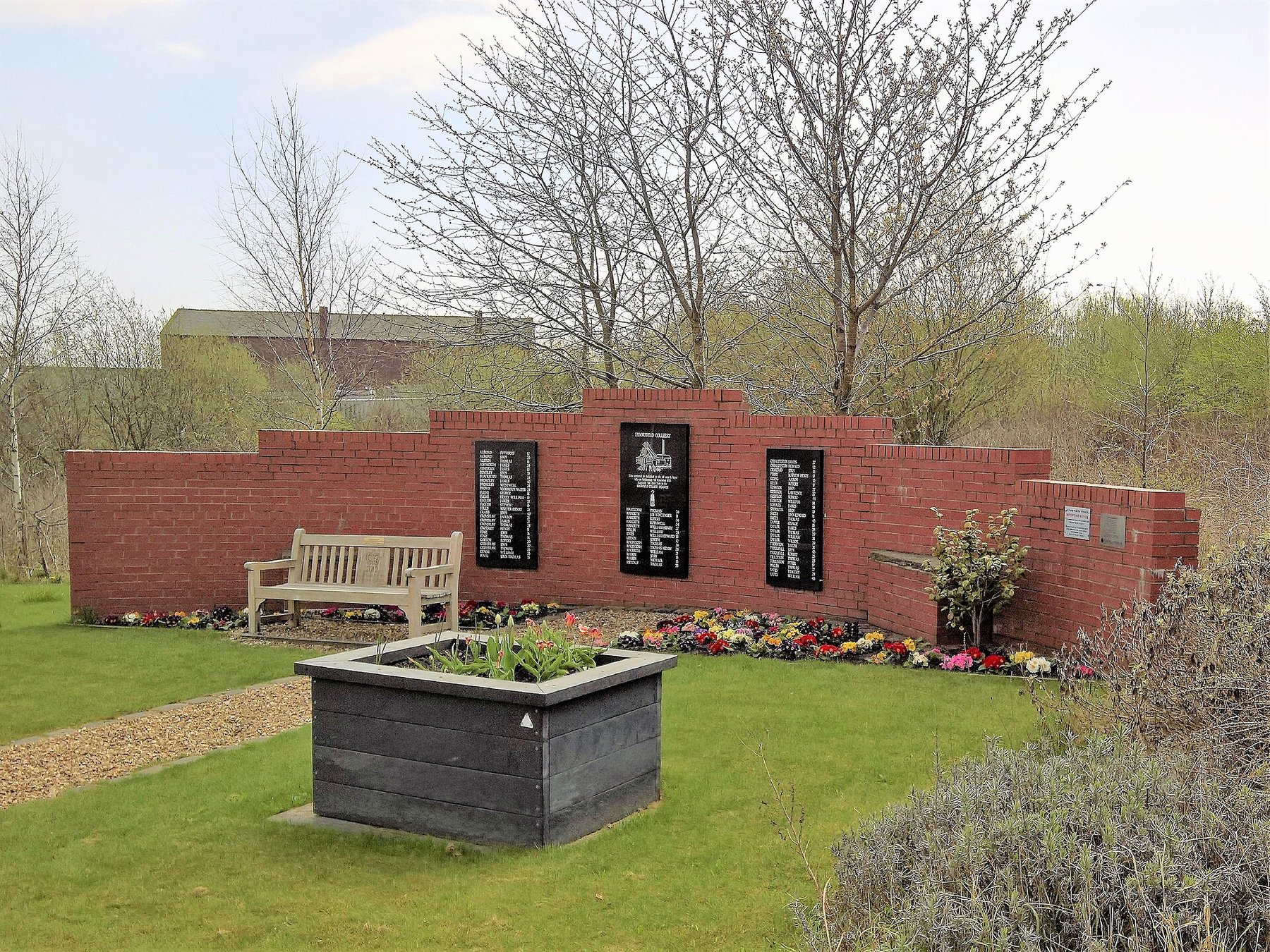
A monument to the disaster stands at Altham, and the explosion remains the event by which the colliery is known locally.
Related mines
- Martholme Colliery — Both Altham Colliery Co. pits; Moorfield miners reopened Martholme in 1927.
- Whinney Hill Colliery — Linked underground to Whinney Hill and worked by the same company under the same manager.
Nearby mines
- Huncoat Colliery — 0.5 miles (0.7 km) SE
- Whinney Hill Colliery — 0.8 miles (1.4 km) SW
- Thorny Bank Colliery — 1.7 miles (2.7 km) E
- Scaitcliffe Colliery — 1.8 miles (2.8 km) S
- Martholme Colliery — 1.9 miles (3.0 km) NW
Straight-line distance, within 9 miles (15 km). Show on the map.
Disasters & major incidents
-
Moorfield Colliery explosion, 1883
7 November 1883 · Explosion · 68 fatalities
At 8.50 a.m. on Wednesday 7 November 1883 a sudden outburst of firedamp exploded in the Moorfield pit between Accrington and Clayton-le-Moors, killing sixty-eight men and boys, the youngest ten, and seriously injuring thirty-nine. Men who had seen gas burning in their lamps had run to the shaft and were waiting for the cage when the blast reached them. The jury could not say how the gas was fired; the Inspector recommended abandoning the Davy lamp. -
Moorfield Colliery roof fall, 1909
12 November 1909 · Collapse / Roof Fall · 2 fatalities
A stone twelve feet long fell from the roof of a roadway in the Mountain seam at Moorfield Colliery, Altham, on 12 November 1909, killing a fireman and a dataller who were heightening it.
What's uncertain
Points where sources disagree or the record could not be settled; both accounts are kept. All open questions in the archive.
- The BGS mine-plans catalogue holds a Mining Remediation Authority abandonment plan titled 'Moorfield' (catalogue 10399, Upper Mountain, dated 1930); the catalogue gives no location and the plan's details do not clearly tie it to this working, so it may belong to another of the same name. (uncertain) 3
Recorded claims
Individual factual claims, each attached to the source(s) that support it below. Where sources disagree, both are kept.
- Moorfield was one of two pits owned by Alderman Barlow for the Altham Colliery Company and had been in operation only two and a half years; it was sunk to 293 yards to a seam 24 to 26 inches thick, with one shaft serving two main drifts. 1
- The 1954 Mines Inspectors' return records Altham, the colliery of which Moorfield was a pit, as closed except for pumping from 21 January 1949. 2
- The colliery worked the Lower Mountain seam throughout the returns from 1894 to 1915, sending out coking, household and manufacturing coal together with fireclay. 2
- The BGS mine-plans catalogue holds a Mining Remediation Authority abandonment plan titled 'Moorfield' (catalogue 10399, Upper Mountain, dated 1930); the catalogue gives no location and the plan's details do not clearly tie it to this working, so it may belong to another of the same name. (uncertain) 3
Photographs & further reading
The parish's account of the disaster, the pit's layout and the inquest finding.
View sourceThe same colliery under the name the Mines Inspectors used: owners from G. W. McAlpine to the National Coal Board, output and employment from 1894 to 1954, the Lower Mountain seam, and the 1883 explosion with the names of the dead.
View sourceSources
- (secondary) Altham history: the Moorfield Colliery explosion — Altham Parish Council
- (primary) Altham Colliery — Durham Mining Museum
- (primary) BGS / Mining Remediation Authority mine plans: MOORFIELD — British Geological Survey / Mining Remediation Authority
- (observational) Moorfield Colliery Memorial — Geograph Britain and Ireland
Record created: 9 September 2026 · Last researched: 11 September 2026