 MineArchive
Whitby Jet Workings
| Location | Whitby, North Yorkshire — 54.4858, -0.6206 (approximate) |
|---|---|
| Commodity | Jet |
| Type | Mineral |
| Worked | 1840–1920 |
Overview
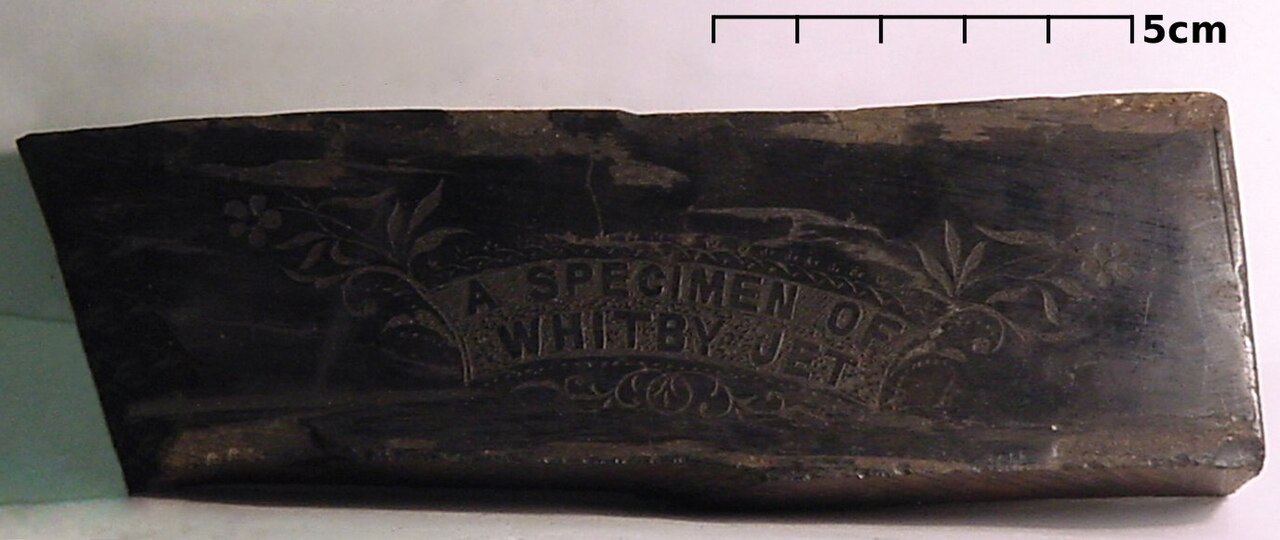
Whitby jet — fossilised monkey-puzzle wood, some 180 million years old — was worked from coastal cliffs and, later, inland drift mines across the North York Moors, feeding a Victorian jet-jewellery boom driven above all by mourning fashion after Prince Albert's death. The industry collapsed almost as fast as it had grown, and the last jet mine closed in 1920.
History
Coastal jet working around Whitby is recorded from around 1840, initially gathering jet exposed in the cliffs between Ravenscar and Boulby before miners began driving deliberate workings into the cliff face and, as coastal supplies thinned, inland into the Esk valley and the Cleveland Hills escarpment as far as Osmotherly — more than 300 individual jet mines have since been recorded across the North York Moors. Demand exploded after Queen Victoria adopted jet mourning jewellery following Prince Albert's death in 1861, and by the late 1800s Whitby supported around 200 jet-working shops and as many as 1,500 jet-related workers alongside roughly 200 miners working the seams directly. The boom collapsed almost as quickly as it had grown: in the decade from 1874 to 1884 alone, the number of jet workers fell by more than a thousand, driven by changing fashion, cheaper imitation materials, and jet's own association with mourning falling out of favour as the century turned. The last jet mine, at Cod Hill near Guisborough, closed in 1920.
Geology
Jet occurs as discontinuous nodules within specific Jurassic shale beds — the Jet Rock — along the North Yorkshire coast and inland across the North York Moors.
Workings
Coastal jet was worked from tunnels ('drifts') driven into the base of the Jet Rock, one man picking at the face while a second barrowed shale to the surface and a third sorted it for jet; as a drift advanced, miners pulled down the roof behind them to form a platform and worked upward toward the overlying Top Jet Dogger seam, using little timber, no explosives, and relying on natural ventilation. On the cliffs themselves, miners were lowered on ropes to reach exposed seams, sometimes camping on sea ledges between tides to avoid the dangerous climb.
Closure
The last working jet mine, at Cod Hill near Guisborough, closed in 1920; since then all new jet has had to be gathered by beachcombing rather than mined, as coastal erosion and the collapse of old cliff tunnels make renewed mining impractical.
What remains
No organised workings survive in usable condition; former drift entrances and spoil can still be found across the North York Moors, and jet washed from eroding cliffs and old workings is still gathered on Whitby's beaches today. Some coastal workings survive and are enterable. A 2015 report on the Loop Wyke workings between Kettleness and Sandsend describes four adits driven into the cliff face almost at shore level, linked by a passage running eight to ten metres in, one entrance choked by rockfall and another partly blocked. The report records fresh roof falls, active cracking and repeated rockfalls from the cliff above during the visit, and notes that many nearby workings along the same stretch of cliff have collapsed outright.
Nearby mines
- Saltwick Nab Alum Quarries — 1.3 miles (2.1 km) E
- Aislaby Quarry — 3.0 miles (4.9 km) SW
- Woodsmith Mine — 3.7 miles (6.0 km) S
- Goldsborough Ironstone Mine — 4.0 miles (6.4 km) NW
- Kettleness Alum Works — 4.9 miles (7.9 km) NW
Straight-line distance, within 9 miles (15 km). Show on the map.
The old cliff and drift workings are unstable and prone to collapse — this entry describes history and general location only, not an access guide; all jet available today is gathered by beachcombing, not mining.
What's uncertain
Points where sources disagree or the record could not be settled; both accounts are kept. All open questions in the archive.
- Slight accidents were reported as frequent among jet miners; in 1873 a miner was reported killed by a fall of shale. (uncertain) 3
Recorded claims
Individual factual claims, each attached to the source(s) that support it below. Where sources disagree, both are kept.
- By the late 1800s Whitby supported around 200 jet-working shops and up to 1,500 jet-related workers, alongside roughly 200 miners working the jet seams directly. 1
- In the decade from 1874 to 1884 alone, the number of jet workers fell by more than a thousand, as fashion changed and jet lost ground to cheaper imitation materials. 1
- More than 300 individual jet mines have been recorded across the North York Moors, as coastal supplies were supplemented and then superseded by inland working. 2
- Slight accidents were reported as frequent among jet miners; in 1873 a miner was reported killed by a fall of shale. (uncertain) 3
- The Loop Wyke workings between Kettleness and Sandsend consist of four adits at close to shore level, connected by a cross-passage some eight to ten metres inside the cliff; a 2015 observation records extensive recent rockfall both inside the workings and from the cliff face above. 4
Photographs & further reading
A photographic record of four surviving coastal jet adits between Kettleness and Sandsend, and of how unstable the cliff workings now are.
View sourceSources
- (secondary) The Black Gold of Staithes: The Story of Jet — Staithes Museum
- (secondary) Jet Mining — Northern Mine Research Society
- (secondary) Whitby Jet — ramsdale.org
- (observational) Loop Wyke jet workings, May 2015 — 28DaysLater
- (secondary) Whitby Jet and Jet Jewellery — Whitby Museum
Record created: 20 August 2026 · Last researched: 9 September 2026