 MineArchive
Kettleness Alum Works
| Also known as | Kettleness Alum Quarries |
|---|---|
| Location | Kettleness, near Runswick Bay, North Yorkshire — 54.5320, -0.7135 (exact) |
| Commodity | Alum |
| Type | Mineral |
| Worked | From around 1727–1861 |
Overview
A Yorkshire coastal alum works so thoroughly consumed by its own quarrying that it eventually undermined the ground beneath the village that housed it — and when the whole headland finally gave way in 1829, the works simply rebuilt on the fresh shale the landslide had exposed and carried on for another thirty years.
History
Alum quarrying and processing began at Kettleness, on the North Yorkshire coast between Whitby and Runswick Bay, from around 1727, one of a string of works along this stretch of coast producing the fixative essential to the textile dyeing industry. It was among the last of the region's alum works to open and, eventually, the last to close. Production peaked between 1805 and 1817, when the works turned out some 900 tonnes of alum a year — an output that came at an extraordinary cost in raw material, since it took around 50 tonnes of shale to produce a single tonne of finished alum, meaning the headland was quarried away on a scale that steadily undermined the ground it stood on. That instability caught up with the works on 17 December 1829, when a large, slow-moving landslide carried the original settlement and its alum house into the sea; the slide moved gradually enough that the villagers had time to evacuate and took refuge on a ship, the Henry, anchored in the bay. Rather than ending the industry, the collapse exposed a fresh face of workable shale, and a new alum house and a new village, rebuilt further inland out of the landslide's reach, were both operating again within a year. Alum production finally ended in 1861, defeated across the whole region by cheaper synthetic alternatives and more efficient manufacturing methods elsewhere.
Geology
The Yorkshire alum industry worked shale of the Lower Jurassic Whitby Mudstone Formation, which contains the aluminium sulphate minerals needed to make alum once roasted and steeped in a long, labour-intensive process — the same shale that gives this stretch of coast its distinctive dark cliffs and, at Kettleness specifically, also yielded jet, worked in small mines beneath parts of the alum quarry itself.
Workings
Shale was quarried directly from the headland, roasted in clamps, and then steeped through a lengthy process of leaching and evaporation to extract the alum, using stone conduits to move liquids between processing stages, steeping pits, and a cistern, remains of all of which survive on site. The scale of quarrying needed — around 50 tonnes of shale per tonne of alum produced — meant the site is unusually complete evidence of every stage of the industry, from raw quarrying through to final processing, in one place.
Closure
Production ended in 1861 as cheaper synthetic dyestuffs and mordants displaced natural alum across the textile industry, closing the last two works in north-east Yorkshire, including Kettleness, within the following decade.
What remains
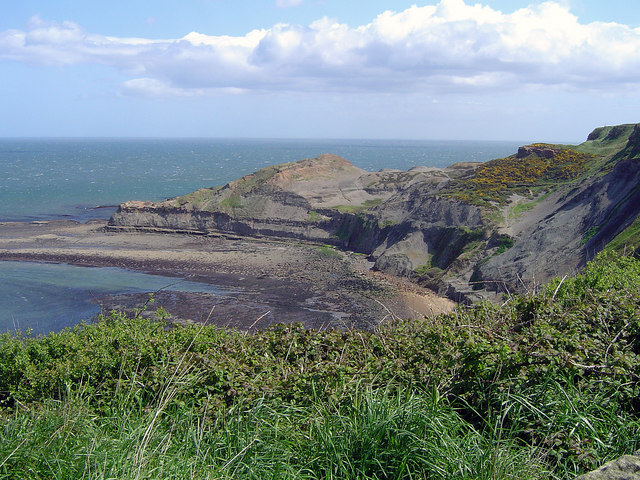
What now read as sea cliffs at Kettleness are in fact the exposed face of the old quarry, the overlying sandstone having been stripped away to reach the alum shale beneath. The foundations of the second, rebuilt alum house survive on flat ground on the west side of the works, along with steeping pits now eroding seaward and stone conduits, all recorded in an English Heritage survey; the whole site is a scheduled monument valued as an unusually complete record of every stage of the alum-making process.
Foundations of the rebuilt alum house, steeping pits, stone conduits and a cistern, and the quarried headland itself, now read by casual visitors as ordinary sea cliffs.
Redevelopment
None — the site remains open coastal ground, part of the Cleveland Way coastal path.
Related mines
- Peak Alum Works — A coastal alum works of the same industry, named here for the December 1829 cliff collapse that buried its works and settlement, and among the last to close in 1871.
Nearby mines
- Goldsborough Ironstone Mine — 1.1 miles (1.8 km) S
- Port Mulgrave Mine — 2.1 miles (3.4 km) NW
- Aislaby Quarry — 4.6 miles (7.4 km) S
- Grinkle Mine — 4.6 miles (7.4 km) W
- Boulby Mine — 4.7 miles (7.5 km) W
Straight-line distance, within 9 miles (15 km). Show on the map.
Recorded claims
Individual factual claims, each attached to the source(s) that support it below. Where sources disagree, both are kept.
- Alum quarrying and processing at Kettleness began around 1727, among the last of the region's alum works to open. 1
- Output peaked between 1805 and 1817 at about 900 tonnes of alum a year, requiring roughly 50 tonnes of shale for every tonne of finished alum. 1
- On 17 December 1829 a slow-moving landslide destroyed the original alum house and settlement; the villagers evacuated safely to the ship Henry, anchored in the bay, and a new alum house and village were rebuilt within a year on freshly exposed shale. 1
- Alum production at Kettleness ended in 1861, part of the wider closure of the north-east Yorkshire alum industry as cheaper synthetic alternatives took over. 1
- Foundations of the second alum house, steeping pits and stone conduits survive on site, with jet mine workings also recorded beneath part of the platform. 2
Photographs & further reading
The official monument listing.
View sourceSources
- (secondary) Kettleness — Wikipedia
- (primary) Kettleness Alum Works — Hidden Teesside
Record created: 25 August 2026 · Last researched: 25 August 2026