 MineArchive
Alum
| Category | Commodities |
|---|---|
| Commodity page | Alum → |
A naturally occurring double sulphate of aluminium and potassium, historically extracted from shale by slow burning and prolonged chemical processing rather than simple digging, and essential for over two centuries as the mordant that fixed dye permanently into cloth before synthetic alternatives replaced it.

Historical usage
For most of the medieval and early modern period, Europe's alum came from a single source: the Papal States, whose rich deposits at Tolfa, discovered in 1461, provided as much as 70% of papal revenue between the 1500s and 1700s. Pope Pius II directed the profits toward a crusade against the Ottoman Empire, and in 1464 Pope Paul II declared that anyone trading in competing Turkish alum would be excommunicated — a decree that, combined with a 1470 cartel agreement with the Kingdom of Naples, let the Church and its Medici Bank agents charge whatever price the market would bear, at times pushing prices so high that European cloth-dyeing economies struggled to cope. England broke this dependence in 1604-05, when Thomas Chaloner established the country's first alum works at Guisborough, North Yorkshire, having recognised that the fossil-bearing shale of the Yorkshire coast resembled the alum-bearing rock he had seen at the papal works in Italy. A popular legend holds that Chaloner smuggled skilled Italian alum workers out of Italy in casks, earning his own excommunication — a colourful story modern historians regard as apocryphal. The industry spread rapidly along the Yorkshire coast over the following two centuries, at works including Peak, Sandsend, Loftus, Boulby and Kettleness, and by the 18th century around 30 sites in Yorkshire, and some 50 across England as a whole, were producing virtually the entire British alum supply. National output peaked in 1769 at around 6,000 tonnes a year. The industry declined sharply from the mid-19th century once synthetic aniline dyes, developed from the 1850s, eliminated the need for a natural mordant, and the last English alum works, at Kettleness and Boulby, closed in 1871.
How it worked
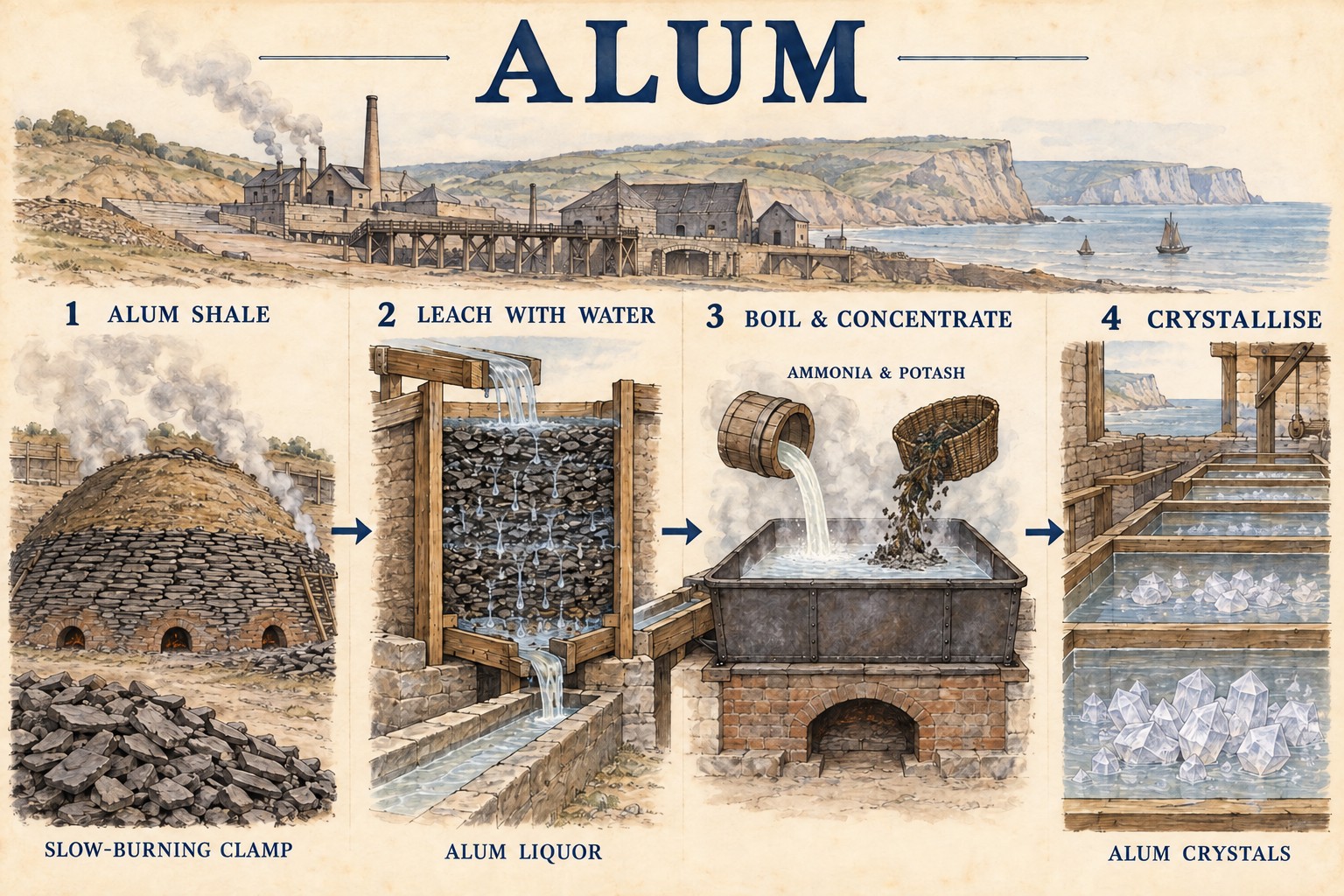
Alum shale was quarried, then piled into enormous clamps — sometimes tens of thousands of tons — and slow-burned for months to convert its iron pyrite and aluminium content into a soluble form. The roasted shale was leached with water, and the resulting liquor boiled and mixed with a source of ammonia, traditionally stale human urine imported by the ton, and roasted seaweed for potassium, to precipitate crystals of alum.
Why it was used
Alum's essential property was as a mordant: without it, most natural dyes would not bond permanently to cloth fibres, washing or fading out almost immediately. It was equally valuable in tanning leather, sizing paper to stop ink bleeding, and as an early fireproofing treatment for fabric and timber.
Value over time
For over a century, Europe's alum trade was less a market than a papal monopoly, with prices set to fund a crusade and enforced by the threat of excommunication for anyone who sourced it elsewhere. Once Chaloner's Guisborough works broke that dependence in 1604-05, British alum grew into a genuine national industry, peaking at around 6,000 tonnes of production a year in 1769 — but its economics stayed precarious throughout: by the late 18th century, alum was sometimes selling for around £13 a tonne against production costs of £14, propped up more by long leases and sunk capital than by real profitability. The whole trade then collapsed within about twenty years of synthetic aniline dyes reaching the market in the 1850s, going from a 250-year-old staple industry to complete extinction by 1871.
Hazards & challenges
Roasting alum shale in open clamps for months at a time released large volumes of sulphurous smoke from its oxidising iron pyrite — one 17th-century London alum works was suppressed in 1627 after its 'loathsome vapour' was blamed for poisoning fish in the Thames, and the industry was later remembered as one of the first of Yorkshire's 'dirty industries', a lineage that ran directly on to ironstone mining, steelmaking and the wider Teesside chemical industry that followed it.
Risks & limitations
Because alum's entire market value rested on one specific chemical property — its use as a textile mordant — the whole industry was extraordinarily vulnerable to any alternative that could do the same job more cheaply; by the late 18th century margins were already so thin that alum sometimes sold for less than it cost to produce, and the arrival of synthetic aniline dyes in the mid-19th century removed the industry's entire reason to exist within a generation.
Regional variation
Almost the entire British alum industry was concentrated on the North Yorkshire coast, the one place in the country where alum shale, coal for roasting, and sea transport for both raw urine and finished product all came together in one place; a solitary exception operated in Lancashire.
Related terminology
Mines associated with this term
5 examples chosen from 7 linked records — the term page is not an index.
- Kimmeridge Oil Shale Workings — Dorset (well documented example)
Named 5 times in this record, first in the summary: “…beach and called coal money. Sir William Clavell burned it to make alum, salt and glass in the early seventeenth century and ruined himself…” - Peak Alum Works — North Yorkshire (well documented example)
Worked from 1650 to 1862 as one of the longest-lived alum works on the Yorkshire coast. - Belman Bank Alum Works — North Yorkshire (well documented example)
Named 15 times in this record, first in the summary: “The first alum works in England, opened at Belman Bank near Guisborough by Sir…” - Hurlet Colliery — Renfrewshire (well documented example)
Named 6 times in this record, first in the summary: “…together, and Hurlet became the place where both copperas (1753) and alum (1766–67) manufacture were first introduced into Scotland. By 1790…” - Boulby Alum Quarries — North Yorkshire (well documented example)
Alum working began here in the 1650s under the Conyers family and became one of the most productive and longest-lived works of Britain's first chemical industry.
See every mine that worked alum →
Sources
- (primary) A Holy Alliance: Collusion in the Renaissance Europe Alum Market — Review of Industrial Organization / Springer
- (secondary) Alum industry in North Yorkshire — Wikipedia
- (secondary) Guisborough History Notes: Chaloner — Guisborough History Notes
- (secondary) Not Even the Pope Can Maintain a Monopoly — Reason
Record created: 22 August 2026 · Last researched: 22 August 2026