 MineArchive
Peak Alum Works
| Location | Ravenscar, near Robin Hood's Bay, North Yorkshire — 54.4059, -0.5021 (approximate) |
|---|---|
| Commodity | Alum |
| Type | Mineral |
| Worked | 1640 (discovery)–1862 |
| Operators | William Child (1763–1834), Robert Campion (1834–?) |
Overview
One of the longest-lived works in England's first great chemical industry — over 200 years quarrying and processing alum shale on the cliffs above Ravenscar, using a process that required up to 200 tons of stale human urine a year, shipped in by boat, before synthetic dyes finally made the whole trade obsolete in 1862.
History
England's alum industry began at Guisborough in 1604-05, when Thomas Chaloner established the country's first works with the help of a cousin who had learned the trade in Ireland — ending total British dependence on alum imported from the Papal States, which had held a monopoly on its production and sale. A popular legend holds that Chaloner smuggled skilled alum workers out of the Pope's works in large casks, earning himself a personal excommunication; modern historians regard this colourful story as apocryphal — Thomas Fuller, writing within fifty years of the founding, said the workmen were brought from Rochelle in France, and the text long printed as the papal anathema is word for word the curse of Ernulphus in Sterne's Tristram Shandy. Chaloner did genuinely visit the papal alum works at Puteoli and travel in Italy before founding the Guisborough works. Alum was discovered in the rocks at Peak, above Ravenscar, in 1640, and the site was worked from 1650 for over two centuries as the industry spread along the Yorkshire coast wherever alum shale could be quarried and shipped — sister works operated at Sandsend, Loftus, Boulby, Port Mulgrave, Kettleness, Saltwick and Hawsker. At its height, Peak's processing required up to 200 tons of stale human urine a year as a source of ammonia, shipped in barrels by boat from as far away as Newcastle and hauled up the cliff by tramway, alongside roasted kelp for potassium; up to 150 men worked the quarries and processing house, housed in small communities nearby. The wider industry's precarious coastal sites were not without real danger: a cliff collapse in December 1829 completely buried Kettleness's works and the settlement around them, though remarkably no lives were lost, the villagers escaping to a ship anchored in the bay. Peak Alum Works itself finally closed in 1862, as cheaper synthetic aniline dyes displaced alum's traditional role as a textile mordant across the whole industry; the last works anywhere on the coast, at Kettleness and Boulby, closed in 1871. Alum was found at Peak in 1640, and the works there passed through a succession of private owners rather than a company. Captain William Child of London, of the King's Regiment of Light Dragoons, bought or leased the works in 1763 and in 1774 built the house above them known as Ravenhill or Peak Hall; George Young's Picture of Whitby of 1840 records the hall as erected for him in that year. The house and the works passed to his daughter Ann Willis, who sold the alum works to Robert Campion in 1834 and died at Ravenhill the following April. Over a hundred people were employed about the works and quarry at its height, and the stone the quarry yielded went into the mock battlements and terraces the Willis family blasted out of the cliff above.
Geology
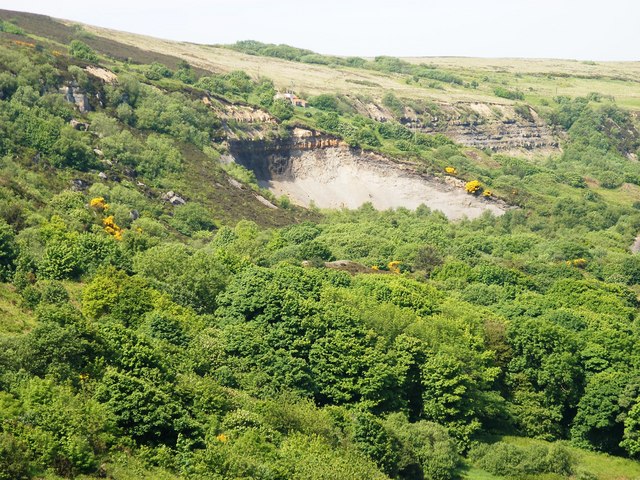
Alum shale is a Jurassic mudstone rich in iron pyrite and aluminium silicates, found in a band along the Yorkshire coast. Alum itself, a double sulphate of aluminium and potassium, could not simply be dug out — it had to be chemically extracted from the shale through prolonged roasting and processing. The band lies within a Jurassic sequence laid down as mud and shell debris and later folded upwards until it fractured: the resulting Peak Fault brought the alum-bearing layer to the surface here, which is why a works was set up at Peak rather than somewhere else along the cliff. Historic England's scheduling records that the shale worked here was quarried from the hillside immediately south of the works.
Geological setting: Faults and Fractures (well documented example), Sedimentary Beds and Seams (well documented example)
Workings
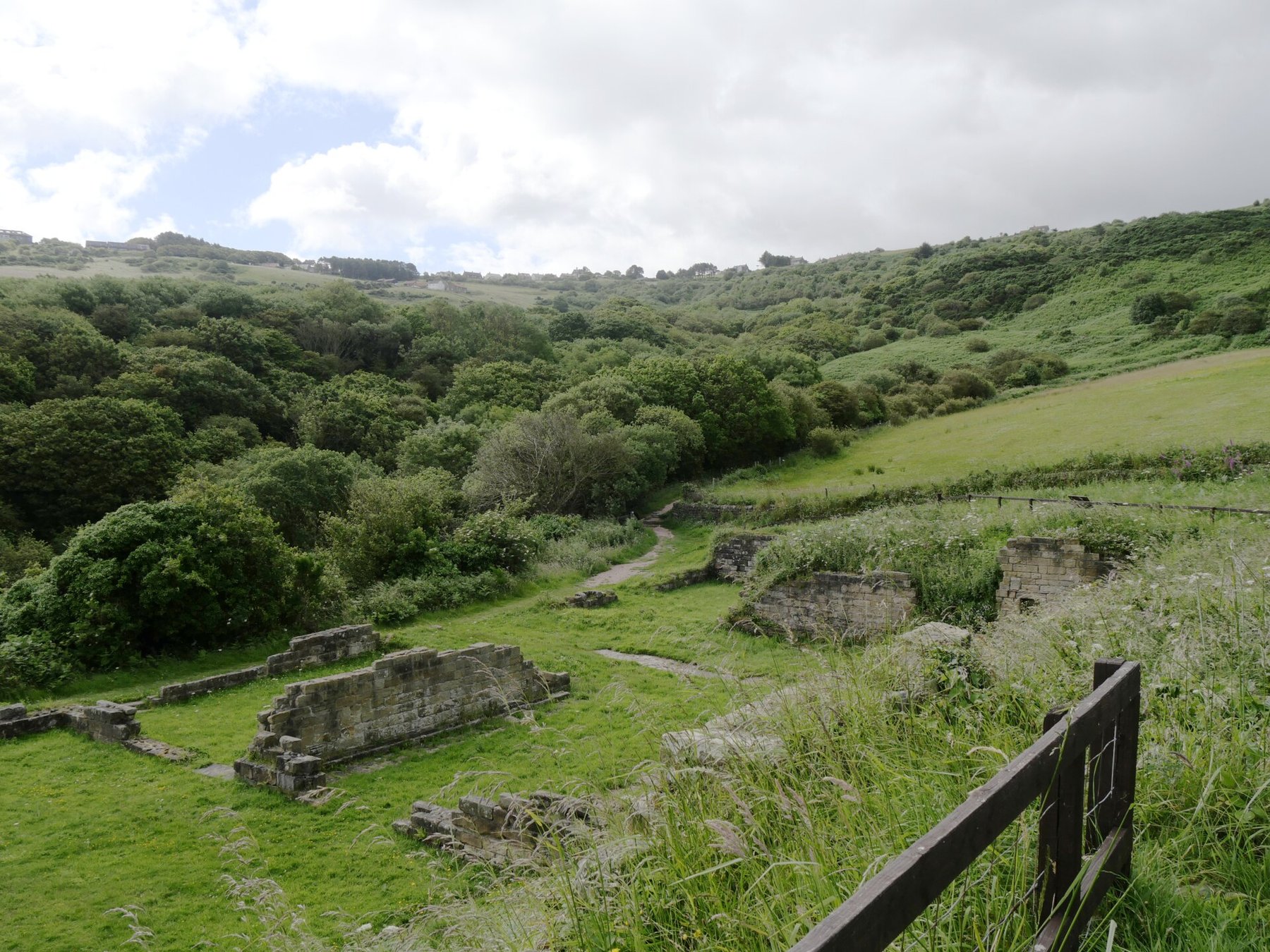
Shale was quarried in a measured 'task' by workers called pickmen — roughly 100 tons of shale to yield a single ton of alum — then piled into vast clamps and slow-burned for months to convert its iron pyrite and aluminium content into a soluble form. The roasted shale was leached with water, and the resulting liquor boiled and mixed with stale human urine, imported by the ton as a source of ammonia, and roasted kelp for potassium, to precipitate crystals of alum. A stone-lined winding house hauled coal deliveries up the cliff to fuel the process and lowered the finished alum down to ships waiting in the dock below. The scheduled remains set out the later, most developed form of the works. Shale was calcined and steeped at the quarry face, and the liquor that resulted was carried down to the works, where a range of buildings running north to south on a lower platform at the east of the site held the boiling, cooling and roaching that produced purified alum. West of them stood reservoirs and a cistern for storing the raw liquor. On the higher ground west again were a grinding mill, which reduced the crystals to powder, and an engine house whose steam engine worked an incline down the cliff to the shore; further west lay a joiners' shop, a plumbers' shop, a smithy, a laboratory and some accommodation for the workforce. Barrels of urine and coal came up the same way they went down, winched from ships' decks to the cliff top.
Closure
Peak Alum Works closed in 1862, part of the wider collapse of the Yorkshire alum industry once synthetic aniline dyes, developed from the 1850s, removed the need for a natural mordant altogether. The industry as a whole was overtaken from the middle of the century by techniques using shale from coal mining, and after 1880 aluminium sulphate replaced alum for most industrial purposes; the last English alum works, at Goole, closed in 1950.
What remains
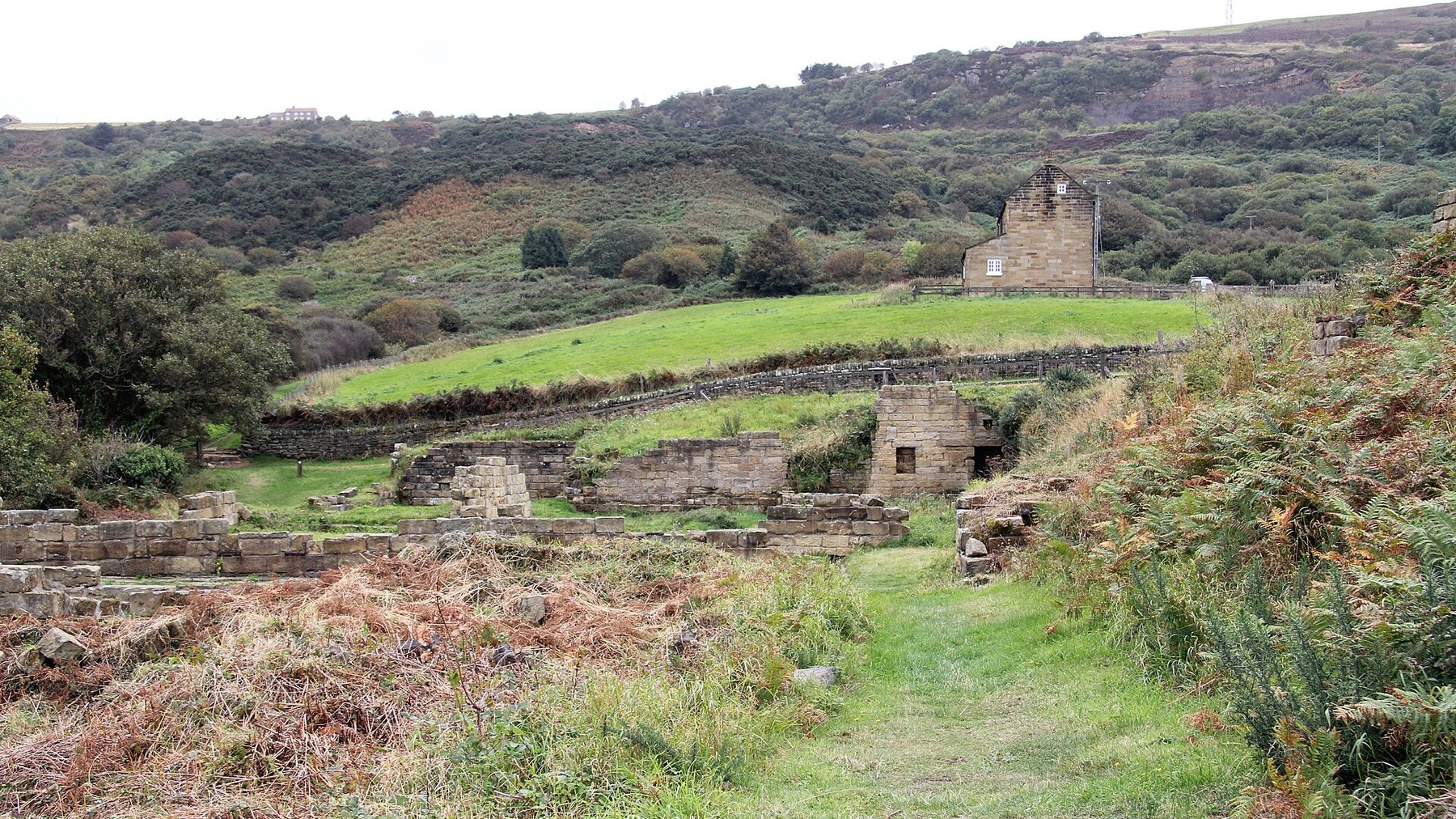
The ruins of Peak Alum Works, cared for by the National Trust, are among the best-preserved on the Yorkshire coast, with the foundations and walls of the processing buildings, a barn, the stone-lined winding house and remains of workers' cottages still visible beside the Cleveland Way coastal path. The site was scheduled on 29 April 1998 as Peak alum works, Historic England 1018146, which records the remains as surviving well, with standing buildings, structures uncovered by excavation and buried remains together covering the whole range of processing. At the north-east of the monument part of the original access causeway to the shoreline survives as a stone trackway running to the cliff edge. A photograph taken on 28 August 2026 shows the Cleveland Way still running to the works through open ground with the ruins in the open.
Substantial masonry ruins survive across the site, including the winding house with its iron fittings and spindle wheels still in place. The circular grinding stone that reduced the alum crystals to powder lies out at the cliff edge beyond the winding house, and the National Trust, which has cared for the site since 1979, has interpretation boards across the ruins.
Related mines
- Belman Bank Alum Works — Belman Bank at Guisborough was the first alum works in England, about 1600; Peak, found in 1640 and at work from about 1650, belongs to the industry it began.
- Boulby Alum Quarries — One of the coastal alum works of the same Yorkshire industry, named in this record's own account of how the trade spread along the cliffs, and among the last to close in 1871.
- Kettleness Alum Works — A coastal alum works of the same industry, named here for the December 1829 cliff collapse that buried its works and settlement, and among the last to close in 1871.
- Saltwick Nab Alum Quarries — A coastal alum works of the same Yorkshire industry, named in this record's account of the trade's spread along the coast.
Nearby mines
- Woodsmith Mine — 5.3 miles (8.5 km) W
- Saltwick Nab Alum Quarries — 6.7 miles (10.7 km) NW
- Whitby Jet Workings — 7.3 miles (11.7 km) NW
- Sil Howe Whinstone Mine — 8.3 miles (13.3 km) W
- Aislaby Quarry — 8.6 miles (13.9 km) NW
Straight-line distance, within 9 miles (15 km). Show on the map.
Culture
- Chaloner and the papal curse (Folklore)
Peak is the archive's researched alum record and a later works of the Yorkshire industry Chaloner's Guisborough venture began; the legend is carried in its own text, but the story does not belong to this site.
What's uncertain
Points where sources disagree or the record could not be settled; both accounts are kept. All open questions in the archive.
- Thomas Chaloner is popularly said to have smuggled the Pope's alum workers out of Italy in casks to found England's first alum works at Guisborough in 1604, earning his own excommunication. The story is regarded as apocryphal: Thomas Fuller, writing within fifty years of the founding, said the workmen were brought from Rochelle in France and named one of them as Lambert Russell, a Walloon, and the text long printed as the papal anathema is word for word the curse of Ernulphus in Sterne's Tristram Shandy. Chaloner did travel in Italy, did visit the papal alum works, and did found the Guisborough works. (disputed) 1,2,3
- Accounts differ on when alum working began at Peak. Historic England dates the first works to about 1650. Popular accounts credit Sir Bryan Cooke of Wheatley near Doncaster with finding alum in the rocks at Peak in 1640, and one gives 1615 for his starting the works. (disputed) 7,8
Recorded claims
Individual factual claims, each attached to the source(s) that support it below. Where sources disagree, both are kept.
- Thomas Chaloner is popularly said to have smuggled the Pope's alum workers out of Italy in casks to found England's first alum works at Guisborough in 1604, earning his own excommunication. The story is regarded as apocryphal: Thomas Fuller, writing within fifty years of the founding, said the workmen were brought from Rochelle in France and named one of them as Lambert Russell, a Walloon, and the text long printed as the papal anathema is word for word the curse of Ernulphus in Sterne's Tristram Shandy. Chaloner did travel in Italy, did visit the papal alum works, and did found the Guisborough works. (disputed) 1,2,3
- Pickmen had to quarry around 100 tons of alum shale to produce a single ton of alum. 4,5
- At the height of the industry, Peak's processing required up to 200 tons of stale human urine a year, shipped in barrels by boat from as far away as Newcastle and hauled up the cliff by tramway. 4
- A cliff collapse in December 1829 completely buried Kettleness's alum works and the settlement around it, though remarkably no lives were lost. 6
- The works were scheduled as a monument on 29 April 1998 (Historic England 1018146). The scheduling records standing buildings, structures uncovered by excavation and buried remains covering the whole range of alum processing, and notes that the first works was established about 1650 and that work continued to 1862, though not continuously. 7
- In its later form the works comprised a north-south range of buildings on a lower platform at the east of the site for boiling, cooling and roaching; reservoirs and a cistern to the west for raw alum liquor; and, on higher ground, a grinding mill and an engine house whose steam engine worked an incline down the cliff to the shore. A joiners' shop, plumbers' shop, smithy, laboratory and some workforce accommodation stood west of the boiling house. 7
- The Peak Fault, a fracture that folded and broke the local Jurassic sequence, brought the alum-bearing shale to the surface at Peak and made it easy to quarry; the shale worked here came from the hillside immediately south of the works. 7,8
- Captain William Child of London, of the King's Regiment of Light Dragoons, bought or leased the Peak Alum Works in 1763 and in 1774 built the house above them, Ravenhill or Peak Hall. The house and works passed to his daughter Ann Willis, who sold the alum works to Robert Campion in 1834 and died at Ravenhill in April 1835. 9,10
- Over a hundred people were employed at the factory and quarry, and barrels of urine and the coal that fired the boiling pans were winched directly from ships' decks to the cliff top. 8
- Alum was the first chemical industry in Britain. Around fifty alum sites have been identified in England, most of them along the Cleveland and Yorkshire coast; the industry was overtaken from the mid-19th century by techniques using shale from coal mining, aluminium sulphate replaced alum for most industrial purposes after 1880, and the last English alum works, at Goole, closed in 1950. 7
- Accounts differ on when alum working began at Peak. Historic England dates the first works to about 1650. Popular accounts credit Sir Bryan Cooke of Wheatley near Doncaster with finding alum in the rocks at Peak in 1640, and one gives 1615 for his starting the works. (disputed) 7,8
Photographs & further reading
Historic England's scheduling entry, with the building-by-building account of the later works and the reasons the site was protected.
View sourceThe National Trust's own page for the coast it has cared for here since 1979, including the alum works.
View sourceA Royal Geographical Society walking trail through the works, which explains the Peak Fault and what each surviving structure did.
View sourceSources
- (secondary) Guisborough History Notes: Chaloner — Guisborough History Notes
- (secondary) Dictionary of National Biography, 1885-1900: Chaloner, Thomas (1561-1615) — Dictionary of National Biography (John Westby-Gibson, 1887), via Wikisource
- (secondary) Guisborough parish, from Bulmer's History, Topography and Directory of North Yorkshire (1890) — T. Bulmer & Co. (1890), via GENUKI
- (secondary) Peak Alum Works in Ravenscar — Atlas Obscura
- (secondary) The History of Alum Production and its links to the Yorkshire Coast — Yorkshire's Best Guides
- (secondary) Echoes of Disaster: The Kettleness Landslide — fhithich.uk
- (primary) Peak alum works, Fylingdales — scheduled monument 1018146 — Historic England, National Heritage List for England
- (secondary) Ravenscar: chemical coast (Discovering Britain trail) — Royal Geographical Society, Discovering Britain
- (secondary) Ravenhill and the Peak Alum works — chradams.co.uk
- (secondary) Ravenscar, North Yorkshire — Wikipedia
- (observational) NZ9701 : The Cleveland Way approaching Peak Alum Works from Ravenscar — Geograph Britain and Ireland
- (secondary) Alum industry in North Yorkshire — Wikipedia
Record created: 22 August 2026 · Last researched: 23 September 2026