 MineArchive
Boulby Alum Quarries
| Also known as | Loftus Alum Works, Boulby Alum Works, Rockhole Hill |
|---|---|
| Location | Boulby and Hummersea, near Loftus, North Yorkshire — 54.5647, -0.8362 (exact) |
| Commodity | Alum |
| Type | Quarry |
| Worked | 1650s–1871 |
| Maximum depth | The alum shale worked here is up to 60 m thick |
| Operators | The Conyers family (1650–1700), The Baker-Baker family (1700–1871) |
Overview
Britain's first chemical industry, run off a cliff face on the Cleveland coast for two hundred years — and fed by barrels of human urine shipped up from London and Newcastle, because the process needed ammonia and nobody had a cheaper source.
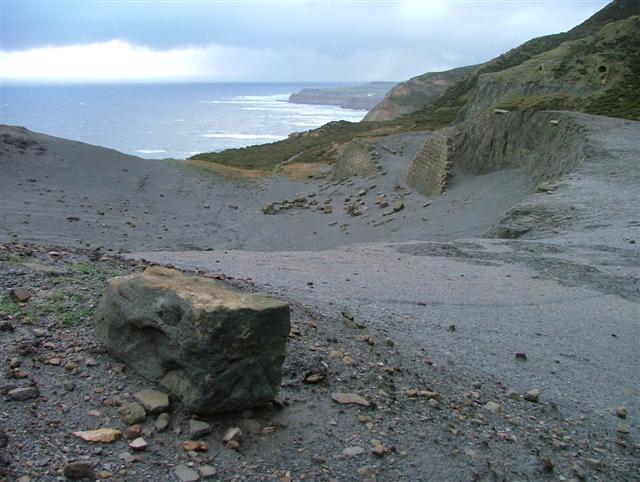
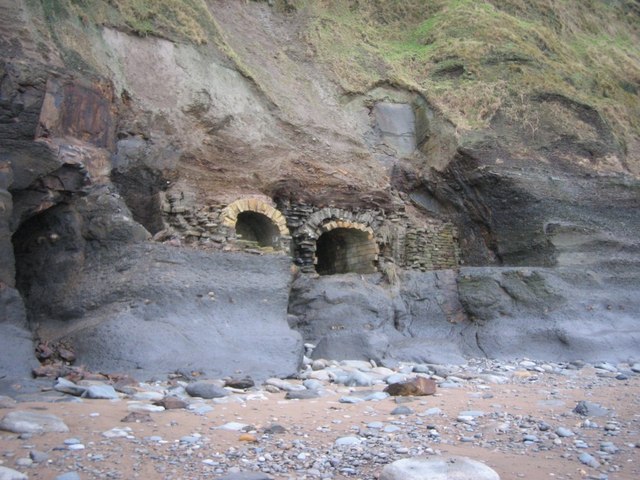
History
Alum working began at Boulby in the 1650s under the Conyers family of Boulby Manor, and control passed before long to the Baker-Bakers. It became one of the most productive and longest-lived works in a region that had effectively invented the British alum trade. The earliest quarrying was at Rockhole Hill; a second and larger operation, the New Works, opened in 1784 and at its peak employed 355 people, 314 of them labourers. The industry went into decline through the 1850s as synthetic dyes and cheaper chemical routes arrived, and Boulby closed in 1871.
Geology
The Cleveland cliffs expose a thick bed of alum shale — up to sixty metres of it here — and that thickness is the whole reason the industry existed on this coast. Alum itself is not a mineral you dig: it has to be manufactured out of the shale, which is why an alum works is a chemical plant rather than a mine, and why the quarries and the works sit together on the same site.
Geological setting: Sedimentary Beds and Seams (well documented example)
Workings
The quarries run about a kilometre along the north-facing coastal cliffs, the faces cut up to 200 metres inland from the present cliff edge, with the two areas — Rockhole Hill and the New Works — separated by very large spoil tips. Making alum took months. Quarried shale was built into enormous clamps and calcined, burning slowly and leaving the mounds still visible on the site; the burnt shale was then steeped in stone-lined pits, seventeen of them at the New Works, and the liquor run off along troughs to the alum house. There it was treated with an alkali and with ammonia, and crystallised out. The ammonia came from stale human urine, collected by the barrel in the poorest districts of London and Newcastle — the trade believing poor people's urine made the better product — and shipped up the coast.
Closure
Boulby closed in 1871, the trade having been undercut through the 1850s and 1860s by new dyes and by cheaper ways of making the mordant it existed to supply.
What remains
A scheduled monument, and eroding. Calcination bases, stone tunnels, fragments of the steeping pits, workshop and building foundations, cisterns and reservoirs survive, much of it below ground. A 17th-century tunnel running to the cliff-top works was exposed by coastal erosion in the early 1990s. A 2015 exploration report covers the site both at surface and underground, which is unusual for an alum works — most of what survives here is normally seen only from the cliff path.
Extensive: the quarry faces themselves, the spoil tips, calcining clamp bases, the steeping pit remains and the tunnel in the cliff. Historic England calls Boulby one of the best national examples of a technically advanced alum quarrying complex.
Redevelopment
None — the site is scheduled and lies on the Cleveland Way. Boulby's modern mining is a separate matter entirely: the potash mine of the same name, elsewhere in this archive, works far beneath the same coast.
Related mines
- Peak Alum Works — One of the coastal alum works of the same Yorkshire industry, named in this record's own account of how the trade spread along the cliffs, and among the last to close in 1871.
Nearby mines
- Boulby Mine — 0.9 miles (1.5 km) SE
- Grinkle Mine — 1.2 miles (1.9 km) SE
- Loftus Mine — 2.6 miles (4.1 km) W
- Carlin How Mine — 2.7 miles (4.3 km) W
- Port Mulgrave Mine — 3.3 miles (5.3 km) E
Straight-line distance, within 9 miles (15 km). Show on the map.
Recorded claims
Individual factual claims, each attached to the source(s) that support it below. Where sources disagree, both are kept.
- Alum working began at Boulby in the 1650s under the Conyers family of Boulby Manor, control passing to the Baker-Baker family. 1,2
- The quarries extend about a kilometre along the coastal cliffs, with faces up to 200 m inland of the present cliff edge, working alum shale up to 60 m thick. 1
- There were two quarrying areas — Rockhole Hill, the earliest, and the New Works, opened in 1784 — separated by large spoil tips; the New Works had seventeen stone-lined steeping pits. 1
- At its peak the New Works employed 355 people, 314 of them labourers. 1
- Alum was manufactured rather than dug: shale was calcined in large clamps, steeped in stone-lined pits, and the liquor run through troughs to the alum house, where ammonia from stale human urine shipped from London and Newcastle was used to crystallise the product. 1,2
- The works closed in 1871, the trade having declined through the 1850s as new dyes arrived. 1,2
- Historic England describes Boulby as one of the best national examples of a technically advanced alum quarrying complex, illustrating Britain's first chemical industry. 1
Sources
- (primary) Boulby Alum Quarries and works, Loftus — scheduled monument 1018336 — Historic England (via ancientmonuments.uk)
- (secondary) The Alum Industry of North-East Yorkshire — East Cleveland's Industrial Heartland
- (observational) Boulby alum works (surface and underground), April 2015 — 28DaysLater
Record created: 24 August 2026 · Last researched: 24 August 2026