 MineArchive
Bramley Fall Quarry
| Location | Bramley, Leeds, West Yorkshire — 53.8240, -1.6320 (approximate) |
|---|---|
| Commodity | Sandstone |
| Type | Stone |
| Worked | From the 12th century–c.1930 |
| Operators | B. Whitaker and Sons (1927–1930) |
Overview
A Leeds gritstone quarry worked since at least the 12th century, whose famously shock-resistant sandstone supplied Leeds Town Hall and Kirkstall Abbey at home and, further afield, the Houses of Parliament, Westminster Bridge, Euston Arch and the Port of Dover, shipped out by canal barge until quarrying finally ended around 1930.
History
Stone has been worked at Bramley Fall, on the hillside above the Leeds and Liverpool Canal at Bramley, since at least the 12th century, giving its name — Bramley Fall stone — to the type of Millstone Grit sandstone quarried there. The quarry's position directly above the canal, built through the valley in the 1790s, made shipping the heavy stone out to customers straightforward, and Bramley Fall stone became one of the most sought-after building and engineering stones in the country: valued not just for ordinary construction but specifically for its ability to withstand shock and strengthen with weathering, properties that made it ideal for docks, locks, bridges, engine beds and defensive works. Closer to home it built Leeds Town Hall, the Corn Exchange, and was used in restoration work at the medieval Kirkstall Abbey; further afield, Bramley Fall stone went into the foundations of the Houses of Parliament, the piers of Westminster Bridge (1854-62), the seaward defences of the Port of Dover, Euston Arch (1838, demolished 1962 despite a long-running preservation campaign), Armley Prison (1847), Scarborough's Valley Bridge and Napoleonic-era Martello towers along the south coast. By 1927 the works was run by B. Whitaker and Sons of Albion Street, Leeds; quarrying at Bramley Fall itself ceased around 1930, though Bramley Fall stone — quarried from related deposits at Bramhope — is still produced today, having supplied some 4,000 tonnes of stone for the 2011 widening of Blackfriars Bridge in London.
Geology
The Rough Rock, the uppermost sandstone of the Millstone Grit of the Namurian, which outcrops along the north side of the Aire valley west of Leeds. It is a moderately coarse-grained amber sandstone, soft to work when raised and weathering to a hard, resistant surface - the combination that made it one of the cheapest and best adapted English stones for heavy engineering, for docks, locks and railways, and for millstones, grindstones, engine beds and foundations. The Rough Rock was the bed most sought after in the Leeds district.
Workings
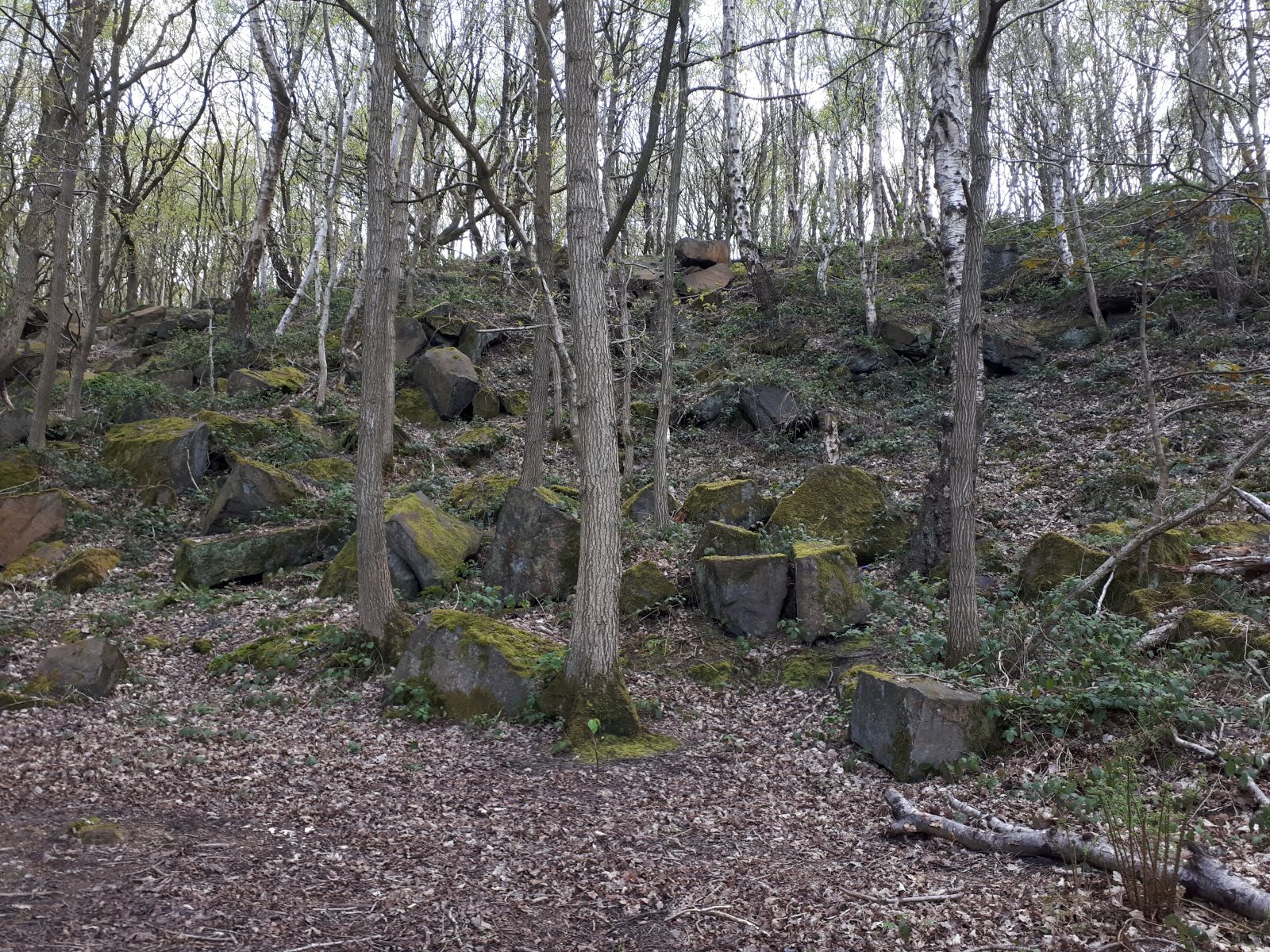
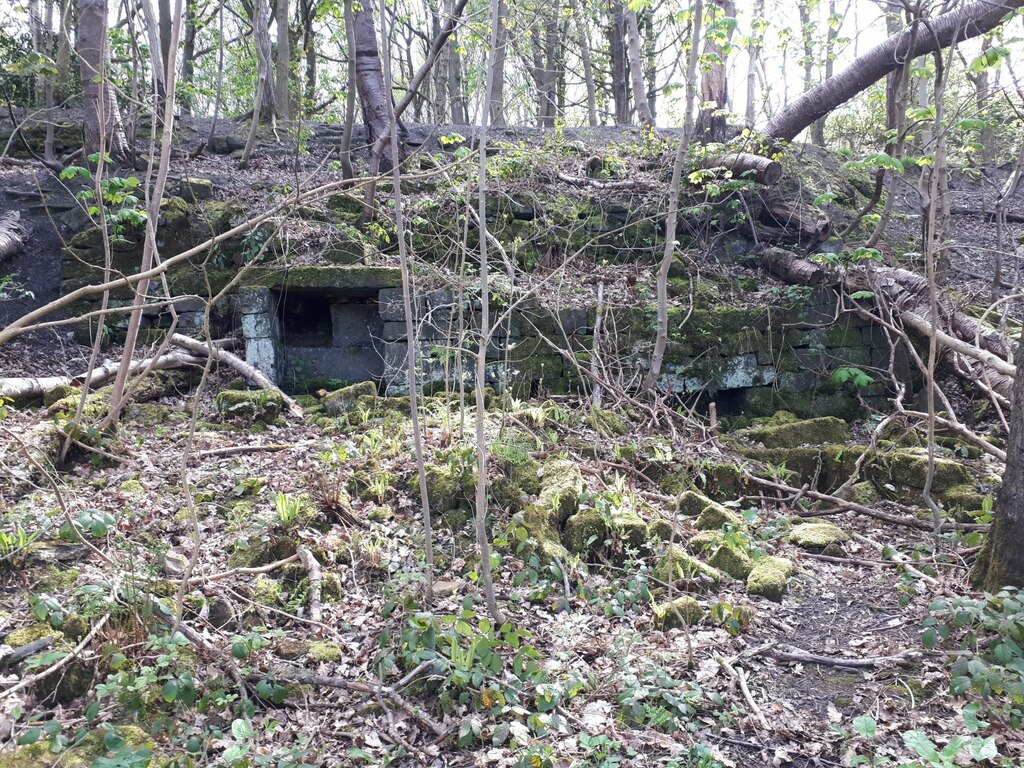
Not one quarry but several of various sizes cut into the Rough Rock outcrop in the woods above the Aire, the largest of them beside the Leeds and Liverpool Canal. A stone drop and wharf on the canal loaded finished blocks straight onto barges, which is how Bramley Fall stone reached London and Mumbai. A quarry building stood among the workings, shown unlabelled on the 1908 Ordnance Survey map.
Closure
Quarrying at Bramley Fall itself ended around 1930; the Bramley Fall stone name lives on at a related, still-active quarry at Bramhope, several miles to the north.
What remains
The quarry ground is Bramley Fall Park, a public park managed by Leeds City Council on the north bank of the Aire west of Kirkstall, and the workings survive within it as worked-out faces of various sizes among woods. Little is left of the old quarry building; a park lodge was put up between 1921 and 1936.
Old quarry faces, a canalside stone drop, possible wharf remains and ruined quarry buildings survive within Bramley Fall Park.
Redevelopment
The quarries and the woods around them are now Bramley Fall Park, a public park in the care of Leeds City Council, laid out with a lodge added between 1921 and 1936.
Nearby mines
- Morley Main Colliery — 5.5 miles (8.9 km) S
- Toftshaw Moor Colliery — 5.8 miles (9.3 km) SW
- Gomersal Colliery — 6.2 miles (10.0 km) S
- Heaton Colliery — 6.3 miles (10.2 km) W
- Northcliffe Colliery — 6.5 miles (10.4 km) W
Straight-line distance, within 9 miles (15 km). Show on the map.
The old quarry faces are steep and the site is managed as parkland rather than a mine — this entry describes history and general location only, not an access guide.
Recorded claims
Individual factual claims, each attached to the source(s) that support it below. Where sources disagree, both are kept.
- Bramley Fall stone was used in Leeds Town Hall, the Corn Exchange, Kirkstall Abbey restoration, the Houses of Parliament's foundations, Westminster Bridge, Euston Arch, Armley Prison, the Port of Dover and Scarborough's Valley Bridge. 1
- The stone recorded a mean crushing strength of around 265.7 tons per square foot on a six-inch cube, strengthens on exposure and resists water damage, making it especially suited to engineering and dock work. 1
- By 1927 the works was operated by B. Whitaker and Sons of Albion Street, Leeds; quarrying ceased around 1930, though related Bramley Fall stone deposits at Bramhope remain in production, supplying around 4,000 tonnes of stone for the 2011 Blackfriars Bridge widening. 1
- A stone drop and wharf on the Leeds and Liverpool Canal loaded finished blocks directly onto barges; old quarry buildings and gateposts marking the quarry and neighbouring Newlay House survive in what is now Bramley Fall Woods. 2
- Grace's Guide records B. Whitaker and Sons of Horsforth, Leeds, with an advertisement of December 1907; this record's other sources place the firm at Albion Street, Leeds, running the Bramley Fall works by 1927. 3
- The stone is from the Rough Rock, the uppermost sandstone of the Millstone Grit, which was the bed most sought after in the Leeds district; stone from the Bramley Fall quarries went to the original Euston Station and Millwall Docks in London and to docks in Mumbai. 4
- A quarry building shown unlabelled on the Ordnance Survey map of 1908 stood in the woods on the quarry ground; by 2022 little of it remained. 5
- The workings in the woods are several worked-out quarries of various sizes rather than a single pit, the largest of them beside the canal. 5
- The quarry ground is now Bramley Fall Park, a public park on the north bank of the River Aire west of Kirkstall, managed by Leeds City Council; a lodge was put up in it between 1921 and 1936. 6,5
Photographs & further reading
The association's account of the district's building stones, which identifies the Rough Rock as the bed the Bramley Fall quarries worked and lists the works its stone went to at home and abroad.
View sourceSources
- (secondary) Bramley Fall stone — Wikipedia
- (secondary) How Bramley Fall Woods links to Leeds Corn Exchange — West Leeds Dispatch
- (secondary) B. Whitaker and Sons, of Horsforth, Leeds — Grace's Guide to British Industrial History
- (secondary) Mineral Resources — Leeds Geological Association — Leeds Geological Association
- (observational) Bramley Fall: an old quarry building (Geograph 7156032) — Geograph Britain and Ireland
- (secondary) Bramley Fall Park — Wikipedia
Record created: 26 August 2026 · Last researched: 28 September 2026