 MineArchive
Gomersal Colliery
| Also known as | Nutter Lane Pit |
|---|---|
| Location | Gomersal, near Birstall, Kirklees, West Yorkshire — 53.7385, -1.6778 (approximate) |
| Commodity | Coal |
| Type | Coal |
| Worked | 1916–June 1973 |
| Maximum depth | About 110 metres to the Beeston seam |
| Operators | Birkenshaw Collieries Ltd (1913–1947), National Coal Board (1947–1973) |
Overview
A colliery at Gomersal, near Birstall, whose two shafts were sunk by Birkenshaw Collieries Ltd between 1913 and 1916. Known locally as Nutter Lane Pit, it got its coal almost entirely by hand until it closed in 1973 for fear of flooding after the Lofthouse inrush; its site is now part of Oakwell Hall Country Park.
History
Gomersal's two shafts, on ground now within Oakwell Hall's park, were sunk by Birkenshaw Collieries Ltd between 1913 and 1916; Kirklees Council's account has the shafts sunk in 1911 and the colliery opening in 1916. At first about 62 men worked the Blocking or Silkstone seam underground, with 16 on the surface. The Birkenshaw Collieries Co. Ltd took over in 1920, but the pit struggled from 1921 to 1931, with few men and periods of closure: 15 were employed in 1923 and in 1933. Recovery began in 1932 under directors from the Gill family, who lived locally, and from 1934 to 1945 the company employed on average 131 underground and 29 on the surface.
The National Coal Board took the colliery over on 1 January 1947 and worked the Beeston seam, about 110 metres down, until 1973, and the Blocking, about 55 metres down, from 1958; in 1967 it drove a drift from the surface to both seams. Known locally as Nutter Lane Pit, it employed over 360 men in the 1960s. Almost all its coal was got by hand: an attempt to mechanise in the 1950s failed, and a coal plough tried in the Blocking in the early 1970s proved unequal to the task. On faces 180 to 230 metres long the day shift hand-filled the coal the night shift had undercut, each filler clearing a stint of 14 or 15 metres of seam 0.6 to 0.7 metres high.
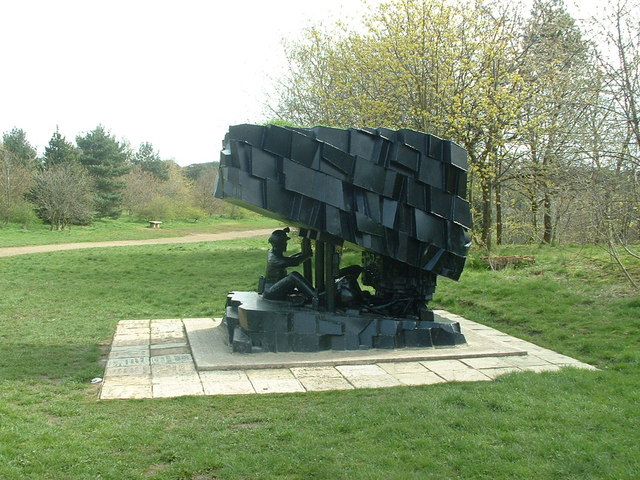
In 1973 a further attempt at mechanisation was overtaken by closure. After the Lofthouse inrush it was judged that Gomersal, ringed by old workings, ran a significant danger of flooding, and the colliery closed in June 1973. The winding gear and buildings were demolished in 1974, and from 1976 the site was reclaimed, its shafts capped, its sludge lagoons removed and its slag heaps levelled and planted, as part of Oakwell Hall Country Park, where a sculpture celebrates the mine and those who worked there.
Geology
Yorkshire coalfield: the Blocking or Silkstone seam at about 55 m and the Beeston or Shertcliffe seam at about 110 m.
Workings
Two shafts sunk 1913-16 and a drift from the surface to both seams (1967); hand-filled longwall faces 180-230 m long.
Closure
Closed in June 1973 after the Lofthouse inrush showed the danger of flooding from old workings; the Beeston plans are dated 1 February 1974.
What remains
The site is part of Oakwell Hall Country Park, planted with wildflowers and woodland.
The winding gear and buildings were demolished in 1974 and the shafts capped.
Redevelopment
Reclaimed from 1976 as part of Oakwell Hall Country Park; a sculpture in the park commemorates the mine and its miners.
Nearby mines
- Soothill Wood Colliery — 3.0 miles (4.8 km) SE
- Morley Main Colliery — 3.6 miles (5.8 km) E
- Ingham Colliery — 5.4 miles (8.7 km) SE
- Combs Colliery — 5.5 miles (8.8 km) SE
- East Ardsley Colliery — 5.8 miles (9.3 km) E
Straight-line distance, within 9 miles (15 km). Show on the map.
What's uncertain
Points where sources disagree or the record could not be settled; both accounts are kept. All open questions in the archive.
- The shafts were sunk in 1911 and the colliery opened in 1916. (disputed) 2
Recorded claims
Individual factual claims, each attached to the source(s) that support it below. Where sources disagree, both are kept.
- Gomersal's two shafts were sunk by Birkenshaw Collieries Ltd between 1913 and 1916. 1
- The shafts were sunk in 1911 and the colliery opened in 1916. (disputed) 2
- Gomersal employed 15 in 1923 and 1933, an average of 160 in 1934-45, 236 in 1954 and over 360 in the 1960s. 1,2,3
- Practically all of Gomersal's output was got by hand; mechanisation failed in the 1950s and a coal plough in the early 1970s. 1
- Gomersal closed in 1973, after the Lofthouse inrush, because of the danger of flooding from old workings. 4,1,2
- The winding gear and buildings were demolished in 1974 and the site reclaimed from 1976 as part of Oakwell Hall Country Park. 2
- Gomersal's Beeston workings were abandoned on 1 February 1974. 5
Photographs & further reading
The colliery's history, its hand-filled faces and the reasons for its closure.
View sourceThe park made on the colliery site and its sculptures.
View sourceSources
- (secondary) Gomersal Colliery — Northern Mine Research Society
- (secondary) Oakwell Hall Country Park — Kirklees Council
- (primary) Gomersal Colliery — Durham Mining Museum
- (secondary) NCB Collieries - England (Northern Mine Research Society) — Northern Mine Research Society
- (primary) BGS mine plan: Gomersal, Beeston (or Shertcliffe), abandoned 1 February 1974 — BGS / Mining Remediation Authority mine plans
Record created: 4 October 2026 · Last researched: 4 October 2026