 MineArchive
Filler
| Also known as | Danner (Shropshire), Dram Filler, Tram Filler, Tub Filler, Loader |
|---|---|
| Category | Labour & Roles |
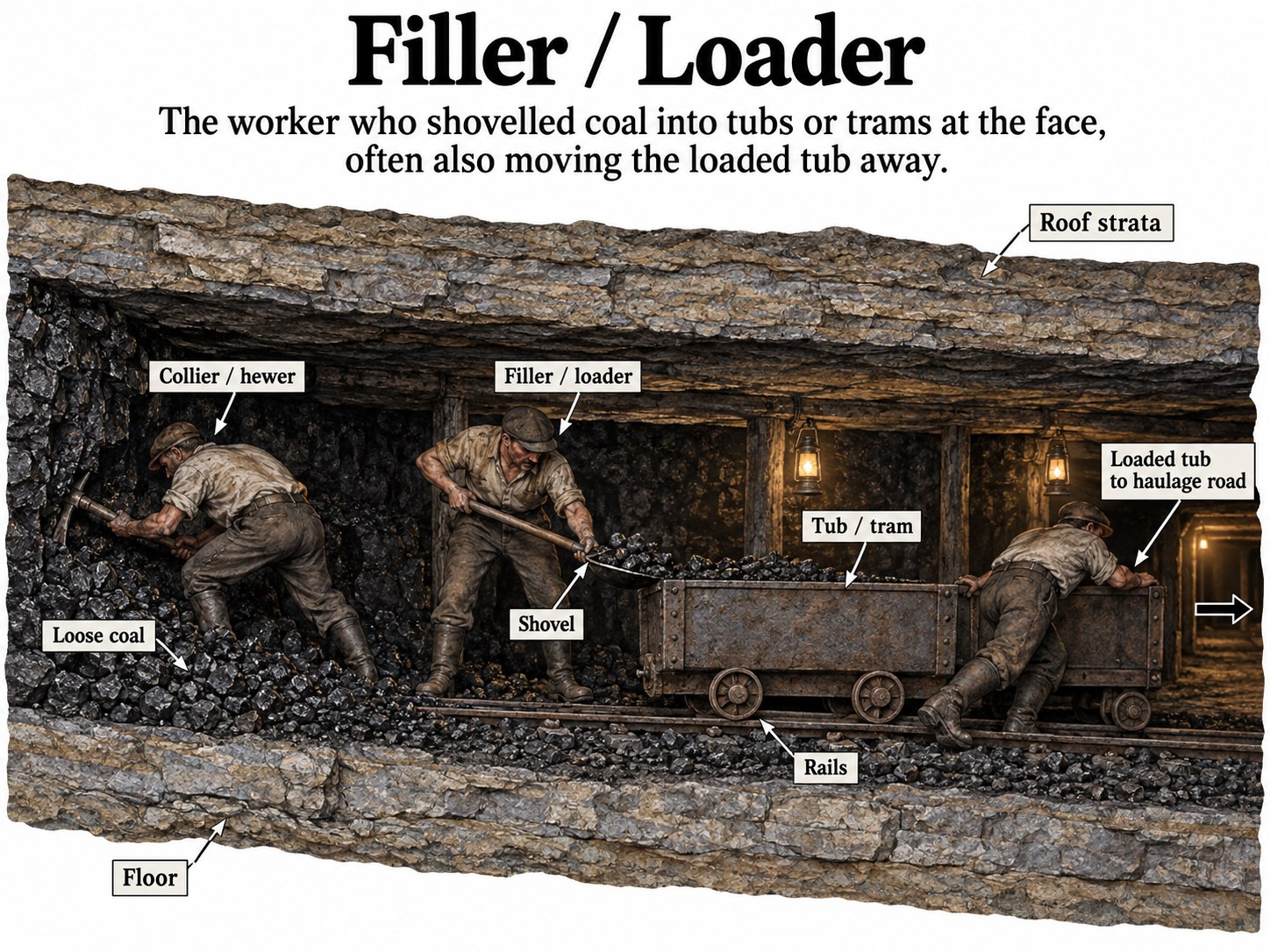
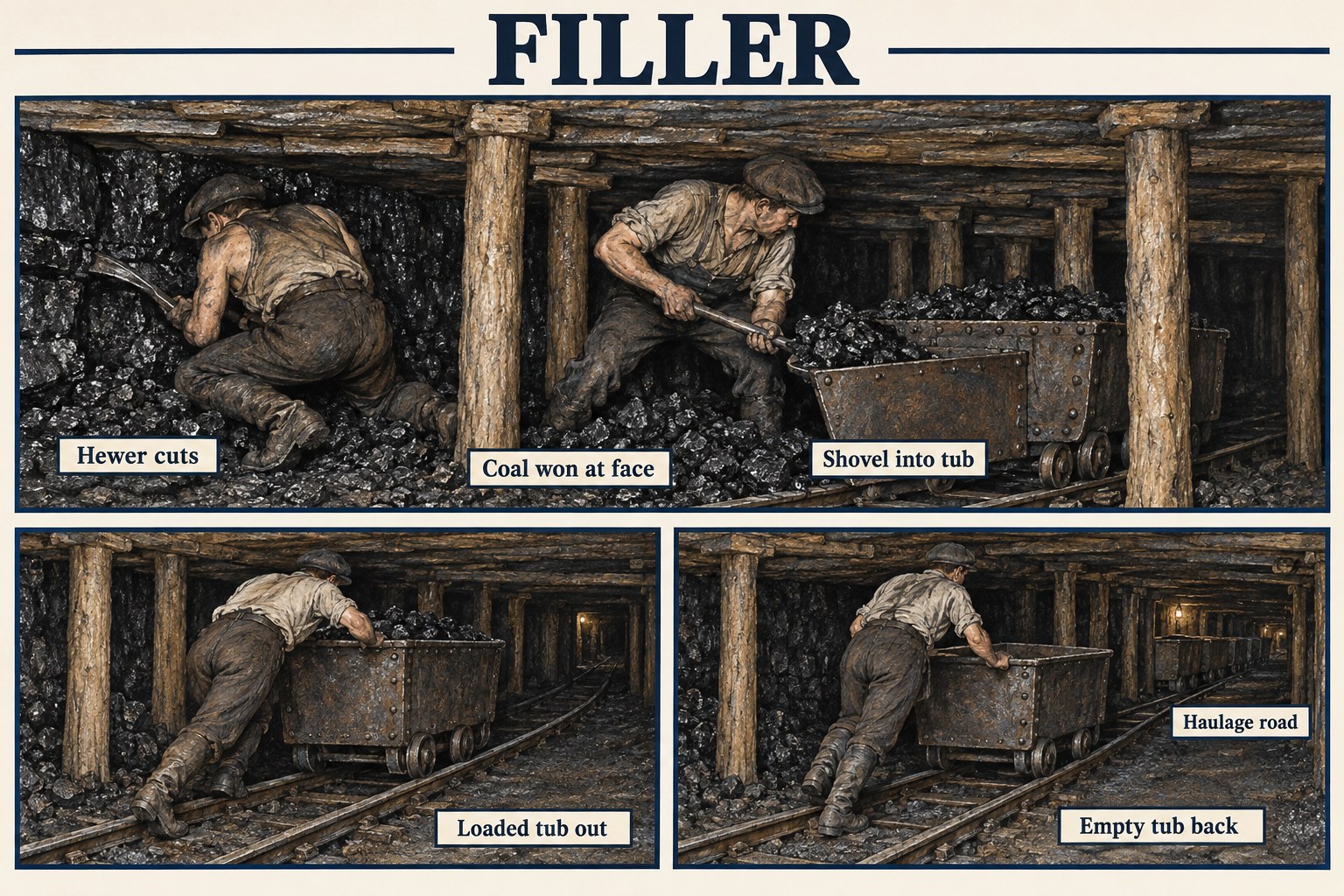
The worker who shovelled coal into trams, tubs or onto a conveyor at the working face, often also pushing or drawing the loaded trams away to the haulage road.
Historical usage
The occupation of two of the youngest, 14-year-old victims of the already-published Kemberton Colliery pit cage disaster of 1910, recorded under this role's own Nottinghamshire/Shropshire border-district dialect name -- while a third victim of the same disaster is recorded under the plain, standard term itself.
How it worked
Working immediately behind the collier or hewer who cut or blasted the coal down, the filler shovelled it into the trams, tubs or corves waiting at the face, and in smaller operations without a separate drawer or putter also pushed the loaded tram away to the nearest haulage road himself.
Risks & limitations
Filling was often a boy's or young man's job, and a physically continuous one: two of the boys killed in the already-published 1913 Rufford Colliery disaster, Randolph Cecil Miles and Albert Jones, were both just 14 and both recorded by their occupation as this role's own East Midlands dialect name.
Regional variation
The role went by a wide range of local names across different coalfields -- dram filler, heaver, loader, loaderer, tram filler, truck filler, truck loader, tub filler and wagon filler among them -- with 'danner' recorded as the term actually used in the Nottinghamshire coalfield.
Related terminology
Mines associated with this term
5 examples chosen from 12 linked records — the term page is not an index.
- Argyll Colliery, Machrihanish — Argyll and Bute (well documented example)
Named in this record’s workings: “…a last attempt to reduce costs. Coal went out over a mechanical boom loader at Campbeltown quay, installed in 1950; the largest cargo ever…” - Brackley Colliery — Greater Manchester (well documented example)
Named in this record’s history: “…against 19 in 1934. After nationalisation a Meco-Moore cutter loader was put into the Plodder; where the machine proved cumbersome…” - Broxtowe Colliery — Nottinghamshire (well documented example)
Named in this record’s history: “…deaths are named between 1901 and 1915, all in the Top Hard: a loader struck by a steel prop knocked out by rolling coal, a stallman under…” - Elphingstone Colliery — East Lothian (well documented example)
Named twice in this record, first in the summary: “…it who were questioned included a coal putter of eight and a coal filler of nine.” - Eppleton Colliery — Tyne and Wear (well documented example)
Named in this record’s history: “…The ignition came from the defective master control box of a Joy loader — a mechanical coal-loading machine — and the Mines Inspector…”
Disasters associated with this term
5 examples chosen from 30 linked records, most direct relationship first.
- Baddesley Colliery Explosion (contextual relationship)
Named in this record’s rescue and recovery: “…Two further descents brought out John Collins, a seventeen-year-old loader who had crawled up the incline, and the carpenter Rowland Till,…” - Bilsthorpe Colliery Explosions (1934) (contextual relationship)
Named twice in this record, first in the cause: “A shotfiring operation in the loader gate ignited accumulated firedamp, causing the first explosion; a…” - Blackwell Colliery roof fall, 1878 (contextual relationship)
Named twice in this record, first in the summary: “A stallman, Isaac Jones, and his loader, James Priestman, were killed by a fall of roof at Blackwell A…” - Crigglestone Colliery explosion, 1941 (contextual relationship)
Named 6 times in this record, first in the cause: “…ignited in a break in the roof by a ripping shot fired in the South Loader gate two and a half hours before the explosion; it burned unseen…” - Dean Lane Colliery explosion, 1886 (contextual relationship)
Named in this record’s narrative: “…the pulley, where it jammed. Nine of the dead, five hewers and four fillers aged 14 to 48, were suffocated; the sixteen-year-old banksman George…”
Sources
- (primary) 042.—Hewers and Getters (A Dictionary of Occupational Terms, 1921 Census) — A Dictionary of Occupational Terms (1921 Census classification)
- (secondary) Kemberton Colliery Shaft Accident - Shifnal - 1901 — Northern Mine Research Society
Record created: 31 August 2026 · Last researched: 31 August 2026