 MineArchive
Baddesley Colliery Explosion
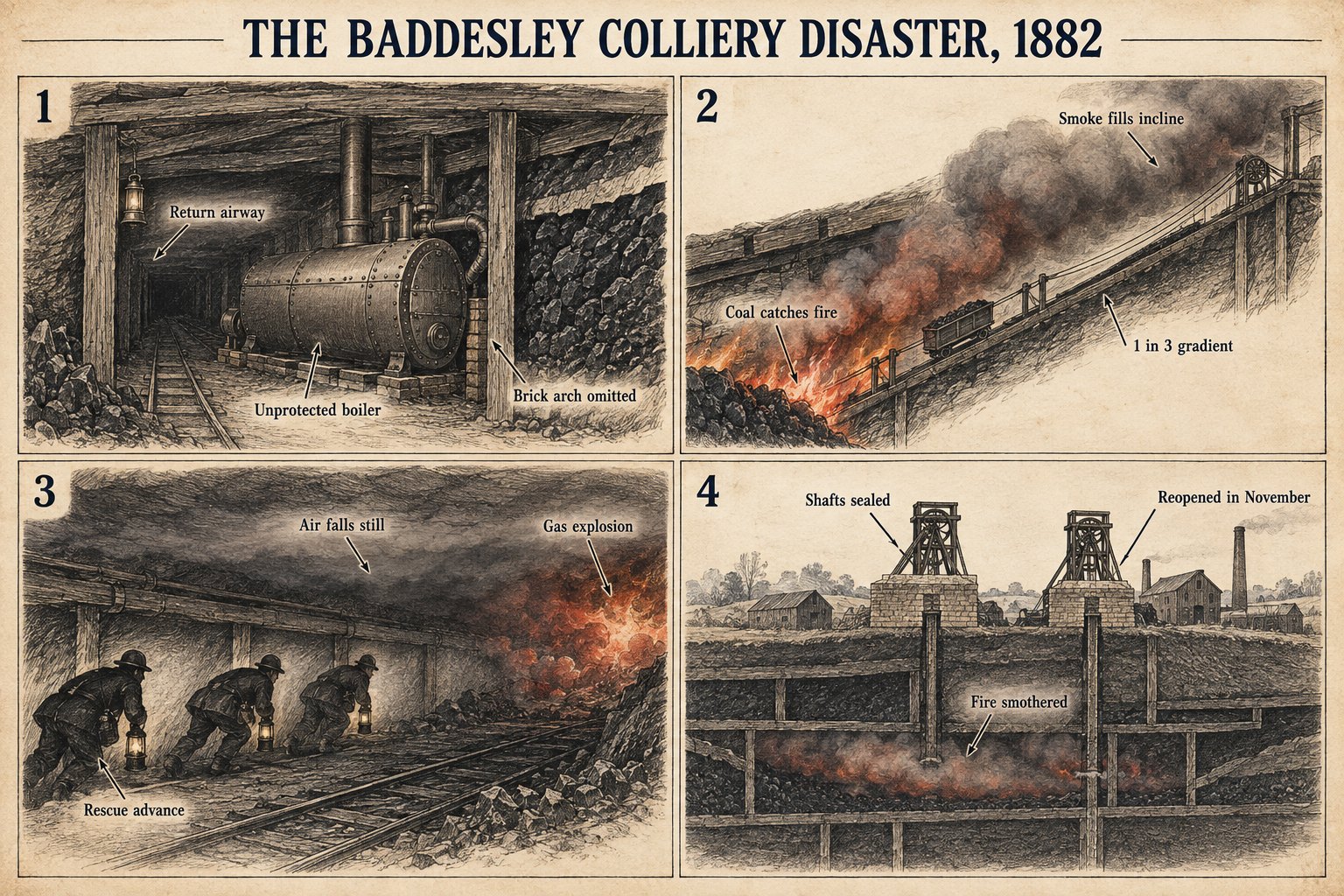
An underground fire, started by an unprotected steam boiler installed in the return airway, trapped nine night-shift men in the deep workings at Baddesley Colliery. The rescue effort ran for fourteen hours before a gas explosion killed twenty-three of the men attempting it, among them the colliery's owner. Thirty-two died in all.
| Date | 1 May 1882 |
|---|---|
| Mine | Baddesley Colliery |
| Region | Warwickshire |
| Primary type | Explosion |
| Associated types | Entrapment, Fire, Gas / Asphyxiation, Rescue |
| Fatalities | 32 (Twenty-three men died in the explosion during the rescue attempt, including the owner William Stratford Dugdale, the agent and his son, the manager and the underviewer; the nine night-shift men trapped by the fire were never reached and died of suffocation. Their bodies were not recovered until the pit was unsealed at the end of November.) |
| Injuries | Several rescuers were severely burnt, including the mining engineer Reuben Smallman, who survived; three men — Dugdale, Rowland Till and John Collins — were dragged out alive from the smoke after the explosion, but all three later died of their injuries. |
| Context | During active mining |
Cause
A self-contained steam boiler, installed at the extreme deep of the workings to drive a pump, was set in the return airway with its roof cut away so smoke and flame passed along the top of the airway. The airway was driven in solid ground but had coal on either side. The consulting engineer had specified that the boiler be set on a brick platform and enclosed in a brick archway; the archway was never built, and the coal beside the boiler is understood to have been set alight by it.
Contributing factors
The boiler was in the return airway rather than near the shaft bottom, so any smoke or fire it produced was carried directly through the workings the men were in. Water had been raised up the incline in leaking wooden tubs, damaging the floor, which was why a pumping arrangement was needed down there at all. The deep workings lay about 1,000 yards from the shaft bottom at the end of an incline falling 1 in 3 in places, so smoke filled the only route in and out.
What happened
Early on the morning of 1 May 1882 a deputy named Day descended the upcast shaft and found it full of smoke. His father Charles went up to see for himself, and was left exhausted by the fumes by the time he reached the surface. George Parker, the manager, descended with several men; repeated attempts to get down the incline were driven back by smoke so dense they could advance only a few yards. Nine men were known to be in the workings beyond it. Reuben Smallman, a mining engineer living close to the colliery, was called in and devised a scheme to drive the smoke out and reach the seat of the fire. Volunteers went in and were beaten back and overcome in turn. William Stratford Dugdale, the colliery's owner, went down himself — he knew nothing of mining procedure, but believed his presence would steady the men. Work went on from six in the evening until half past eight the following morning, when the air suddenly went still. There was a report like a roll of thunder and a sheet of flame that burnt Dugdale, the agent John Pogmore and his son Frank, the manager Parker and others, and killed twenty-three men. Of the eighteen in the advance party, one survived.
Rescue & recovery
Arthur Henry Stokes, the Assistant Inspector of Mines, reached the colliery at nine in the morning to find Smallman lying badly burnt in the engine house — so badly that Stokes did not recognise him until he spoke. Warned that another explosion could come at any time, Stokes called for volunteers anyway and went down with the engineer Samuel Spruce and four others. They found the engine plane filled with noxious fumes and smoke from the roof to within about a foot of the floor, and crawled beneath it, shouting into the dark and being answered. Stokes stumbled over Dugdale lying on his back and the party dragged him clear. Two further descents brought out John Collins, a seventeen-year-old loader who had crawled up the incline, and the carpenter Rowland Till, hauled out on a rope. All three later died. With fire still raging, the Inspector Mr Evans and the engineer Gillett judged further attempts foolhardy, and the following day it was decided nobody could still be alive below. The shafts were sealed to smother the fire and stayed sealed until the end of November, when the pit was reopened, explored and the bodies recovered. The Waddell fan had survived undamaged and the colliery ventilated well enough that the furnace did not need relighting.
Investigation & inquiry
The inquest was held at the Town Hall, Atherstone before Dr Iliffe, the County Coroner for Warwickshire, and Stokes gave a detailed account of the descent that brought Dugdale out. The jury returned a verdict of accidental death, but added that it considered it an error of judgement to have placed the engine and boiler so far from the bottom of the shaft in the return airway, and in such an imperfect and unprotected manner, subjecting the pit to great risks — and that this was the cause of the fire. Arnold Morley MP produced two reports on the circumstances of the accident, and it was covered in the Mines Inspector's Report for 1882.
Legal & regulatory aftermath
The coroner's jury attributed the fire to the manner in which the boiler had been installed but returned an accidental verdict, and no prosecution followed. First Class Albert Medals were awarded by the Queen to Reuben Smallman, Arthur Henry Stokes, and the colliers Charles Day and Charles Chetwynd; Second Class Albert Medals to Samuel Spruce, the colliery managers Frederick Samuel Marsh and Thomas Henry Mottram, and the colliers William Morris, William Pickering and Joseph Chetwynd. They were presented at the Corn Exchange, Atherstone on 19 February 1883 by Lord Leigh, Lord-Lieutenant of Warwickshire, who told them he did not believe any soldier awarded the Victoria Cross had performed a more gallant action.
Memorials & commemoration
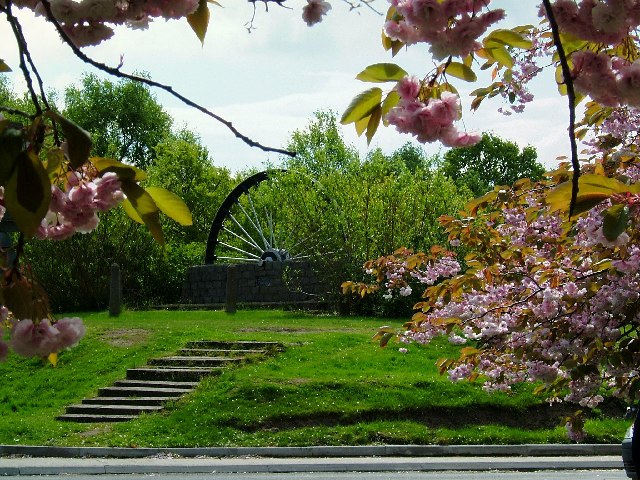
A colliery winding wheel stands on the site of the pit. The dead ranged from Joseph Scattergood, an incline boy of thirteen, to William Day, a collier of seventy-one; both were among the nine left in the workings.
Recorded claims
Individual factual claims, each attached to the source(s) that support it below. Where sources disagree, both are kept.
- A self-contained engine boiler was placed in the return airway at the extreme deep of the workings, with coal on either side; the engineer had instructed that it be insulated with brick, which was not done, and the coal is supposed to have been set on fire by it. 1,2
- Twenty-three men were killed by the explosion during the rescue attempt, and the nine night-shift men trapped by the fire died of suffocation — thirty-two in all. 1
- Among the dead were the colliery's owner William Stratford Dugdale, aged 54; the agent John Pogmore, 57, and his son Frank, 27; the manager John Parker, 58; the incline boy Joseph Scattergood, 13; and the collier William Day, 71. 1
- Arthur Henry Stokes, Assistant Inspector of Mines, led a party of six that crawled beneath about eleven feet of dense smoke and brought out Dugdale, John Collins and Rowland Till alive; all three later died. 1
- The coroner's jury returned a verdict of accidental death but found it an error of judgement to have placed the engine and boiler so far from the shaft bottom in the return airway, in such an imperfect and unprotected manner, and that this was the cause of the fire. 1
- Four First Class and six Second Class Albert Medals were awarded for the rescue and presented at Atherstone Corn Exchange on 19 February 1883 by Lord Leigh, Lord-Lieutenant of Warwickshire. 1
- The shafts were sealed the day after the explosion to smother the fire and remained sealed until the end of November 1882, when the mine was explored and the bodies recovered. 1
Related terminology
Mining terms this disaster is structurally linked to, with the nature of the relationship.
- Afterdamp (hazard involved)
The nine men trapped beyond the fire died of suffocation rather than burns, and every rescue party sent down the incline was driven back or overcome by the fumes filling it. - Filler (contextual relationship)
Named in this record’s rescue and recovery: “…Two further descents brought out John Collins, a seventeen-year-old loader who had crawled up the incline, and the carpenter Rowland Till,…” - Incline (contextual relationship)
The deep workings lay at the foot of an incline falling 1 in 3 in places, and it was the water hauled up it in leaking wooden tubs that made a pumping arrangement — and its boiler — necessary at all. - Return Airway (contextual relationship)
Named 4 times in this record, first in the summary: “…fire, started by an unprotected steam boiler installed in the return airway, trapped nine night-shift men in the deep workings at Baddesley…” - Waddle Fan (contextual relationship)
Named in this record’s rescue and recovery: “…when the pit was reopened, explored and the bodies recovered. The Waddell fan had survived undamaged and the colliery ventilated well enough that…”
Photographs & further reading
This page doesn't try to reproduce everything — these are the best original sources found for this disaster.
The county record office's account of the disaster and its commemoration.
View sourceThe Mines Inspector's account in full, with the named dead and the inquest evidence.
View sourceSources
- (primary) Baddesley Colliery Explosion — Atherstone — 1882 — Northern Mine Research Society
- (secondary) Baddesley Colliery — Our Warwickshire — Warwickshire County Council / Warwickshire County Record Office
Record created: 25 August 2026 · Last researched: 25 August 2026