 MineArchive
Baddesley Colliery
| Also known as | Stratford Pits, Baxterley Colliery |
|---|---|
| Location | Baxterley, near Atherstone, North Warwickshire — 52.5710, -1.5901 (approximate) |
| Commodity | Coal |
| Type | Coal |
| Worked | From May 1850–1989 |
| Maximum depth | No. 1 and No. 2 shafts given as 840 yards, 7 ft in diameter; the Speedwell pumping pit 771 ft deep and 8 ft in diameter |
| Operators | Stratford Dugdale family (1850–1947), National Coal Board (1947–1987), British Coal Corporation (1987–1989) |
Overview
A Warwickshire pit sunk by the Dugdales of Merevale in 1850 and worked for 139 years, best remembered for the night in 1882 when a boiler installed underground — on an engineer's design, but without the brick casing he specified — set the coal alight, and the rescue party that went in after the trapped men was killed almost to a man.
History
The Stratford Dugdale family of Merevale Hall bought the land and mineral rights of Baxterley Hall in 1848, and turned the first sod of their new colliery in May 1850. Two shafts were sunk, known as the Stratford Pits; despite the name the colliery stood just over the parish boundary in Baxterley rather than in Baddesley Ensor. By 1876 reserves in the Ryder Seam were running down and the company began working coal down the dip, into ground that flooded persistently and defeated several attempts at drainage. The consulting engineer brought in to solve it, Mr Gillett, specified a self-contained engine boiler set at the extreme deep of the workings, on a brick platform and enclosed in a brick archway, to drive a pump. The manager had the boiler installed; the brick archway was never built. The fire that started in the coal beside it on 1 May 1882 killed thirty-two men (see Disasters, below). The pit was not finished by it: a third shaft was sunk in 1897 to meet rising demand, and the colliery worked another century. For its first hundred years Baddesley took coal from the Two Yard, or Ryder, seam alone; after nationalisation in 1947 the National Coal Board mechanised the workings and opened up three more, the Nine Feet, Seven Feet and Bench. The first armoured face conveyor went in in 1952, underground locomotives in 1958, electric winding engines in place of the steam winders in 1955 and 1961, and a new coal preparation plant in 1962.
Geology
Baddesley worked the Warwickshire Coalfield, a concealed extension of the Midlands Coal Measures where the productive seams dip eastward beneath younger cover. The Two Yard, or Ryder, seam carried the colliery for its first century; the Nine Feet, Seven Feet and Bench seams were opened up under the National Coal Board. It was the geology that finished the pit as well as making it: conditions deteriorated sharply from 1988, and the working faces could no longer be made to pay.
Geological setting: Sedimentary Beds and Seams (well documented example)
Workings
The two Stratford shafts were each 7 feet in diameter, and the 1882 Inspector's account gives their depth as 840 yards. A third shaft served as ventilating shaft or fan drift, all three connected underground by a drift, and a separate pumping pit — the Speedwell, 771 feet deep and 8 feet across — carried an engine able to lift over a million gallons a week. From the bottom of the No. 1 shaft a double roadway ran towards Hurley and down to the deep workings, about 1,000 yards from the shaft bottom and reached by an incline steep enough to fall at 1 in 3 in one place, with an engine at the shaft bottom hauling coal back up. The colliery was ventilated by a Waddell fan.
Closure
Baddesley began to hit serious geological problems in 1988 and productivity collapsed to the point that the colliery was losing £300,000 a week. It closed in 1989 with the loss of 650 jobs; a number of the men transferred to Daw Mill, and many others took early retirement or redundancy.
What remains
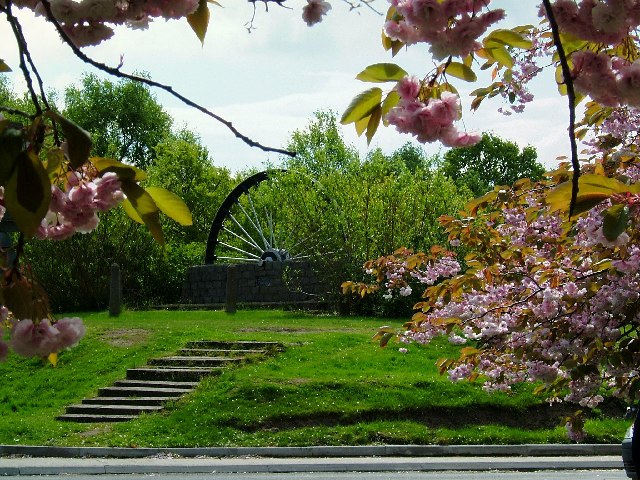
The colliery was levelled in 1989, the stockpiled coal removed and the site cleared. A colliery winding wheel is preserved above ground as a memorial to the pit and the men who worked it.
A preserved winding wheel; the colliery buildings, shafts and headgear were cleared during the 1989 levelling of the site.
Redevelopment
The colliery site was levelled after closure; the former colliery offices at Baxterley remain in commercial use.
Nearby mines
- Dexter Colliery — 2.7 miles (4.4 km) W
- Ansley Hall Colliery — 2.8 miles (4.5 km) SE
- Birchmoor Colliery — 3.2 miles (5.2 km) NW
- Kingsbury Colliery — 3.9 miles (6.2 km) W
- Pooley Hall Colliery — 4.3 miles (6.9 km) N
Straight-line distance, within 9 miles (15 km). Show on the map.
Disasters & major incidents
-
Baddesley Colliery Explosion
1 May 1882 · Explosion · 32 fatalities
An underground fire, started by an unprotected steam boiler installed in the return airway, trapped nine night-shift men in the deep workings at Baddesley Colliery. The rescue effort ran for fourteen hours before a gas explosion killed twenty-three of the men attempting it, among them the colliery's owner. Thirty-two died in all.
Recorded claims
Individual factual claims, each attached to the source(s) that support it below. Where sources disagree, both are kept.
- The Stratford Dugdale family acquired the land and mineral rights of Baxterley Hall in 1848; the first sod was turned in May 1850 and two shafts, the Stratford Pits, were sunk. 1
- The colliery's No. 1 and No. 2 shafts were each 7 feet in diameter and are given in the 1882 Inspector's account as 840 yards deep, with a separate pumping pit, the Speedwell, 771 feet deep and 8 feet in diameter. 2
- A ventilating shaft or fan drift connected to the two winding shafts by an underground drift, and the colliery was ventilated by a Waddell fan. 2
- By 1876 reserves in the Ryder Seam were diminishing and coal had to be worked down the dip, where water proved impossible to remove by the methods first tried. 1
- For its first hundred years the colliery worked the Two Yard (Ryder) seam alone; after nationalisation in 1947 the National Coal Board also worked the Nine Feet, Seven Feet and Bench seams, mechanising the pit with an armoured face conveyor in 1952, underground locomotives in 1958, electric winders in 1955 and 1961 and a new coal preparation plant in 1962. 1
- Geological problems from 1988 cut productivity to the point that the colliery was losing £300,000 a week; it closed in 1989 with the loss of 650 jobs. 1
Sources
- (secondary) Baddesley Colliery — Our Warwickshire — Warwickshire County Council / Warwickshire County Record Office
- (primary) Baddesley Colliery Explosion — Atherstone — 1882 — Northern Mine Research Society
Record created: 25 August 2026 · Last researched: 25 August 2026