 MineArchive
Ansley Hall Colliery
| Also known as | Ansley Nos. 1, 2 and 3, Ansley Colliery |
|---|---|
| Location | Ansley, near Atherstone, Warwickshire — 52.5392, -1.5485 (approximate) |
| Commodity | Coal |
| Type | Coal |
| Worked | 1874–1959 |
| Maximum depth | 168 yards (154 m) in the No. 1 shaft; 140 yards (128 m) in the No. 2 |
| Operators | Ansley Hall Colliery Company (1874–1947), National Coal Board (1947–1964) |
Overview
Sunk in 1874 by William Garside Philips of Oldbury Grange, with three shafts — two winding shafts of thirteen feet and thirteen feet six inches, 168 and 140 yards deep, and an eight-foot furnace shaft for ventilation. It took the Two Yard and Bare coals for its first nine years and by 1882 had exhausted them; what saved it was working down the dip on inclined headings, which kept it going for another three-quarters of a century on small tubs and, after 1889, larger ones. The colliery employed some 700 people at its peak. It was linked underground to Haunchwood Colliery in 1959 and closed in a phased shutdown from that year, its remaining districts transferred to Haunchwood and drawn up the Tunnel shaft.
History
Ansley Hall Colliery was sunk in 1874 by William Garside Philips of Oldbury Grange — the great-grandfather of Mark Phillips, Princess Anne’s first husband — and appears in the official list of collieries at work in 1880 as "Ansley Nos. 1, 2, 3, Atherstone, Ansley Hall Colliery Co." Its arrival added a mining element to the population of nearby Atherstone, where some of the miners sought lodgings.
For its first nine years it took the Two Yard and the Bare coals, and by 1882 those were exhausted; the colliery would have closed but for the technology that allowed coal to be won from down the dip using inclined headings, with level roadways driven out either side of the incline. The severity of that incline limited profitability, because only small tubs could be used on it, and in 1889 Garside Philips began an investment programme to allow larger ones and increase output. He had undertaken it on the understanding that John Beaumont Ludford-Astley of Ansley Hall would lease him further mineral rights as they were acquired; Ludford-Astley then refused, and offered the hall and its estate for sale instead. To stop another proprietor sinking a colliery on top of his own workings, and to secure the minerals, Garside Philips bought Ansley Hall and the estate in the colliery’s name in 1892.
He retired in 1921 and his son J. H. Philips took over, into a declining industry: the colliery brickworks began cutting back on labour, and by the time Garside Philips died in 1929 it employed four men. In 1927 a fault stopped production on one of the coalfaces and the colliery ran at a loss for three months while a new district was opened. Pithead baths were built on the opposite side of Coleshill Road and opened in 1938.
At nationalisation in 1947 the colliery was short of investment, but a national fuel shortage and a government directive to produce coal at any cost made that unimportant while production was subsidised. When the economic climate changed in 1955 it was told to become more efficient and produce cheaper coal. An industry-wide manpower shortage brought in experienced miners from declining coalfields elsewhere and stateless men from the refugee camps in Germany, and still there were not enough: every available man went onto productive facework rather than roadway repair, the underground roads deteriorated, and it became hard to get supplies to the faces. Profitability dropped past recovery and the colliery was scheduled for phased closure in 1959.
Geology
The Warwickshire coalfield east of Atherstone, where the seams dip away beneath later cover. Ansley Hall’s shafts were shallow — 168 and 140 yards — and reached the Two Yard and Bare coals, which were worked out within nine years of sinking. Everything after 1882 was won from down the dip: inclined headings driven from the exhausted horizon into deeper coal, with level roadways off either side. That is a geological constraint expressed as an engineering one, and the incline’s steepness governed the colliery’s economics for the next thirty years.
Geological setting: Sedimentary Beds and Seams (well documented example)
Workings
Three shafts: No. 1 thirteen feet in diameter and 168 yards deep, No. 2 thirteen feet six inches and 140 yards, and a third of only eight feet intended as a furnace shaft to ventilate the mine. From 1882 the coal came from inclined headings driven down the dip, with level roadways out to either side; only small tubs could work the incline until the 1889 investment allowed larger ones. The company also ran a brickworks alongside. Pithead baths were added in 1938, on the far side of Coleshill Road. From 1959 the workings were connected underground to Haunchwood Colliery, and after Ansley Hall stopped producing in 1964 two of its districts were assigned to Haunchwood and wound up the Tunnel shaft.
Closure
Accounts differ slightly. Our Warwickshire’s article on Ansley Hall has the colliery scheduled for a phased closure in 1959, the shafts filled and much of the plant demolished; its article on Haunchwood says Ansley Hall closed for production in 1964, when two of its underground districts were assigned to Haunchwood. A phased closure beginning in 1959 and ending in 1964 reconciles the two, but no source says so explicitly. The surface site was not wholly abandoned: part became the National Coal Board’s Area Workshop and Stores.
What remains
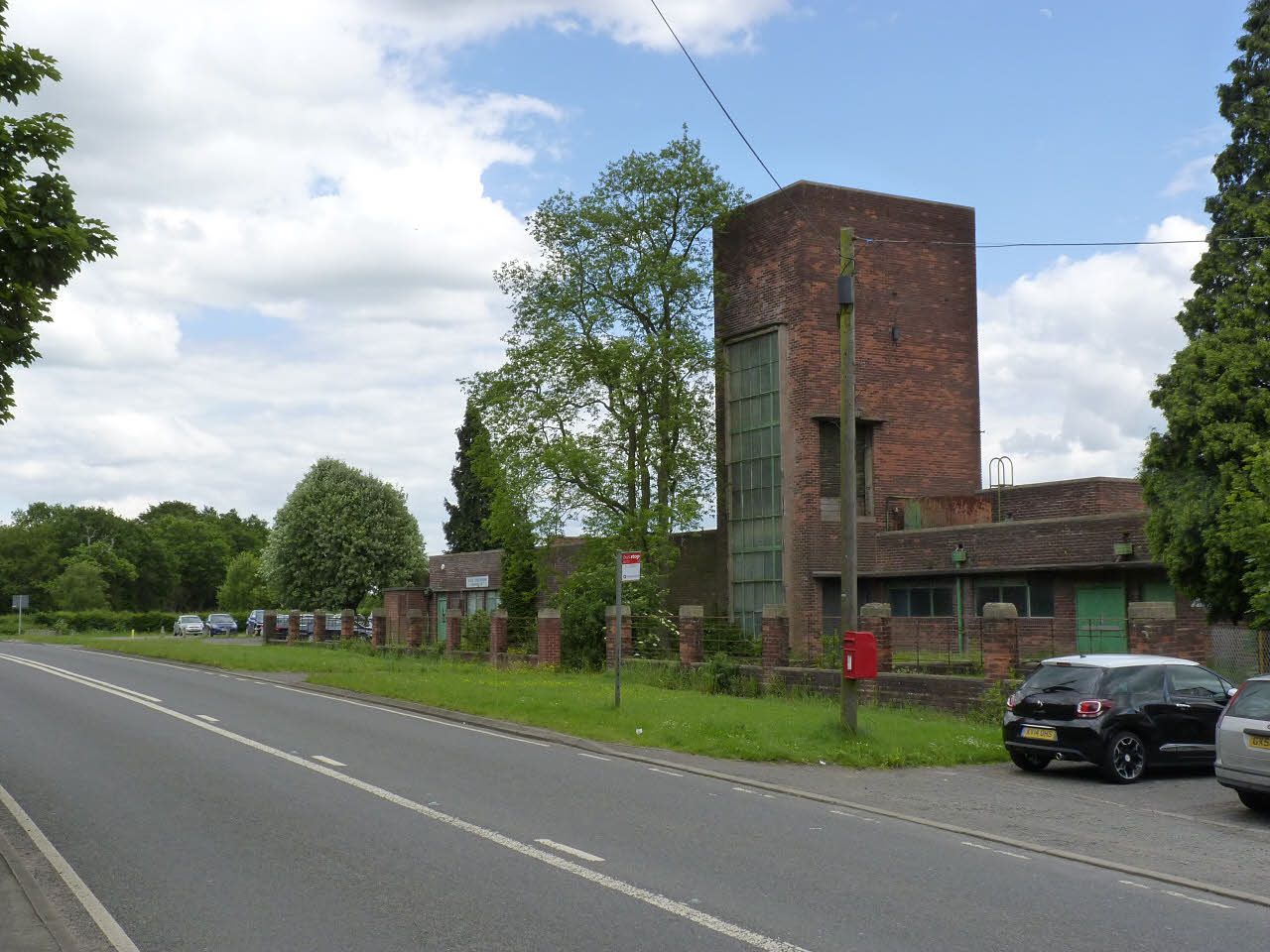
The shafts are filled and most of the plant was demolished, but the 1938 pithead baths survive on the far side of Coleshill Road and were photographed in June 2014. Part of the surface site continued in use as the NCB’s Area Workshop and Stores after the colliery closed. Ansley Hall Colliery was until recently counted as a separate settlement within Ansley civil parish.
The former pithead baths on Coleshill Road, and the Victorian colliery housing at Ansley Common built for the workforce.
Related mines
- Haunchwood Colliery — An underground roadway linked the two collieries’ workings in 1959, and when Ansley Hall stopped producing two of its districts were assigned to Haunchwood and drawn up the Tunnel shaft.
Nearby mines
- Nuneaton Colliery — 2.5 miles (4.0 km) SE
- Haunchwood Colliery — 2.7 miles (4.3 km) E
- Baddesley Colliery — 2.8 miles (4.5 km) NW
- Midland Quarry — 2.9 miles (4.7 km) E
- Arley Colliery — 3.6 miles (5.9 km) SW
Straight-line distance, within 9 miles (15 km). Show on the map.
What's uncertain
Points where sources disagree or the record could not be settled; both accounts are kept. All open questions in the archive.
- Our Warwickshire’s article on this colliery has it scheduled for phased closure in 1959; its article on Haunchwood says Ansley Hall closed for production in 1964, when two of its underground districts were assigned to Haunchwood. (disputed) 3,2
Recorded claims
Individual factual claims, each attached to the source(s) that support it below. Where sources disagree, both are kept.
- The official list of collieries at work in 1880 returns the pit as "Ansley Nos. 1, 2, 3, Atherstone, Ansley Hall Colliery Co." 1
- Ansley Hall Colliery was sunk in 1874 by William Garside Philips of Oldbury Grange and had three shafts: one 13 ft in diameter and 168 yards deep, a second 13 ft 6 in and 140 yards, and a third of only 8 ft intended as a furnace shaft to ventilate the mine. 2
- For its first nine years the colliery worked the Two Yard and Bare coals; by 1882 it had exhausted them and would have closed but for working coal from down the dip using inclined headings, with level roadways driven out either side. 2
- Garside Philips bought Ansley Hall and its estate in the colliery’s name in 1892, after John Beaumont Ludford-Astley refused to lease further mineral rights and offered the estate for sale, in order to secure the minerals and stop another proprietor sinking a colliery on the site. 2
- From 1955 an industry-wide manpower shortage brought experienced miners from declining coalfields elsewhere and men of stateless nationality from the refugee camps in Germany; the shortage persisted, all available men were put on productive facework rather than roadway repair, and the underground roadways deteriorated. 2
- Our Warwickshire’s article on this colliery has it scheduled for phased closure in 1959; its article on Haunchwood says Ansley Hall closed for production in 1964, when two of its underground districts were assigned to Haunchwood. (disputed) 3,2
- The opening of Ansley Hall Colliery in the 1870s added a mining element to Atherstone’s population, some of the miners seeking lodgings in the town. 4
- The BGS mine-plans catalogue holds a Mining Remediation Authority abandonment plan titled 'Ansley Hall' (catalogue WM129, Two Yard, dated 1957). 5
Photographs & further reading
Warwickshire County Council’s account, drawing on Fretwell’s chapter in The Warwickshire Coalfield: the three shafts and their dimensions, the exhaustion of 1882 and the inclined headings that answered it, the 1892 purchase of the estate, and the post-war labour shortage that finished the pit.
View sourceSources
- (secondary) List of coal mines UK 1880 — Coalmining History Resource Centre
- (secondary) Ansley Hall Colliery — Our Warwickshire, Warwickshire County Council
- (secondary) Haunchwood Colliery — Our Warwickshire, Warwickshire County Council
- (primary) Parishes: Ansley — A History of the County of Warwick, Volume 4 — Victoria County History, via British History Online
- (primary) BGS / Mining Remediation Authority mine plans: ANSLEY HALL — British Geological Survey / Mining Remediation Authority
- (observational) Ansley Hall and Ansley Hall Colliery — shared description — Geograph Britain and Ireland
Record created: 6 September 2026 · Last researched: 6 September 2026