 MineArchive
Bolehill Quarry
| Also known as | Bole Hill Quarry, Bolehill Millstone Quarry |
|---|---|
| Location | Bole Hill, above Grindleford, Longshaw, Derbyshire — 53.3141, -1.6285 (exact) |
| Commodity | Sandstone |
| Type | Quarry |
| Worked | 600–c. 1914 (dam contract) |
| Maximum depth | Open quarrying on the edge; no shaft depth applies. |
| Operators | Benjamin Bradley (1901–?) |
Overview
A gritstone quarry above Grindleford which had made millstones, grindstones and crushing stones for over six hundred years, and was given a new and short life by the Derwent Valley Water Act of 1901. It supplied the stone for the Howden and Derwent dams: an estimated 1.25 million tons were taken out of a reserve reckoned at 2.4 million tons of high-quality silica gritstone, sent down a steep incline to the railway west of Grindleford station and on through Bamford to the dams. The quarrymen lived in tin huts, ten to a hut with a hutkeeper and his family, and struck for higher pay in 1904.
History
Bole Hill was chosen for quarrying because of the quality of its rock, and millstones, grindstones and crushing stones were made there for over six hundred years. What transformed it was a public works scheme: the Derwent Valley Water Act of 1901 committed to building the Howden and Derwent dams, and Bole Hill was given a lease of life as the source of their stone. An estimated 1.25 million tons were removed from a reserve estimated at 2.4 million tons of high-quality silica gritstone. The workforce lived on site in tin huts, each housing a hutkeeper, his family and ten quarrymen, with a recreation room and a library. Hutkeepers were responsible for good order, and did not always achieve it — the quarry manager Benjamin Bradley wrote in 1905 that "if there is any more of the rowdyism the hutkeeper will have to give up the possession of the hut, as I am determined not to have any more of it." Men worked between eight and ten hours a day depending on the season and the daylight. When hours were shortened meal breaks were shortened too, though instructions were given that "young persons under eighteen years of age must have their full meal breaks". The work was dangerous and the record of it is plain: several young people were crushed by heavy lifting equipment or hit by runaway train carriages. When fourteen-year-old Charles was crushed by a counterbalance from a crane, the Sheffield Daily Telegraph of 4 July 1904 reported that "the boy’s father saw the accident and fainted at the dreadful sight". In 1904 the workers went on strike for higher pay. When the dams were built the quarry’s purpose was gone.
Geology
Millstone Grit on the eastern edges of the Peak — the coarse siliceous sandstone that gave the formation its name, because for six centuries this is what it was used for. The stone at Bole Hill was described as high-quality silica gritstone, hard and abrasive, which is exactly what suits a millstone and also what suits the facing of a masonry dam.
Workings
Open quarrying along the edge, with an internal railway system and cranes; the broad flat tracks where the rails were laid are still visible. The stone left by a steep incline down to the main railway line just west of Grindleford station, and went from there through Bamford and up the Derwent valley to the dam sites. The quarry ran as a self-contained industrial community, its workers housed on the hill in tin huts.
Closure
Bolehill was reopened for a contract and closed when the contract ended. The Howden and Derwent dams were built; the quarry had no other market at that scale, and the millstone trade it had lived on for six centuries was long gone.
What remains
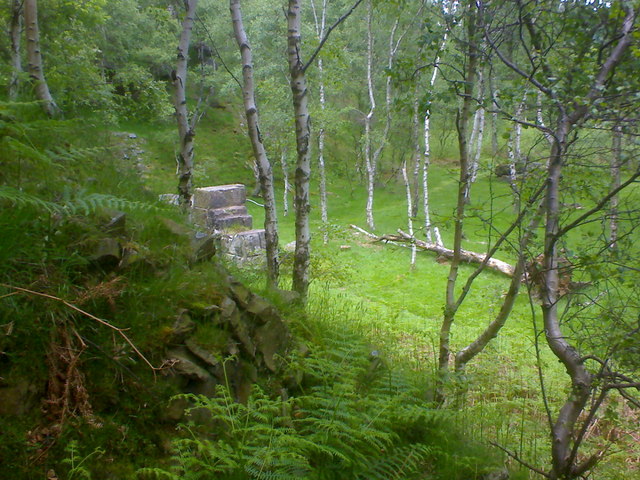
A quiet corner of the National Trust’s Longshaw estate, covered in silver birch and valued for wildlife. Remnants of the quarry’s infrastructure survive — buildings, stone features, abandoned millstones and the flat tracks of the railways — and it is a popular site for walkers and for climbers.
Abandoned millstones, quarry buildings and stone features, the graded tracks of the internal railways, and the formation of the incline down to the Grindleford line.
Nearby mines
- Froggatt Wood Smelt Mill — 1.6 miles (2.5 km) S
- Ladywash Mine — 2.5 miles (4.0 km) SW
- Little Brookhead Mine — 2.5 miles (4.0 km) SW
- Merlin Mine — 2.5 miles (4.1 km) SW
- Glebe Mine — 2.7 miles (4.4 km) SW
Straight-line distance, within 9 miles (15 km). Show on the map.
Recorded claims
Individual factual claims, each attached to the source(s) that support it below. Where sources disagree, both are kept.
- Bole Hill was chosen for quarrying due to the quality of the rock, and millstones, grindstones and crushing stones were made here for over 600 years. 1
- The quarry was given a lease of life in 1901 with the passing of the Derwent Valley Water Act and the commitment to construct the Howden and Derwent Dams. It is estimated that 1.25 million tons of stone were removed from an estimated 2.4 million tons of high quality silica gritstone. 1
- The steep incline leading down to the railway line just west of Grindleford Station was constructed to transport rock away from the quarry, through Bamford and up to the dams; the broad, flat tracks where the railways were laid can still be seen. 1
- Quarry workers lived in tin huts, each of which housed a hutkeeper, his family and ten quarrymen, along with a recreation room and library. Hutkeepers were responsible for keeping their huts in good order. 1
- The quarrymen worked between eight and ten hours a day depending on the time of year and the hours of daylight. When working hours were shortened, meal breaks were also shorter, although instructions were given that "young persons under eighteen years of age must have their full meal breaks". 1
- Many incidents were reported, including several young people being crushed by heavy lifting equipment or hit by runaway train carriages. When 14-year-old Charles was crushed by a counterbalance from a crane, the Sheffield Daily Telegraph reported on 4 July 1904 that "the boy’s father saw the accident and fainted at the dreadful sight". 1
- Bole Hill is now a quiet corner of Longshaw covered by silver birch trees and a haven for wildlife, popular with walkers, with remnants of the quarry’s infrastructure such as old buildings and stone features still visible. 1
Photographs & further reading
The quarry as a working community: the dam contract that reopened it, the tin huts and their hutkeepers, the hours and meal breaks, the accidents to young workers, and the 1904 strike — researched from Derbyshire Record Office material.
View sourceSources
- (secondary) The history of Bole Hill at Longshaw — National Trust
- (secondary) Howden Reservoir — Wikipedia
Record created: 8 September 2026 · Last researched: 8 September 2026