 MineArchive
Ladywash Mine
| Location | Eyam, Derbyshire — 53.2850, -1.6650 (approximate) |
|---|---|
| Commodities | Lead, Fluorspar |
| Type | Metal |
| Worked | 1714–1979 |
| Maximum depth | 721 feet (fluorspar-era shaft) |
| Operators | Eyam Mining Company (1870–1890), Glebe Mines Ltd (1936–1959) |
Overview
Ladywash, on the moor above the plague village of Eyam, was worked twice over for two entirely different commodities two centuries apart — first for lead from the 1740s, then, once lead itself was no longer worth the effort, reopened in the 1930s to feed Britain's steel industry with fluorspar instead.
History
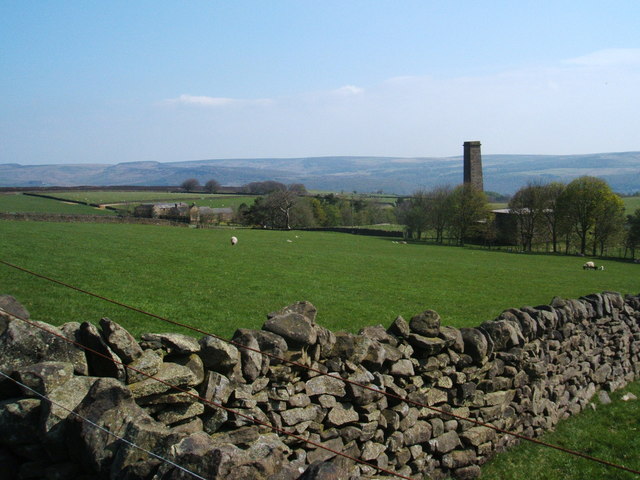
A drainage sough to Old Ladywash was begun in 1714, and the mine itself started in 1740, working westward along one of the Hucklow Edge veins that ran beneath Eyam Moor — one of a large number of lead mines worked along the same vein system. Further drainage came from the Stoke sough, begun in 1755 and reaching the mine by 1770. The well-preserved chimney surviving on the site today dates from around 1870, when the Eyam Mining Co. was working the mine for lead; by the 1890s, however, falling lead prices and the constant struggle against flooding had brought lead mining at Ladywash to a virtual standstill. The mine was bought by Glebe Mines Ltd in 1936 and reworked from the early 1950s for fluorspar, used as a flux in steelmaking, with the ore processed nearby at Cavendish Mill; Glebe Mines was itself taken over by Laporte Minerals in 1959. Fluorspar working continued until 1979, when in-vein sub-level stoping methods had become unsafe, and the mine had become uneconomic to run from its 721-foot shaft, which had only a one-tonne winding capacity.
Geology
The mine worked the Hucklow Edge vein system of the Derbyshire orefield, a hydrothermal, non-magmatic mineralised system distinct from the granite-related lodes of Cornwall and Devon, yielding both lead ore and, in its later working, fluorspar.
Geological setting: Hydrothermal Deposits (well documented example), Veins and Lodes (well documented example)
Workings
The mine was drained first by the 1714 Old Ladywash sough and later by the Stoke sough, reaching Ladywash by 1770; its later fluorspar working was hoisted via a 721-foot shaft with only a one-tonne winding capacity, a limitation that contributed to the mine's eventual closure.
Closure
Fluorspar working ended in 1979, once in-vein sub-level stoping methods had become unsafe and the mine's limited winding capacity had made it uneconomic to continue.
What remains
The chimney standing on the site, well preserved, dates from around 1870.
A well-preserved chimney, dating from around 1870, survives on the site.
Related mines
- Glebe Mine — Ladywash was reworked for fluorspar by Glebe Mines Ltd, the company that grew out of this site, and both mines had earlier been worked for lead by the Eyam Mining Company.
Nearby mines
- Little Brookhead Mine — 0.1 miles (0.2 km) NW
- Glebe Mine — 0.3 miles (0.5 km) W
- Sallet Hole Mine — 0.4 miles (0.6 km) SW
- Nickergrove Mine — 0.6 miles (1.0 km) SW
- Merlin Mine — 1.0 miles (1.7 km) NW
Straight-line distance, within 9 miles (15 km). Show on the map.
What's uncertain
Points where sources disagree or the record could not be settled; both accounts are kept. All open questions in the archive.
- A 2024 exploration report states that management informed the workforce in February 1979 that Ladywash was to close, citing falling world fluorspar prices alongside rising costs 'in light of recent fatalities which led to the need for increased investment in health and safety' — no further detail on these fatalities (names, dates or number) is recorded. (uncertain) 2
Recorded claims
Individual factual claims, each attached to the source(s) that support it below. Where sources disagree, both are kept.
- A drainage sough to Old Ladywash began in 1714, and the mine started in 1740; a further sough from Stoke, begun in 1755, reached the mine by 1770. 1
- Fluorspar working ended in 1979, once in-vein sub-level stoping methods had become unsafe and the mine's 721-foot shaft, with only a one-tonne winding capacity, had become uneconomic. 1
- A 2024 exploration report states that management informed the workforce in February 1979 that Ladywash was to close, citing falling world fluorspar prices alongside rising costs 'in light of recent fatalities which led to the need for increased investment in health and safety' — no further detail on these fatalities (names, dates or number) is recorded. (uncertain) 2
Photographs & further reading
An April 2024 surface visit to the mine above Eyam, with the fullest history of the four linked here: the 1714 sough to Old Ladywash, the mine proper from 1740, the chimney of about 1870 from the Eyam Mining Co's lead working, the switch to fluorspar for the steel industry under Glebe Mines from 1936, 104 fathoms deep by 1949, and the 1979 closure decision taken on price and cost rather than exhausted reserves.
View sourceSources
- (secondary) Mines and minerals in Derbyshire (UK): Ladywash Mine — Mines and Minerals in Derbyshire
- (observational) Ladywash Mine (surface), Derbyshire, April 2024 — 28DaysLater Urban Exploring Forums
- (primary) Ladywash Mine mine plan — British Geological Survey / Chatsworth Estate
Record created: 24 August 2026 · Last researched: 24 August 2026