 MineArchive
Flagstone
| Category | Commodities |
|---|---|
| Commodity page | Flagstone → |
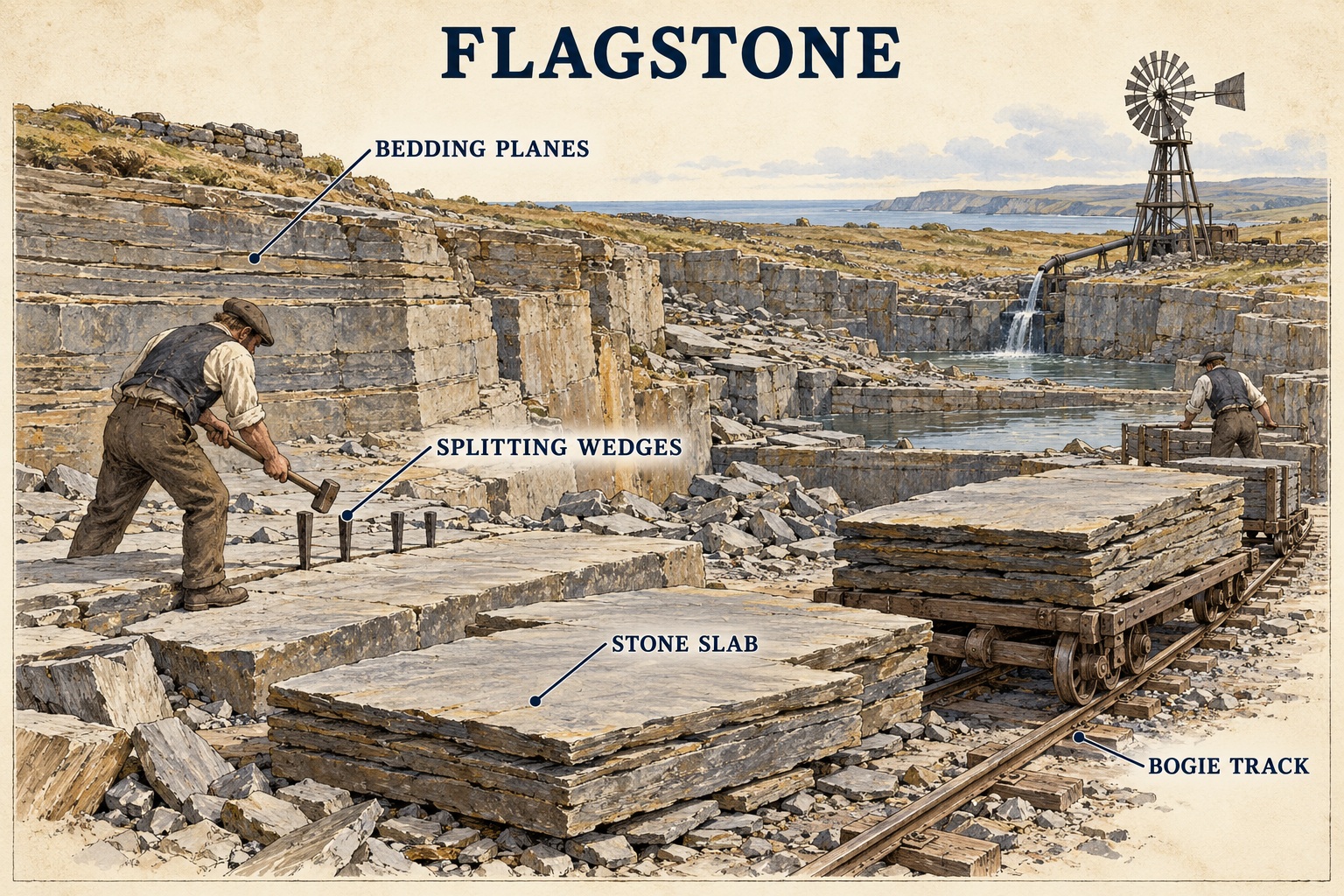
A thinly bedded siltstone or fine sandstone that splits naturally along parallel bedding planes into flat, durable slabs.
Historical usage
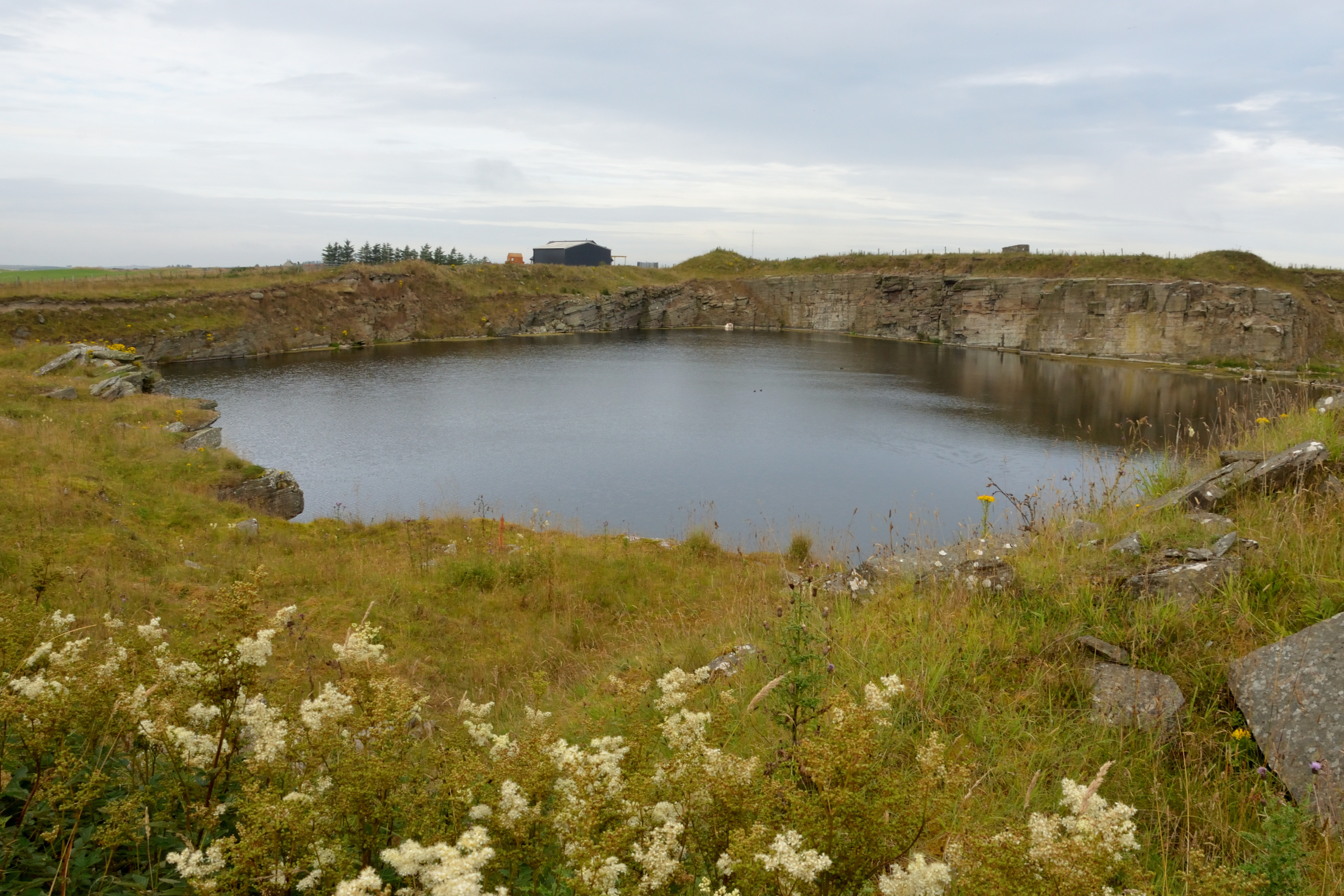
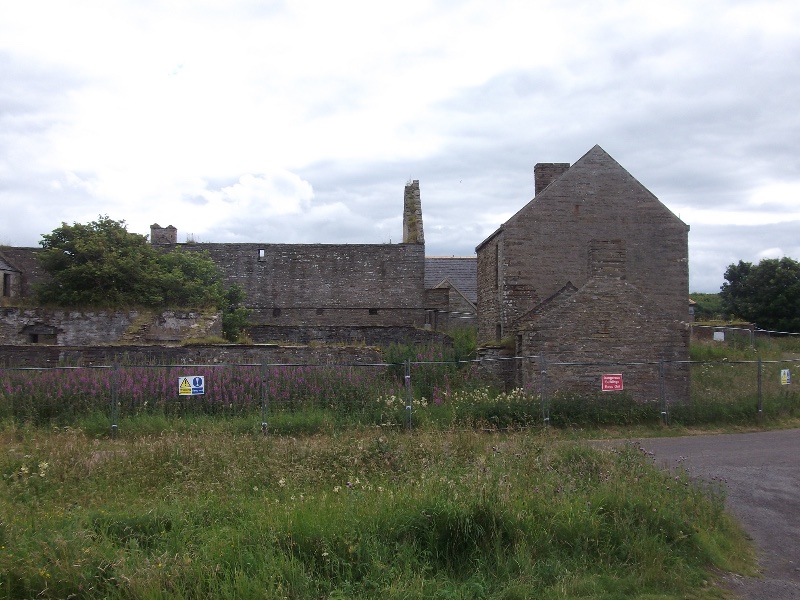
The Caithness and Orkney flagstones formed around 370-387 million years ago from mud and fine sand settling on the bed of Lake Orcadie during the Devonian. James Traill began commercial extraction in Caithness in 1758, using windmill-powered pumps to keep quarries workable, and by 1793 flagstone was already being shipped as far as Boston, USA. The industry peaked between the 1850s and 1920s: by 1902 Caithness alone was producing around 35,000 tonnes a year, employing over 1,000 workers across eleven major quarries, with dedicated harbours built at Castlehill and Harrow specifically to export it worldwide -- including, notably, to the Fray Bentos meat-packing works in Uruguay. Cheap mass-produced concrete paving displaced flagstone through the early 20th century and the industry contracted sharply, though quarrying resumed on a smaller scale from 1949 at Spittal, which remains active today. James Traill of Rattar, Sheriff of Caithness, built the harbour at Castlehill in 1820 and shipped the first cargo in April 1825; regular shipments to ports all over Britain followed, and cargoes went on to Europe and to North and South America. The stone paved the Strand and the London Docks and floored the concourse of Euston, and Caithness flag was quarried at more than seven hundred sites. Castletown's hundred flagstone workers of 1825 had grown to five hundred by 1902, when output reached 35,000 tons, and at the industry's height over a thousand men worked in it, an output second in Scotland only to Aberdeen granite. England's great flagstone is the Elland Flags of the Lower Coal Measures around Halifax, Elland, Brighouse and Hipperholme, quarried since the twelfth century, mined from drifts by 1850 and from shafts in the Hipperholme district for nearly a century after, with at least forty quarries at work in 1900 supplying paving to Halifax, Leeds, Bradford and London; the Yorkshire Dales flags of Burtersett and Cragg End served the same trade from underground.
How it worked
The stone was split rather than cut: wedges driven into the bedding plane lifted a flag whole, and the sheet was then trimmed to size and, for the finest work, dressed. In Caithness the quarries were shallow and wet, kept workable by windmill-driven pumps in Traill's day, and bogie tracks ran from quarries such as Weydale down to the harbours at Castlehill and Thurso. In Yorkshire the flag beds were followed underground by drift and by shaft.
Why it was used
Its flatness, its density and its resistance to wear: a stone that arrived already in slabs needed little dressing, and Caithness flag in particular took the traffic of a London street for decades.
Value over time
Flagstone's value lay in its ready-made flatness: because it split naturally into usable slabs along its own bedding planes, it needed far less dressing than a stone that had to be sawn to shape, keeping it competitive as a paving material despite the cost of shipping it worldwide by sea. That advantage disappeared once cheap, locally pourable concrete paving became widely available in the early 20th century, and the industry never recovered its earlier scale even after reviving in 1949. Concrete ended it. By the First World War Caithness output had fallen to about 5,000 tons a year, and in the 1920s most of the quarries closed as concrete pavements and paving blocks came into the towns; by 1939 flag cost 12s 6d a square yard in Edinburgh against 4s 6d for a non-slip concrete block of the same size. A small revival came later, with diamond saws in place of wedges, and Caithness flag is quarried again today for the heritage and paving trade.
Hazards & challenges
No hazard specific to flagstone itself is well documented; the generic risk of any hard-rock quarrying and dressing is airborne silica dust, carrying a risk of silicosis without proper dust control.
Risks & limitations
A product whose whole advantage was cheapness of dressing could not survive a rival that needed none; and a stone quarried at the far north of Scotland or in the Pennines paid freight to every market it reached.
Regional variation
Caithness and Orkney flag is Devonian lake sediment of the Orcadian Basin; the Elland Flags and their Pennine relations (Rough Rock Flags, Woodhouse Flags and the rest) are Carboniferous sandstones of the Coal Measures and Millstone Grit; the Yoredale flags of Wensleydale and Swaledale were mined rather than quarried.
Related terminology
Mines associated with this term
Included only where MineArchive's own research gives a reasonable evidential basis — not every mine where this might plausibly apply.
- Burtersett Flag Stone Mine — North Yorkshire (well documented example)
Named 3 times in this record, first in the summary: “…mine above Burtersett near Hawes, driven into the hillside to win flagstone from a sandstone bed between limestones. It employed fifty-four…” - Cragg End Flag Stone Mine — North Yorkshire (well documented example)
Named 6 times in this record, first in the summary: “Cragg End was a flagstone working in upper Arkengarthdale, a dale far better known for its…” - Stromness Flagstone Quarries — Orkney (well documented example)
Named 3 times in this record, first in the history: “The Stromness Flags take their name from the town they helped build: flagstone used to construct Stromness itself was quarried from the shore at…” - Stags Fell Quarries — North Yorkshire (well documented example)
Named 3 times in this record, first in the history: “…driven into the hillside. They produced split sandstone for roofing, flagstones and millstones: old maps show an opencast quarry here by 1854 and up…”
See every mine that worked flagstone →
Sources
- (primary) Caithness Flagstone — Building Stone Database Scotland — British Geological Survey
- (primary) Stromness Flagstone — Building Stone Database Scotland (British Geological Survey)
- (secondary) An Introduction to the Caithness Flagstone Industry (John Porter, 1982) — Scottish Society for Northern Studies
- (secondary) Elland flags — Engole
- (secondary) Flagstone heritage, Castletown — Undiscovered Scotland
- (secondary) History — A & D Sutherland Ltd
Record created: 27 August 2026 · Last researched: 8 September 2026