 MineArchive
Stromness Flagstone Quarries
| Location | Stromness, Orkney — 58.9630, -3.2970 (approximate) |
|---|---|
| Commodity | Flagstone |
| Type | Quarry |
| Worked | to Still active |
Overview
Devonian lakebed siltstones split so cleanly into flat, durable slabs that they paved and roofed Stromness itself, worked from numerous small quarries across West Mainland Orkney.
History
The Stromness Flags take their name from the town they helped build: flagstone used to construct Stromness itself was quarried from the shore at the Point of Ness nearby, and the same beds were worked in numerous small quarries across West Mainland Orkney for paving flags and roofing slates. The rock's fine, even bedding — laid down as mud and silt accumulated in a vast Devonian lake around 387 million years ago — let it be split into thin, tabular slabs ready-made for paving without heavy dressing. Today only the Quoyloo quarry remains active, though modern extraction yields fewer of the well-preserved fossil specimens the formation is also known for; historic flagstone from an old, reopened Orkney quarry has more recently been used to match existing paving during restoration work in Stromness itself. The shore quarries at the Point of Ness were known in the town simply as 'the quarries'. In the 1850s, once the Police Act let the town council raise a rate, Stromness laid flagstones in its streets. The British Geological Survey records Stromness Flagstone from numerous quarries in Orkney and several in Caithness; it is no longer quarried as building stone, though a sandstone variant is still extracted at one quarry.
Geology
The Stromness Flags are grey and black, thinly bedded and in part laminated dolomitic siltstones, shales and subordinate very fine sandstones, part of the Middle Old Red Sandstone sequence deposited in the ancient Orcadian Basin lake during the Devonian period. The sequence comprises more than fifty rhythmic cycles, each recording a lake-level change from deep, fish-rich water through shallow desiccating conditions to river-deltaic sediments, and includes the striking fossil algal reefs known as the 'Horse-tooth Stone' at Yesnaby.
Workings
Worked from numerous small quarries scattered across West Mainland, splitting the rock along its natural bedding planes into flat slabs requiring little further dressing.
Closure
Most of the historic small quarries have long fallen out of use; only the Quoyloo quarry remains active today.
What remains
The Quoyloo quarry remains active; the many smaller historic workings across West Mainland are disused.
Flagstone from these quarries survives widely in Stromness's own paving and building fabric, with historic stone periodically reused in restoration work.
Nearby mines
- Yesnaby Quarries — 4.6 miles (7.4 km) NW
Straight-line distance, within 9 miles (15 km). Show on the map.
Recorded claims
Individual factual claims, each attached to the source(s) that support it below. Where sources disagree, both are kept.
- Flagstone used to build Stromness itself came from the shore at the Point of Ness; the same beds were worked in numerous small quarries across West Mainland for paving and roofing. 1
- The Stromness Flags are dolomitic siltstones and shales laid down in the Orcadian Basin lake during the Devonian period, in over fifty rhythmic cycles recording lake-level change; only the Quoyloo quarry remains active today. 2
- Stromness Flagstone came from numerous quarries in Orkney and several in Caithness, used locally for masonry, paving and roofing; it is no longer quarried for building stone, though its Stromness Sandstone variant is extracted at one quarry. 1
- The Sandwick Fish Bed was worked in many small West Mainland quarries for paving flags and roofing slates; only the quarry at Quoyloo is still active. 2
- The flagstone to build Stromness came from the shore at the Point of Ness, an area called 'the quarries'; in the 1850s the town council used new rating powers to lay flagstones in the streets. 3
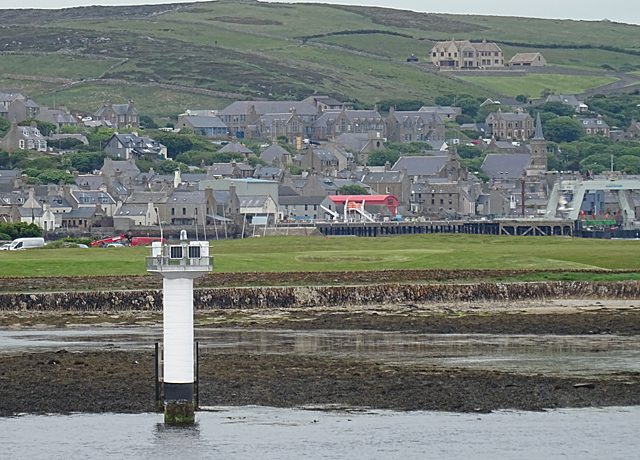
- A 2018 photograph shows the Point of Ness as a low grassy shore with a harbour light, Stromness behind. 4
Photographs & further reading
The British Geological Survey's record of the stone, its quarries, uses and historic significance.
View sourceGeological account of the Stromness Flags, their lake cycles, fish beds and quarrying.
View sourceHistory of the town, including the Point of Ness quarries that supplied its flagstone.
View sourceSources
- (primary) Stromness Flagstone — Building Stone Database Scotland (British Geological Survey)
- (primary) Middle Old Red Sandstone of Orkney, Stromness Flags — British Geological Survey (Earthwise)
- (secondary) A Brief History of Stromness in Orkney — NorthLink Ferries
- (observational) Point of Ness (Geograph photo 5811598, 2018) — Geograph Britain and Ireland
Record created: 27 August 2026 · Last researched: 16 September 2026