 MineArchive
Yesnaby Quarries
| Also known as | Old Millstone Quarry, Yesnaby, Yesnaby uranium prospect |
|---|---|
| Location | Yesnaby, west coast of Orkney Mainland, Orkney — 59.0230, -3.3520 (approximate) |
| Commodity | Freestone |
| Type | Quarry |
| Worked | to After 1945 |
Overview
A clifftop millstone quarry nearly wiped out by a tsunami generated by the 1755 Lisbon earthquake — and, two centuries later, the site of a discovery that briefly threatened to make Orkney a uranium-mining island, until the islanders themselves stopped it.
History
Yesnaby's exceptionally hard sandstone made it a natural place to quarry millstones, worked here for an unknown length of time before the industry's best-documented moment: in 1755 an earthquake near Lisbon sent a tsunami across the Atlantic that reached Orkney and very nearly destroyed the quarry, washing away tools, equipment and finished millstones, though without loss of life. Quarrying resumed afterwards and continued into the Second World War, when demand for millstones fell away and the industry declined; wartime coastal defence installations were also built in the area. Two centuries after the tsunami, Yesnaby found a very different kind of fame. In the early 1970s a UK Atomic Energy Authority survey identified a corridor of uranium-bearing rock running between Stromness and the Yesnaby cliffs, and in December 1976 the South of Scotland Electricity Board applied to sink eleven test boreholes in the area — two of them at Yesnaby itself, with others near Blackhall and the Mill of Cairston — to establish the size of the deposit. Rio Tinto Zinc also carried out prospecting nearby with the British Geological Survey. The proposal met near-universal local opposition, led by the Orkney Heritage Society, and in March 1977 Orkney Islands Council refused planning permission under a policy specifically barring uranium exploitation in the islands; a subsequent public inquiry recommended the scheme be abandoned. No uranium was ever extracted at Yesnaby, and no mine was ever built.
Geology
The quarried rock is part of the Stromness Flagstone Formation and the underlying Yesnaby Sandstone Group, hard, evenly bedded Devonian sandstones and flagstones deposited in the ancient Lake Orcadie — the same lake-bed sequence that gives Orkney and Caithness their building flagstone. The uranium found nearby occurs disseminated within the basal beds of the Stromness Flagstones as a low-grade placer-type concentration, formed as heavy minerals eroded from older metamorphic rocks were sorted and deposited by the ancient lake.
Geological setting: Sedimentary Beds and Seams (well documented example)
Workings
Millstones were cut directly from the exposed flagstone and sandstone beds at the clifftop and dressed on site before being moved for sale — a craft quarrying operation on a small scale rather than an industrial one. The 1970s uranium episode never went beyond exploratory diamond drilling: no shaft, adit or working mine was ever developed.
Closure
Millstone quarrying declined through lack of demand after the Second World War. The 1970s uranium prospect was stopped at the planning stage in 1977 and never resumed.
What remains
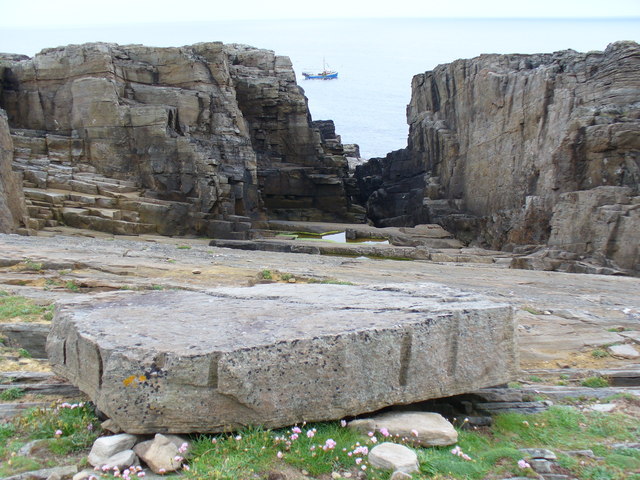
The old millstone quarry survives as an exposed, worked rock face on the clifftop, along with remains of wartime coastal installations nearby; both are readily visible from the coastal footpath. Nothing was ever built for the uranium prospect beyond the boreholes themselves, which leave no visible surface trace.
The worked quarry face and associated tool marks at the clifftop, and nearby wartime defence remains.
Redevelopment
None — the quarry and surrounding coast are open access countryside, part of a well-known coastal walking route.
Nearby mines
- Stromness Flagstone Quarries — 4.6 miles (7.4 km) SE
Straight-line distance, within 9 miles (15 km). Show on the map.
Recorded claims
Individual factual claims, each attached to the source(s) that support it below. Where sources disagree, both are kept.
- The quarried rock belongs to the Yesnaby Sandstone Group and Stromness Flagstone Formation, hard Devonian sandstones and flagstones deposited in the ancient Lake Orcadie. 1
- In 1755 a tsunami generated by the Lisbon earthquake reached Orkney and nearly destroyed the quarry, washing away tools, equipment and finished millstones without loss of life; quarrying resumed and continued until the Second World War. 1,2
- In the early 1970s a UK Atomic Energy Authority survey found uranium-bearing rock between Stromness and Yesnaby; in December 1976 the South of Scotland Electricity Board applied to sink eleven test boreholes at Yesnaby, Blackhall and the Mill of Cairston. 3
- Local opposition, led by the Orkney Heritage Society, was near-universal by 1977; Orkney Islands Council refused planning permission in March 1977 under a policy barring uranium exploitation, and a public inquiry recommended the scheme be abandoned. No uranium was ever extracted. 3,4
Sources
- (primary) Yesnaby and Gaulton Coast Section, Orkney — Geological Conservation Review / Scottish Geology Trust
- (secondary) Orkney Walks: Yesnaby — T'other Way — The Orkney News
- (primary) Orkney uranium and the planning process — International Atomic Energy Agency / INIS
- (secondary) Orkney's Uranium Protests — The Orkney News
Record created: 24 August 2026 · Last researched: 24 August 2026