 MineArchive
Flint
| Category | Commodities |
|---|---|
| Commodity page | Flint → |
A hard, fine-grained form of silica found as nodules in chalk, worked since prehistory by knapping it into sharp-edged tools, and later into gunflints for firearms.
Historical usage
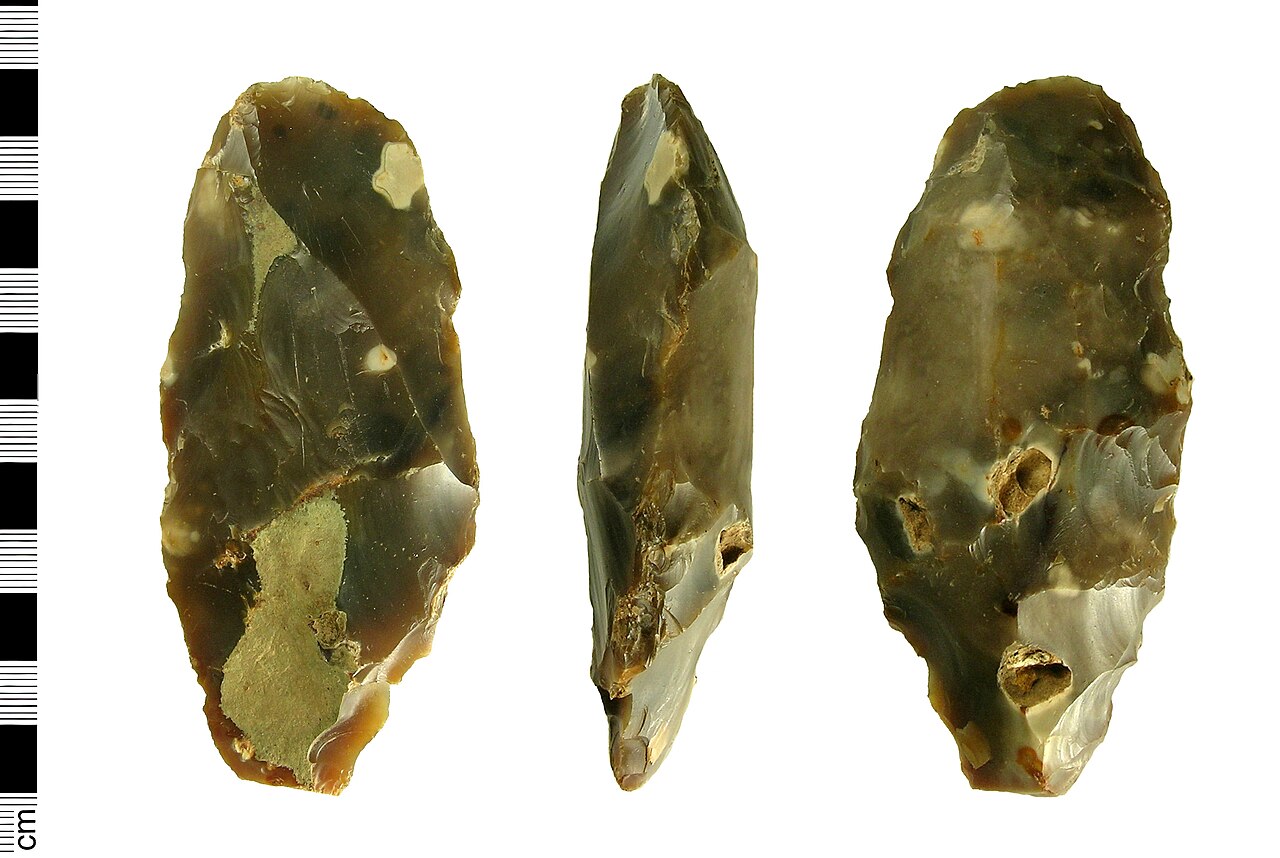
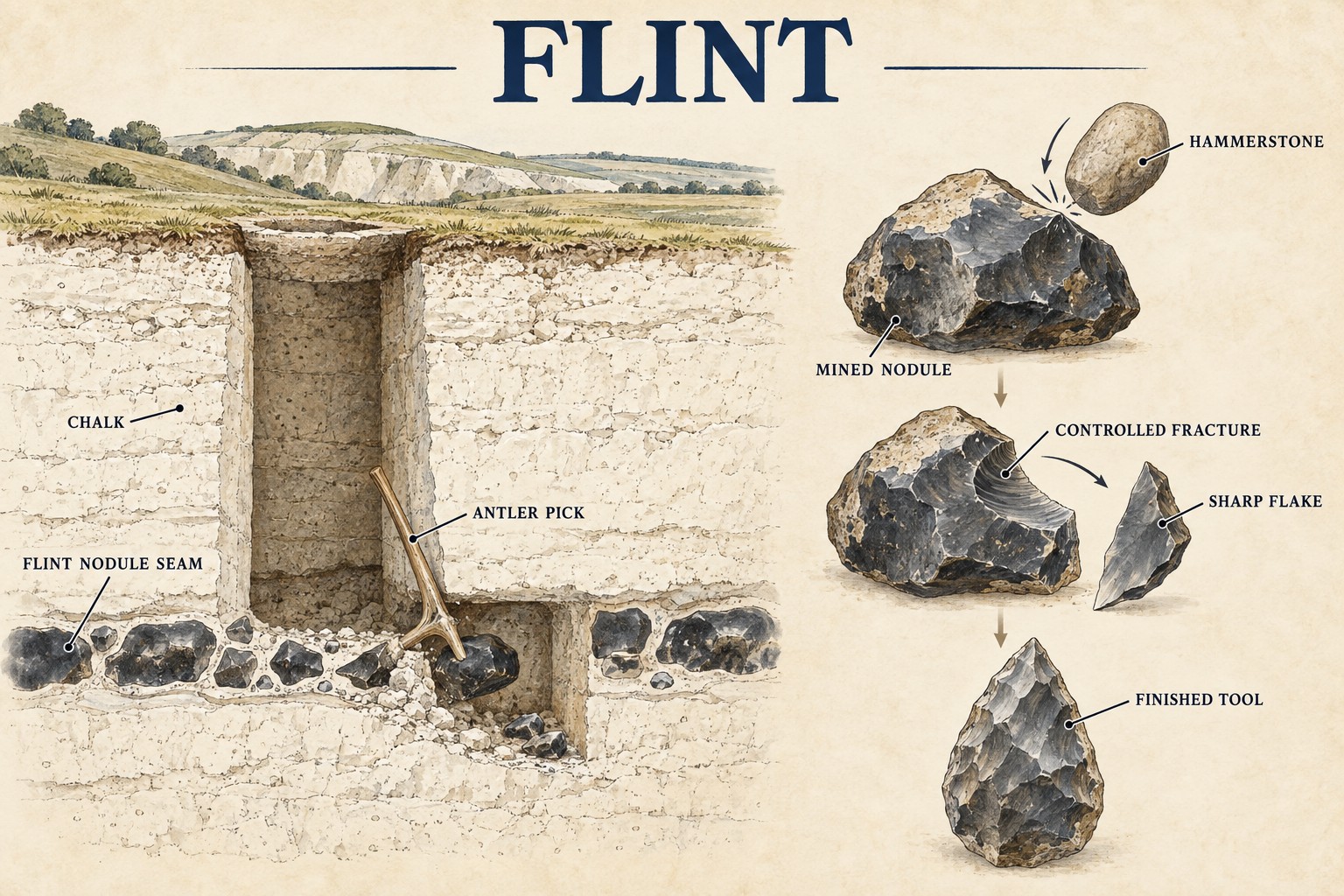
Flint was Britain's first mined commodity: Neolithic miners at sites like this site's own Grime's Graves sank shafts to reach seams of flint prized for axe-making, over 4,000 years before any metal was worked in these islands. The trade only really ended, in its industrial form, with the 20th-century decline of Brandon in Suffolk, the last major centre of English flint knapping, where the final professional knapper worked into the 1980s.
How it worked
A knapper strikes a flint nodule with a hammerstone or, later, a metal hammer, controlling the fracture to remove long, sharp-edged flakes; a skilled knapper can shape a nodule with real precision, producing a consistent, repeatable edge far sharper than most metals. Neolithic mine flint, sought specifically because it was more consistent and less weathered than surface-gathered nodules, had to be dug out with antler picks and hauled up shafts before knapping could even begin.
Why it was used
Before metal tools existed, flint's ability to be flaked into an extremely sharp, predictable edge made it indispensable for axes and other cutting tools, traded widely across prehistoric Britain. Millennia later, the same fracturing property made it ideal for flintlock gun mechanisms, where a precisely shaped flint struck against steel to throw the spark that fired the weapon — a technology that kept commercial flint knapping alive long after its original Stone Age purpose had vanished.
Value over time
Flint's commercial value shifted entirely with technology. Its prehistoric trade in worked axes collapsed millennia ago with the coming of bronze and then iron tools, but flint found an entirely new industrial market from the 18th century as the gunflint supplying Britain's flintlock muskets and pistols: in 1792 the whole English trade consolidated around Brandon, Suffolk, whose knappers developed a modified, much faster French-style technique and came to dominate gunflint supply worldwide. That market too was ultimately doomed by a change in technology — the percussion cap, and later cartridge ammunition, made the flintlock obsolete through the 19th century — and Brandon knapping survived afterward only on a small, specialist scale, mainly supplying flints for older weapons and reproduction firearms, until the industry finally died out with its last professional knapper in the 1980s.
Hazards & challenges
Flint knapping is now recognised as one of the oldest occupational diseases on record: fracturing flint releases extremely fine airborne silica dust, and generations of Brandon's gunflint knappers, working long hours in poorly ventilated workshops, suffered devastating rates of silicosis, locally known as 'knappers' rot'. It has been claimed that silicosis was responsible for the early death of three-quarters of Brandon's gunflint makers, and in one recorded workshop, seven of eight workmen died of the condition before the age of fifty. The underlying hazard goes back to the very earliest mining of any kind — silicosis itself takes its name from the Latin silex, meaning flint.
Regional variation
England's flint-knapping industry became overwhelmingly concentrated at Brandon in Suffolk, close to the ancient flint mines of Grime's Graves, rather than remaining spread across the many chalk regions where flint could be found.
Related terminology
Mines associated with this term
5 examples chosen from 9 linked records — the term page is not an index.
- Chislehurst Caves — Kent (well documented example)
Flint was worked here alongside the chalk — the two together in the same Kent workings, later famous as a wartime shelter for up to 15,000 people. - Blackpatch Flint Mines — West Sussex (well documented example)
Named 6 times in this record, first in the summary: “A Neolithic flint mine of at least 64 shafts on the south-west slope of Blackpatch…” - Brandon Flint Mines — Suffolk (well documented example)
Brandon's flint mines are a direct example of both the Neolithic mining tradition and the later gunflint industry this term describes. - Church Hill Flint Mines — West Sussex (well documented example)
Named 7 times in this record, first in the summary: “A Neolithic flint mine on Church Hill above Findon, one of a group of Sussex Downs…” - Emmer Green (Hanover) Chalk Mine — Berkshire (well documented example)
Named 3 times in this record, first in the geology: “…the Seaford Chalk Member — white, soft and nodular, with abundant flint seams — beneath the sandy clays of the Reading Beds, in modern terms…”
See every mine that worked flint →
Sources
- (primary) Knappers' rot: Silicosis in East Anglian flint-knappers — Medical History (PMC)
- (secondary) A History of Flint Knapping in Brandon, Suffolk — nosher.net
- (secondary) Brandon Flint Mine Pits — Breaking New Ground
Record created: 21 August 2026 · Last researched: 21 August 2026