 MineArchive
Church Hill Flint Mines
| Location | Church Hill, near Findon, West Sussex (about 3 miles north-west of Worthing; OS grid TQ 114 083), West Sussex — 50.8633, -0.4181 (approximate) |
|---|---|
| Commodity | Flint |
| Type | Mineral |
| Worked | Early Neolithic (c. 4300 BC)–No reliable closure date has yet been located. |
| Maximum depth | Surviving shafts 0.9 to 1.8 metres deep, reaching flint seams with galleries driven along them. |
Overview
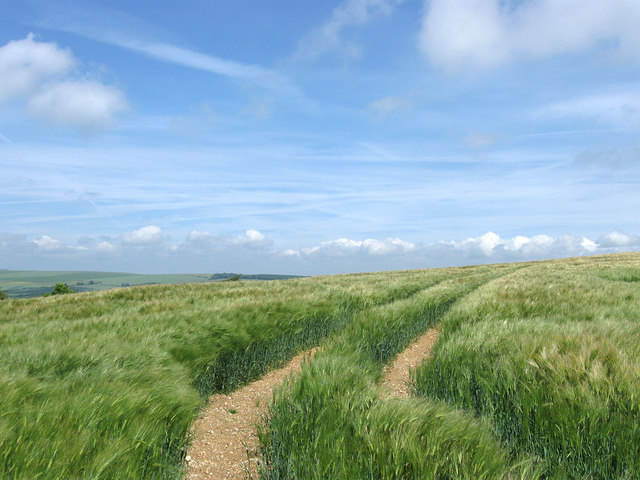
A Neolithic flint mine on Church Hill above Findon, one of a group of Sussex Downs mines with Cissbury, Blackpatch and Harrow Hill. About 36 shafts, now levelled by cultivation and visible only from the air, were sunk to reach seams of flint, with galleries running off along the seams. An antler pick from the workings has been radiocarbon-dated to about 4300 BC, among the earliest dates for flint mining in Britain.
History
Church Hill is a chalk hill on the South Downs near Findon, about 3 miles north-west of Worthing, carrying a group of roughly 36 infilled flint-mine shafts. Modern ploughing has levelled the ground, so the shafts now show only as crop marks on aerial photographs. The amateur archaeologist John Pull excavated six shafts here, across two campaigns in the 1930s and 1940s, and further investigation followed in 1984-86. The shafts, surviving 0.9 to 1.8 metres deep, reached seams of flint from which horizontal galleries were driven. Pottery at the shaft bottoms dated from the Late Neolithic and the Early to Middle Bronze Age, and an antler pick was radiocarbon-dated to about 4300 BC. Several pictograms, or engraved designs, were found above the entrances to the galleries and on their roofs, and the traces of a circular timber building were identified among the shafts. A Late Neolithic to Early Bronze Age cremation in a beaker-style urn had been placed in the upper face of one shaft. In the south-east of the mining area a bowl barrow, also levelled by cultivation, stands partly over an infilled shaft. Recorded as a circular mound about 15.5 metres across, it yielded a beaker with a cremation and two flint axes, marking the site's continued use into the Beaker period. The monument was scheduled in 1935.
Geology
Shafts sunk through the chalk of the South Downs to reach seams of flint, worked along the seams by radiating galleries.
Workings
About 36 infilled shafts, levelled by cultivation and visible as crop marks from the air, with galleries along the flint seams; the traces of a circular timber building lie among them.
Closure
Unknown. Pottery at the shaft bottoms reaches the Early-Middle Bronze Age, but no date for the end of mining is recorded.
What remains
Levelled by modern ploughing; the shafts survive as buried features visible only on aerial photographs. A scheduled monument.
No upstanding shafts; a largely levelled bowl barrow lies in the south-east of the mining area.
Redevelopment
None; the hill is under cultivation.
Related mines
- Blackpatch Flint Mines — Neighbouring Sussex Downs flint mines, both excavated by John Pull.
- Cissbury Flint Mines — Neighbouring Sussex Downs flint mines, both excavated by John Pull.
- Harrow Hill Flint Mines — Neighbouring Neolithic flint mines on the Sussex Downs, about 3.5 km apart.
Nearby mines
- Blackpatch Flint Mines — 2.1 km W
- Cissbury Flint Mines — 2.5 km E
- Harrow Hill Flint Mines — 3.6 km NW
- Amberley Chalk Pits — 9.2 km NW
Straight-line distance, within 15 km. Show on the map.
Recorded claims
Individual factual claims, each attached to the source(s) that support it below. Where sources disagree, both are kept.
- The mine is a group of about 36 infilled shafts, levelled by cultivation and visible as crop marks on aerial photographs, with galleries driven along the flint seams. 1,2
- John Pull excavated six shafts in the 1930s and 1940s, and further investigation followed in 1984-86. 1,2
- An antler pick from the shafts was radiocarbon-dated to about 4300 BC, and pottery at the shaft bottoms ranged from the Late Neolithic to the Early-Middle Bronze Age. 1,2
- Pictograms or engraved designs were found above the gallery entrances and on the gallery roofs, and a cremation in a beaker-style urn had been set in the upper face of one shaft. 2
- A bowl barrow about 15.5 metres across, now levelled, stands partly over an infilled shaft and held a beaker with a cremation and two flint axes. 1,2
- The flint mine and bowl barrow were scheduled in 1935 (National Heritage List 1015238). 2
Photographs & further reading
The official scheduling for the Church Hill flint mine and bowl barrow.
View sourceSources
- (secondary) Church Hill, West Sussex — Wikipedia
- (primary) Flint mine and a bowl barrow on Church Hill, 400m south west of Findon Place (National Heritage List 1015238) — Historic England, National Heritage List for England (reproduced by ancientmonuments.uk)
Record created: 21 September 2026 · Last researched: 22 September 2026