 MineArchive
Cissbury Flint Mines
| Also known as | Cissbury Ring flint mines |
|---|---|
| Location | Cissbury Ring, Findon, north of Worthing, West Sussex — 50.8598, -0.3825 (approximate) |
| Commodity | Flint |
| Type | Mineral |
| Worked | Early Neolithic (c. 3700 BC)–No reliable closure date has yet been located. |
| Maximum depth | About 12 metres (40 ft). |
Overview
One of the earliest and largest Neolithic flint mines in Britain, at least 270 shafts sunk through the chalk of a Sussex Downs spur north of Worthing to reach seams of flint for axes, later partly buried under the ramparts of the Iron Age hillfort of Cissbury Ring.
History
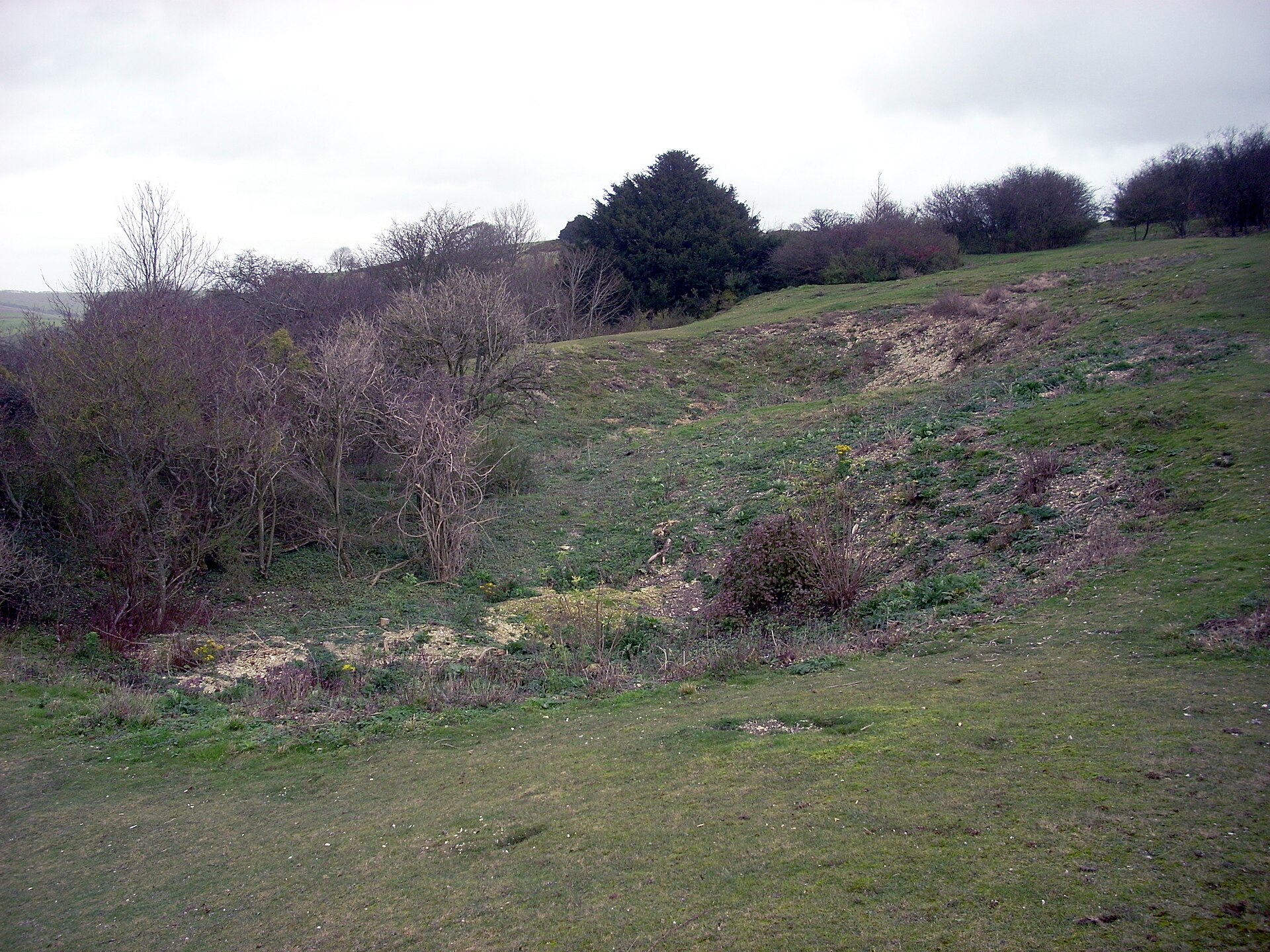
Long before Cissbury Ring was fortified, Neolithic miners sank shafts into the chalk of the hill to reach its seams of flint, digging with antler picks and driving horizontal galleries out from the shaft bottoms to follow the seams. Some shafts went down about 12 metres, and up to eight galleries radiated from a single shaft, often joining those of its neighbours. The flint was made into axes and blades on the spot, the axes leaving as rough-outs to be finished and traded, and Cissbury flint has been found as far away as Italy. It is one of a group of Sussex flint mines, with the slightly older Harrow Hill nearby, and marks the move from gathering flint near the surface to deep shaft mining for better stone. The workings spread over the south-western part of the hilltop and down the slopes to the south and west; around 400 BC the builders of the hillfort cut across them, and later cultivation, a Napoleonic infantry post and a Second World War anti-aircraft battery disturbed them further. Augustus Lane-Fox, later General Pitt-Rivers, excavated part of the ring in 1867-68. Human remains have come from three shafts: a man and a woman found in the 19th century, and a young woman found by John Pull in the 1950s at the foot of a shaft, once taken for a miner killed by a collapse and since radiocarbon dated to about 3700 BC; the burials have also been read as deliberate use of worked-out mines for burial. The site was scheduled in 1933 and is owned by the National Trust.
Geology
Upper Chalk of the South Downs, capped by clay-with-flints, worked for its horizontal seams of flint nodules.
Workings
At least 270 shafts, surviving as roughly circular hollows 3 to 36 metres across and up to 3 metres deep, with galleries radiating from the shaft bottoms along the flint seams, surrounded by spoil heaps up to about 3.5 metres high and smaller mounds and hollows marking flint-working floors.
Closure
Mining is thought to have ended in the late Neolithic, though worked flint was reused later.
What remains
The shafts survive as hollows and spoil mounds over the south-western part of the hillfort and the slopes below it, partly disturbed by the hillfort, later ploughing and illicit metal detecting.
Infilled shaft hollows, spoil heaps and flint-working areas, with struck flint flakes around some shaft heads.
Redevelopment
None; the hill is a scheduled monument and Site of Special Scientific Interest owned by the National Trust.
Related mines
- Blackpatch Flint Mines — Neighbouring Neolithic flint mines on the Sussex Downs above Worthing, both excavated by John Pull.
- Grime's Graves — Both Neolithic flint mines worked with antler picks from shafts and radiating galleries.
Nearby mines
- Blackpatch Flint Mines — 4.6 km W
- Amberley Chalk Pits — 11.7 km W
Straight-line distance, within 15 km. Show on the map.
What's uncertain
Points where sources disagree or the record could not be settled; both accounts are kept. All open questions in the archive.
- Wikipedia gives the period of use as both around 300 years and around 900 years in different sections. (disputed) 2
Recorded claims
Individual factual claims, each attached to the source(s) that support it below. Where sources disagree, both are kept.
- The Neolithic flint mine survives as at least 270 roughly circular hollows 3m to 36m in diameter and up to 3m deep, the partly infilled remains of shafts; excavation showed horizontal galleries radiating from the shafts to follow the flint seams. 1
- Around 270 shafts were dug, up to 12 metres deep and 7 metres across at the surface, with up to eight galleries extending from the bottoms, often interconnecting. 2
- Wikipedia gives the period of use as both around 300 years and around 900 years in different sections. (disputed) 2
- The flint mine ranges over the south-western part of the hillfort and down the slope to the south and west, and was partly disturbed by the hillfort's construction (c.400 BC) and later uses. 1
- John Pull's excavation in the 1950s found the remains of a young woman, radiocarbon dated to c.3700 BC; a man and a woman were recovered from other shafts in the 19th century. 2
- Scheduled 23 February 1933, amended 31 January 1997 (NHLE 1015817). 1
Photographs & further reading
The scheduling entry describing the flint mine shafts, the hillfort and the later remains on the hill.
View sourceSources
- (primary) Cissbury Ring hillfort, prehistoric flint mine and associated remains (NHLE 1015817), scheduling text as reproduced by AncientMonuments.uk — Historic England, via AncientMonuments.uk
- (secondary) Cissbury Ring — Wikipedia
Record created: 21 September 2026 · Last researched: 21 September 2026