 MineArchive
Chert
| Category | Commodities |
|---|---|
| Commodity page | Chert → |
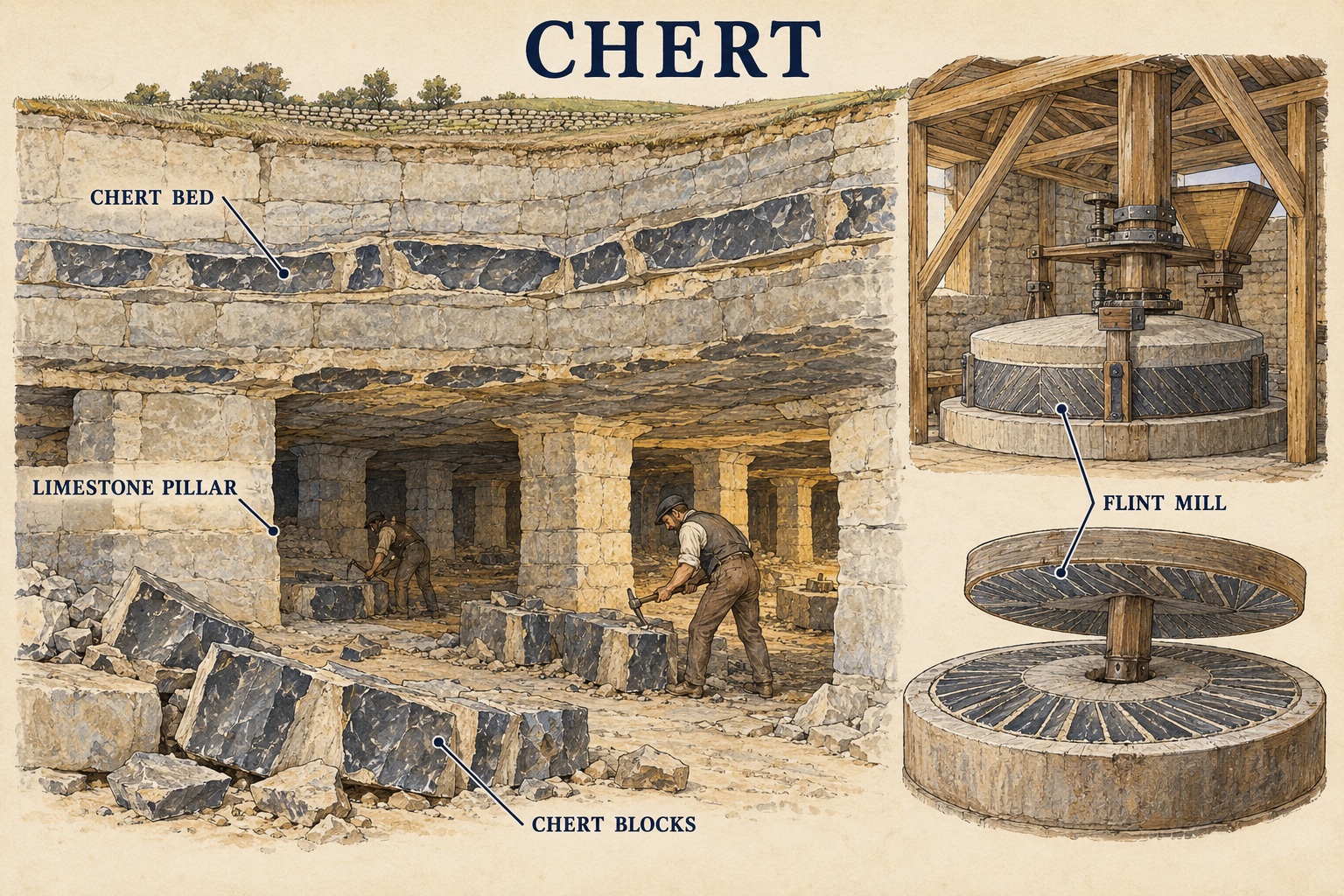
A hard, dense, cryptocrystalline silica — flint's cousin, found as beds and nodules in limestone rather than chalk — too brittle to build with and too hard to shape, whose value lay entirely in that hardness: blocks of it lined and paved the flint mills of the Staffordshire potteries, grinding calcined flint to the white powder that whitens earthenware and strengthens bone china without contaminating it.
Historical usage
Chert was worked into tools in prehistory, but its industry began in the middle of the eighteenth century, when Thomas Benson's wet-grinding process for flint made the potteries want a grinding stone that would not shed dark grit into the white slip: granite millstones left black specks, and in 1772 Josiah Wedgwood recommended Derbyshire chert as a great improvement. Bakewell chert was in the Potteries from about then. The Holme Bank workings at Bakewell began as a quarry on the Gell estate leased to Richard Arkwright from 1778, are documented by name in 1832, were underground by mid-century and were known as Bakewell Chert Mine or Smith's Mine by 1880; Holme Bank and the neighbouring Holme Hall mine shared surface works and, later, an entrance, and between them yielded perhaps half of all the chert mined in Derbyshire. The Pretoria mine opened about 1902. In Swaledale the chert beds high on Fremington Edge were worked from underground levels for the same trade. The industry peaked at the end of the nineteenth century and fell away quickly; small-scale production continued at Holme Bank to about 1960, the mine closed between 1959 and 1961, and Pretoria's deregistration in 1968 ended chert mining in Derbyshire.
How it worked
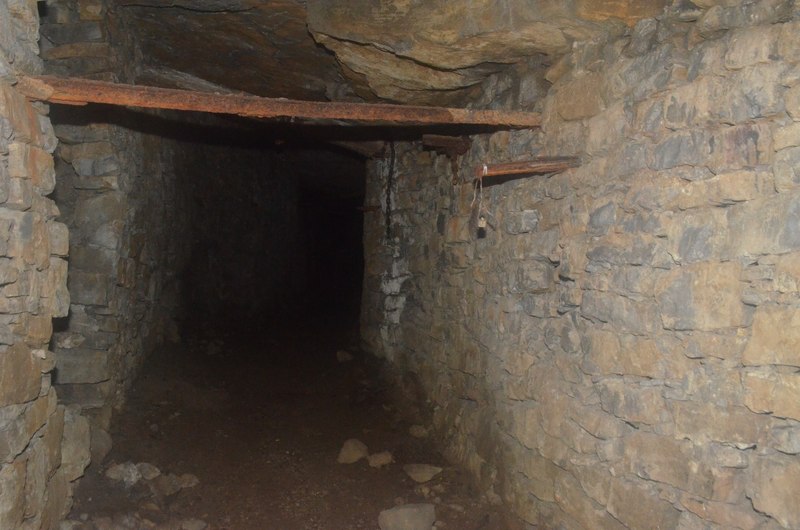
Chert lies in beds in the uppermost Carboniferous limestone, so it was got by driving levels along the bed and taking out the stone in large blocks — the flint mill wanted paving blocks for the pan floor and runners for the grinding — leaving pillars of limestone and chert to hold the roof. At Holme Bank eight entrances are known, the main ones in the old quarry, and a water pump and railway lines survived underground; the limestone 'deads' were later worked for breeze blocks.
Why it was used
Purity and hardness. Ground flint has to be white, and a grinding stone that wore into it had to be silica itself; chert is nearly pure silica and harder than the flint it ground, so it neither discoloured the product nor wore away quickly.
Value over time
Chert was never a high-value mineral by weight, but for a century and a half it had a captive customer: every flint mill in the Potteries needed its pan floors and runners renewed, and Derbyshire and Swaledale were where the blocks came from. The trade rose with the potteries through the nineteenth century and peaked at its end; it declined rapidly in the twentieth as the mills changed their methods and materials and the demand for ground flint fell, so that by the 1950s Holme Bank was working on a small scale and the last mine went in 1968.
Hazards & challenges
Chert is silica, and cutting and dressing it by hand raised the dust that causes silicosis, the hazard shared with the flint grinders it supplied; underground the workings had the ordinary risks of a bedded stone mine, roof falls in the limestone above the chert bed above all. No fatal incident at a chert mine is recorded in the archive.
Risks & limitations
A single-market mineral: chert's only substantial use was as a grinding medium for one industry, so when the potteries' demand changed the mines had nothing else to sell, and the trade collapsed within two generations of its peak. The beds are thin and interbedded with limestone, so the proportion of saleable block to waste was low.
Regional variation
Two districts supplied the trade: the Bakewell area of Derbyshire — Holme Bank, Holme Hall, Pretoria, Greenfield and the Endcliffe Wood mines — and the Swaledale and Arkengarthdale beds in the Yorkshire Dales, where Fremington Edge was the last chert quarry working. Both sent their stone to Staffordshire.
Related terminology
Mines associated with this term
Included only where MineArchive's own research gives a reasonable evidential basis — not every mine where this might plausibly apply.
- Fremington Edge Quarry — North Yorkshire (surviving physical example)
The last-surviving chert quarry in Swaledale, worked from underground levels on the Edge for grinding stone sent to the Staffordshire potteries. - Holme Bank Chert Mine — Derbyshire (well documented example)
Named 16 times in this record, first in the summary: “An underground chert mine at Bakewell, worked for the stone that ground flint for the…” - Hungry Chert Quarries — North Yorkshire (well documented example)
Named 14 times in this record, first in the summary: “The last of the Arkengarthdale chert workings, run from 1932 until the early 1950s in the old lead hushes…”
See every mine that worked chert →
Sources
- (primary) MDR12988 — Holme Bank chert quarry mine and Holme Hall chert mine, Bakewell — Derbyshire Historic Environment Record
- (secondary) Chert — Wikipedia
- (secondary) Holme Bank Chert Mine — Subterranea Britannica
Record created: 5 September 2026 · Last researched: 8 September 2026