 MineArchive
Silica Sand
| Also known as | Glass Sand (Named for its principal historic use), Silver Sand |
|---|---|
| Category | Commodities |
| Commodity page | Silica Sand → |
A very pure, fine-grained quartz sand — grains worn down to rounded quartz with almost nothing else mixed in — valued not for any single mineral but for its chemical cleanliness and near-absence of the iron that discolours ordinary sand. The finest, palest grades have long been sold as silver sand.
Historical usage
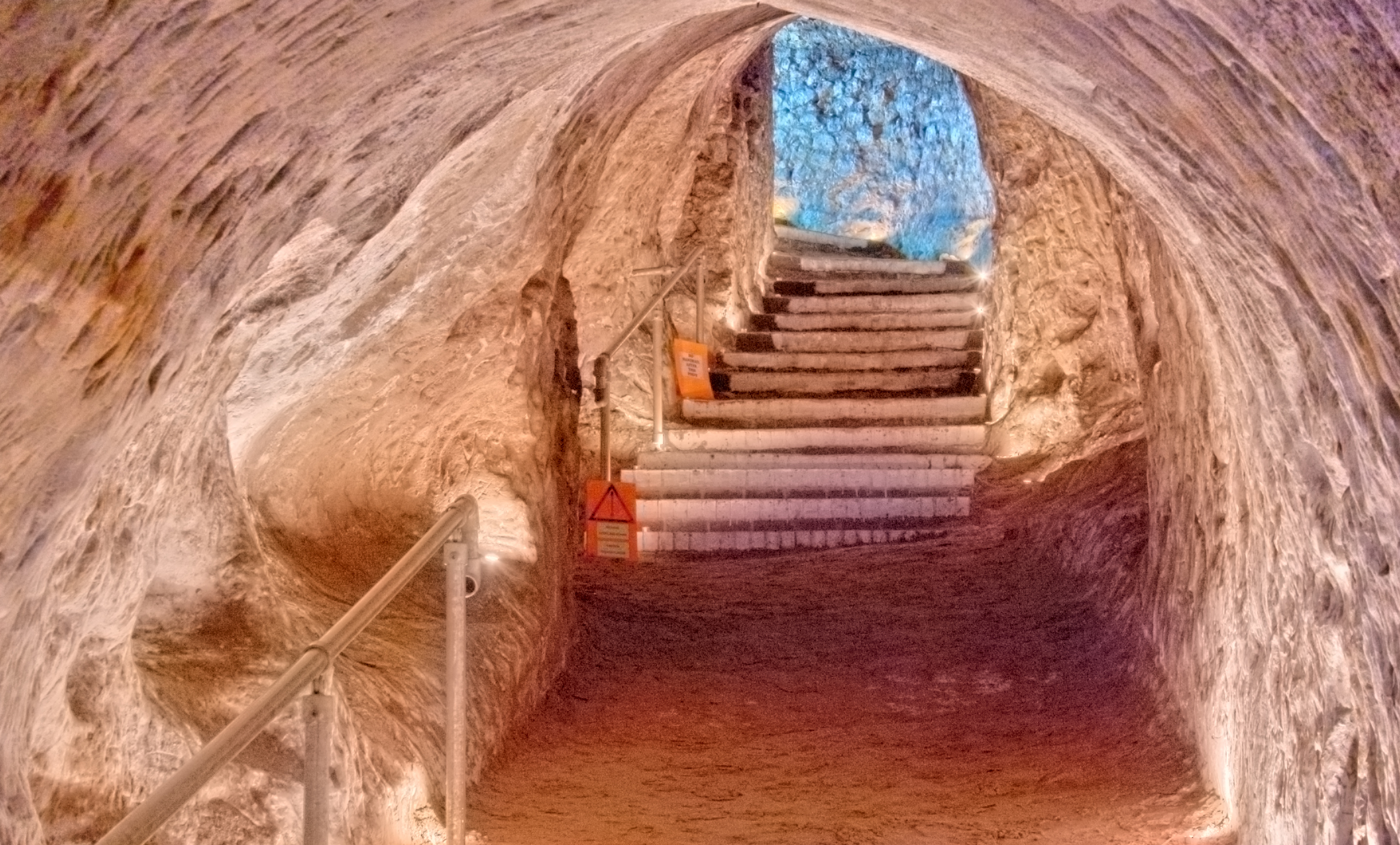
The Lower Greensand around Leighton Buzzard and Heath and Reach, Bedfordshire, has been quarried for its fine, iron-free 'silver sand' since the early 19th century. John Arnold began extracting sand commercially in the 1860s, expanded by his son Joseph to eight pits by 1911; George Garside started a separate operation at Billington Road in the 1890s, later expanding to Grovebury and Heath and Reach. The Chance Brothers glassworks at Smethwick, Birmingham drew on Leighton Buzzard sand for high-quality glass, including the panes for the 1851 Crystal Palace exhibition building. Extraction methods moved from hand-dug 'dobbers' and horse-drawn carts to mechanical excavators and washing plant, with light railways later giving way to road transport; the industry continues today under companies including Aggregate Industries and LB Silica Sand Ltd. The trade is older and more scattered than Bedfordshire alone. Silver sand was dug from pits and mines across the Weald, most notably in the Dorking–Reigate–Godstone district of Surrey, from at least the eighteenth century into the early twentieth: at Reigate two separate mine complexes were driven into the hillside after the town's road tunnel and cutting opened in 1823, one originally meant only to give the local brewery cellar storage, with the sand removed sold on as a profitable by-product; the workings ran until around 1900, the eastern mine closing by the 1860s after a large fall of roof. Alum Bay's white sand went to London and Bristol glass and porcelain makers, and in 1940 Lochaline on the Morvern peninsula was opened urgently as an underground mine in an exceptionally pure Cretaceous sandstone to supply the wartime optical-glass industry.
How it worked
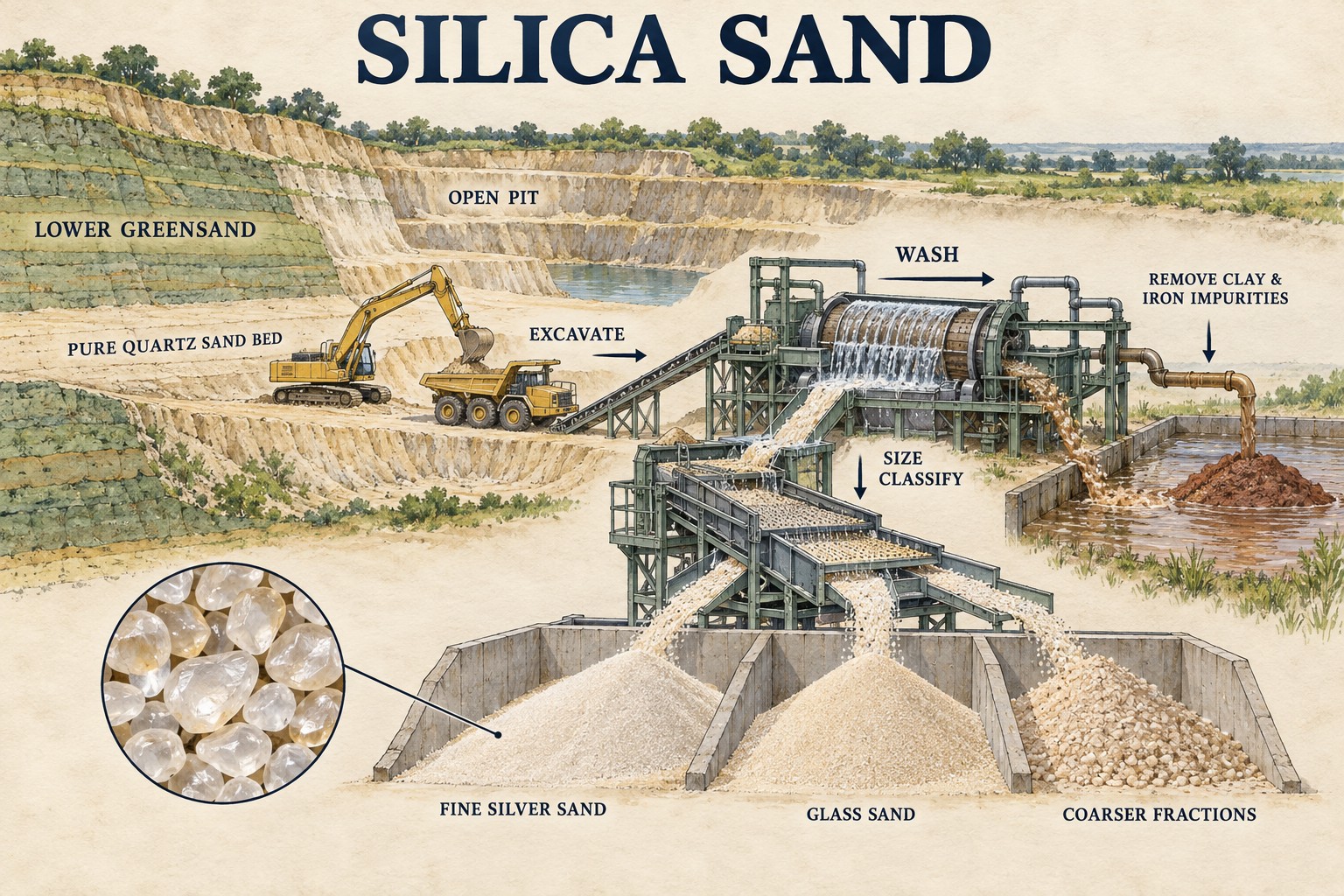
In Bedfordshire the sand lies in thick beds of the Lower Greensand and is worked in open pits, dug by hand and horse-cart in the nineteenth century and by excavator and washing plant since. In the Weald it occurs in the Folkestone Beds, part of the same Lower Greensand, not as a continuous bed but as discrete pockets of unusually fine, well-sorted quartz within coarser sandstone; because the sand was soft and needed no blasting it could be dug straight from galleries driven into the hillside, the simple pick-and-gallery method used at Reigate. Lochaline is the exception that proves how much purity is worth: an underground mine in solid white sandstone, still the only one of its kind in Europe.
Why it was used
Purity was the entire point. Ordinary building or river sand carries clay, iron oxide and other impurities that discolour or weaken whatever it goes into; silica sand's near-total lack of them made it the sand for clear glass, for foundry moulds, for horticultural composts and seed-sowing mixes where a clean inert medium mattered, and as a fine abrasive for scouring and cleaning. Graded by particle size and iron content, the same deposit could serve everything from optical glass to sports-pitch dressing.
Value over time
Leighton Buzzard's sand owes its value to purity rather than volume: graded into more than forty different specifications, its finest grades commanded a premium for glassmaking and precision uses, while coarser grades served ordinary building sand and foundry moulds at the bottom of the range. This graded-purity model let the same deposit serve markets from cheap bulk aggregate to specialist sports-surface and filtration sand, keeping the industry viable long after many other local sand pits closed. The small hand-worked pocket pits of the Weald never commanded a high price by weight, but their purity gave them a durable local market through the eighteenth and nineteenth centuries; they lost it gradually rather than through any single collapse, as the larger open workings at Leighton Buzzard and elsewhere, better suited to twentieth-century glass and foundry production, took over the trade.
Hazards & challenges
No hazard specific to this deposit is well documented; the generic risk of any silica sand operation is airborne respirable crystalline silica dust during drying, screening and bagging, carrying a risk of silicosis without proper dust control. The old gallery mines had the hazards of any soft-rock working rather than of the mineral: roof falls in unsupported sandstone galleries, such as the collapse that closed Reigate's East Mine in the 1860s.
Risks & limitations
Where it occurs in scattered pockets rather than a predictable bed, as in the Weald, a working could run out of sand unexpectedly, and soft, weakly supported galleries were prone to roof falls. The bedded Bedfordshire deposits carry the opposite risk, of a bulk product whose value rests on grading and washing rather than scarcity: only the finest fraction earns the premium, and the rest competes with ordinary building sand.
Regional variation
'Silver sand' is the older trade name, still used in horticulture, for the finest and palest grade; 'silica sand' is the industrial and geological name for the same material. Not to be confused with ordinary building or plastering sand, or with the sand and gravel worked in bulk for concrete. The Weald's pocket deposits, the Bedfordshire beds and Lochaline's underground sandstone are three forms of one commodity.
Related terminology
Mines associated with this term
5 examples chosen from 6 linked records — the term page is not an index.
- Double Arches Pit — Bedfordshire (well documented example)
Named in this record’s summary: “A Leighton Buzzard silica sand quarry opened by Joseph Arnold in 1916, when the war cut off Belgian…” - Alum Bay Sand and Copperas Workings — Isle of Wight (well documented example)
Alum Bay's cliffs gave up white sand so pure it was worked commercially even though the alum the site was originally searched for was never found there. - Leighton Buzzard Sand Quarries — Bedfordshire (well documented example)
Named 3 times in this record, first in the summary: “Silica sand quarries so pure they glazed the Crystal Palace and, a century…” - Lochaline Mine — Highland (well documented example)
An exceptionally pure white Cretaceous sandstone, developed urgently in 1940 to supply Britain's wartime optical-glass industry. - Penwyllt Quarry — Powys (well documented example)
Named 4 times in this record, first in the summary: “…The place went on to make silica bricks as well as lime, quarrying silica sand at Pwll Byfre and firing refractory bricks at works beside the Neath…”
See every mine that worked silica sand →
Sources
- (primary) Underground Surrey — Wealden Cave & Mine Society
- (secondary) History — The Sand Museum Virtual Archive
- (secondary) Nine Acres Pit — Wikipedia
- (secondary) Reigate Caves — Subterranea Britannica
- (secondary) Sand uses — The Sand Museum Virtual Archive
Record created: 27 August 2026 · Last researched: 29 August 2026