 MineArchive
Penwyllt Quarry
| Also known as | Penwyllt Limestone Quarry, Penwyllt Dinas Silica Brick Works |
|---|---|
| Location | Penwyllt, upper Swansea Valley, Fforest Fawr, Powys — 51.8390, -3.6890 (approximate) |
| Commodities | Limestone, Silica Sand |
| Type | Quarry |
| Worked | c. 1820–1937 |
| Maximum depth | Open quarrying in benches; no shaft depth applies. |
| Operators | John Christie (1819–1827), Joseph Claypon (1827–?), Kershaw & Pole Ltd (1865–?), Penwyllt Dinas Silica Brick Company |
Overview
A limestone quarry and quicklime works high in the upper Swansea Valley, developed from about 1820 by John Christie, a London indigo importer who had bought much of Fforest Fawr at its enclosure and built the Brecon Forest Tramroad to reach it. He was bankrupt by 1827. The place went on to make silica bricks as well as lime, quarrying silica sand at Pwll Byfre and firing refractory bricks at works beside the Neath and Brecon Railway until 1937 or 1939. Beneath it all lies Ogof Ffynnon Ddu, and the village is now a caving centre.
History
In 1819 Fforest Fawr, the Great Forest of Brecknock, was enclosed, and large parts of it became the property of John Christie, a Scottish businessman based in London who had grown wealthy importing indigo. Christie developed a limestone quarry at Penwyllt and decided to build lime kilns there as well; in 1820 he moved to Brecon and built the Brecon Forest Tramroad, running from a depot at Sennybridge through Fforest Fawr by way of the Penwyllt quarries to the Drim Colliery near Onllwyn, with a branch to the Gwaun Clawdd Colliery and an extension to the Swansea Canal. It was too much: Christie was declared bankrupt in 1827 and most of his assets, the tramroad included, passed eventually to his principal creditor, Joseph Claypon of the banking house of Garfit & Claypon in Boston, Lincolnshire. The place existed to make quicklime for the industries of the lower Swansea Valley, and the kilns record its phases: a bank of seven at Twyn-disgwylfa built by Claypon between 1836 and 1842, largely destroyed since by quarry tipping so that only one draw arch can be seen; four at Pen-y-foel near the Penwyllt Inn, put up about 1863 to 1867, it is thought by the Brecon Coal & Lime Co., with a loading bank for railway wagons in front of them; and two at the quarry itself, created in the railway age by Jeffreys, Powell and Williams and dated 1878. Later the Penwyllt Dinas Silica Brick Company quarried silica sand at Pwll Byfre and made refractory bricks for industrial furnaces at the Penwyllt brick works, served by a narrow-gauge railway with a rope-worked incline and standing beside the Neath and Brecon Railway, which became part of the Great Western Railway on 1 July 1922. The brickworks closed in 1937 or 1939.
The silica brickworks opened in 1865 under Kershaw and Pole Ltd and had become the Penwyllt Dinas Silica Brick Co. Ltd by 1895. By 1885 its limestone came from quarries higher up the hillside and its sand from Pwll Byfre, brought down a rope-worked incline of 2 ft 3 in gauge to the works beside the Neath and Brecon Railway of 1863, itself laid largely along the line of Christie's tramroad. The works were dismantled in the 1950s; the incline, the foundations of its winding house and loco shed and the early kilns remain.
Geology
Carboniferous limestone on the northern rim of the South Wales coalfield, with silica sand worked separately at Pwll Byfre for refractory brick. The limestone is cavernous: beneath Penwyllt lies Ogof Ffynnon Ddu, one of the longest and deepest cave systems in Britain, part of which was the first underground national nature reserve designated in the United Kingdom, with a corresponding surface area on the slopes of Carreg Cadno also within the reserve.
Workings
Open quarrying for limestone, burnt on site in successive banks of kilns, with a separate silica sand working at Pwll Byfre feeding the brickworks by a narrow-gauge railway worked in part by a rope incline. Transport shaped the site twice over: first the Brecon Forest Tramroad of the 1820s, and then the Neath and Brecon Railway, beside which the brickworks was built and in front of whose loading bank the Pen-y-foel kilns stand.
Closure
The brickworks closed in 1937 or 1939 — the sources give both. Quicklime burning had already given way, and the settlement emptied. Modern quarrying continues in the area, but the nineteenth-century works are done with.
What remains
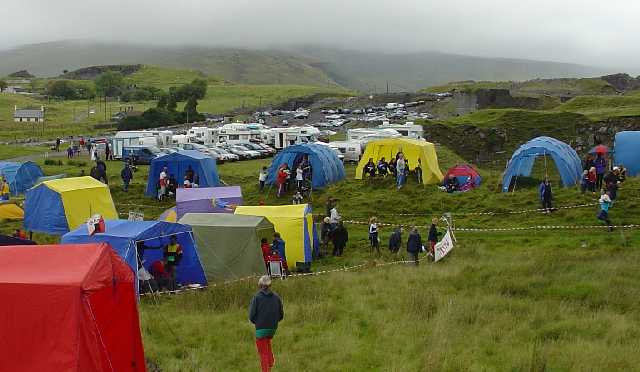
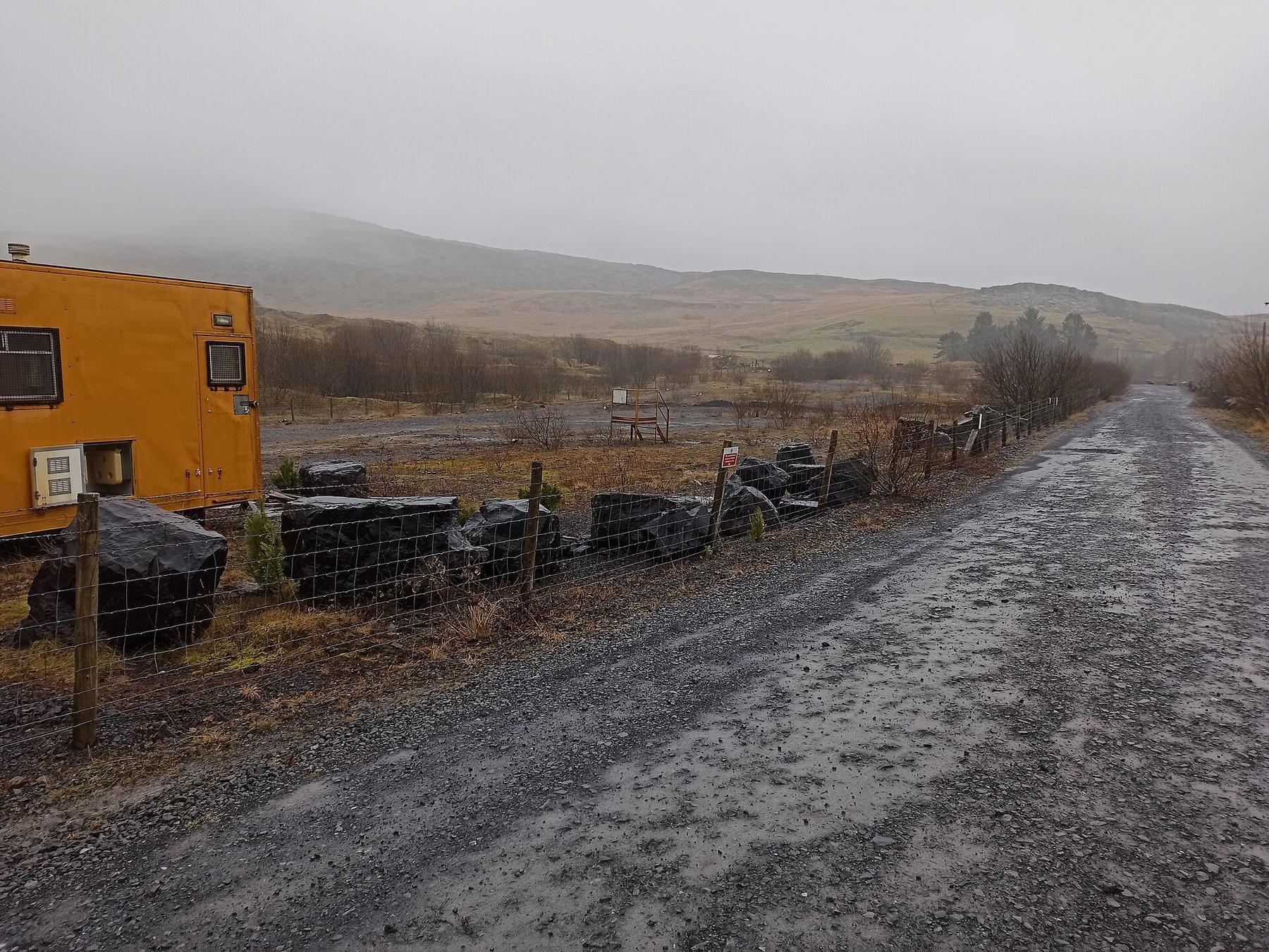
A caving centre. The only group of terraced houses still occupied is in Powell Street, which forms the headquarters of the South Wales Caving Club and of the South & Mid Wales Cave Rescue Team. The former pub survives as private accommodation for cavers, and the former Craig-y-nos station as a private holiday cottage; Patti Row, a block of back-to-back houses dating from the Brecon Forest Tramroad, stands derelict. The disused quarry has been used as parking for orienteering events on the Ogof Ffynnon Ddu ground, with the line of the dismantled railway still visible across it.
Three groups of lime kilns in varying condition — one draw arch left of the seven at Twyn-disgwylfa, four at Pen-y-foel with their wagon loading bank, and the pair of 1878 at the quarry — together with the quarry faces, the formation of the dismantled railway, Patti Row, and the terraced houses in Powell Street now used by the caving club.
Nearby mines
- Abercrave Colliery — 3.2 miles (5.1 km) S
- International Colliery, Abercrave — 3.3 miles (5.3 km) S
- Gwaunclawdd Colliery — 3.5 miles (5.6 km) SW
- Onllwyn Colliery — 4.0 miles (6.5 km) S, Neath Port Talbot
- Hendreladais Colliery — 4.6 miles (7.4 km) SW
Straight-line distance, within 9 miles (15 km). Show on the map.
What's uncertain
Points where sources disagree or the record could not be settled; both accounts are kept. All open questions in the archive.
- Three groups of kilns are recorded: two at Penwyllt quarry created in the railway age by Jeffreys, Powell and Williams and dated 1878; a bank of four at Pen-y-foel near the Penwyllt Inn erected around 1863 to 1867, it is thought by the Brecon Coal & Lime Co., with a loading bank for railway wagons in front; and a bank of seven at Twyn-disgwylfa built by Joseph Claypon between 1836 and 1842, largely destroyed by quarry tipping with only one draw arch now visible. (uncertain) 1
- The Penwyllt Dinas Silica Brick company quarried silica sand at Pwll Byfre and manufactured refractory bricks at the Penwyllt brick works, destined for use in industrial furnaces; a narrow-gauge railway with a rope-worked incline transported silica sand and stones to the brickworks, which stood adjacent to the Neath and Brecon Railway. The works closed in 1937 or 1939. (disputed) 1
Recorded claims
Individual factual claims, each attached to the source(s) that support it below. Where sources disagree, both are kept.
- Penwyllt developed primarily as a result of the need for quicklime in the industrial processes in the lower Swansea Valley, taking limestone from the quarries and turning it into quicklime in lime kilns. 1
- In 1819 Fforest Fawr was enclosed and large parts became the property of John Christie, a Scottish businessman based in London who had become wealthy through the import of indigo. Christie developed a limestone quarry at Penwyllt and lime kilns there, and in 1820 moved to Brecon and developed the Brecon Forest Tramroad, which ran from Sennybridge through Fforest Fawr by way of the Penwyllt quarries to the Drim Colliery near Onllwyn. 1
- Christie was declared bankrupt in 1827 and most of his assets, including the tramroad, eventually passed to his principal creditor, Joseph Claypon, of the banking house of Garfit & Claypon in Boston, Lincolnshire. 1
- Three groups of kilns are recorded: two at Penwyllt quarry created in the railway age by Jeffreys, Powell and Williams and dated 1878; a bank of four at Pen-y-foel near the Penwyllt Inn erected around 1863 to 1867, it is thought by the Brecon Coal & Lime Co., with a loading bank for railway wagons in front; and a bank of seven at Twyn-disgwylfa built by Joseph Claypon between 1836 and 1842, largely destroyed by quarry tipping with only one draw arch now visible. (uncertain) 1
- The Penwyllt Dinas Silica Brick company quarried silica sand at Pwll Byfre and manufactured refractory bricks at the Penwyllt brick works, destined for use in industrial furnaces; a narrow-gauge railway with a rope-worked incline transported silica sand and stones to the brickworks, which stood adjacent to the Neath and Brecon Railway. The works closed in 1937 or 1939. (disputed) 1
- Beneath Penwyllt and the surrounding area is the extensive limestone cave system of Ogof Ffynnon Ddu, part of which was the first designated underground national nature reserve in the UK, with a corresponding surface area on the slopes of Carreg Cadno also part of the reserve. 1,2
- The only group of terraced houses still occupied is in Powell Street and forms the headquarters of the South Wales Caving Club and the South & Mid Wales Cave Rescue Team; the former pub survives as private accommodation for cavers and Patti Row, dating from the days of the Brecon Forest Tramroad, survives in a derelict state. 1
- The Brecon Forest Tramroad of 1821-22, laid with three-foot L-section cast-iron rails and worked by horses, ran from Sennybridge to Pwll Byfre to carry limestone for improving the Forest's moorland; it was extended south to Grawen by 1825, its Pwll Byfre line was abandoned once the Penwyllt limestone came into use, and the Neath and Brecon Railway of 1863 largely followed its route. 3
- The Dinas silica brickworks opened in 1865 under Kershaw and Pole Ltd and had become the Penwyllt Dinas Silica Brick Co. Ltd by 1895; by 1885 its limestone came from quarries higher on the hillside and its sand by tramway from Pwll Byfre, a rope-worked 2 ft 3 in incline carrying materials down to the works beside the railway, and the incline, the winding-house and loco-shed foundations, early kiln remains and building fragments survive, the works having been dismantled in the 1950s. 4
Photographs & further reading
The village and its industries: Christie’s quarry and tramroad and his bankruptcy, the three groups of lime kilns and who built them, the silica brickworks and its railway, and what survives now as a caving centre.
View sourceSources
- (secondary) Penwyllt — Wikipedia
- (secondary) Ogof Ffynnon Ddu — Wikipedia
- (secondary) Penwyllt in the Nineteenth Century (Croydon Caving Club) — Croydon Caving Club
- (secondary) Penwyllt Dinas Silica Brickworks (GooseyGoo) — GooseyGoo
Record created: 8 September 2026 · Last researched: 24 September 2026