 MineArchive
Quicklime
| Category | Ore Processing |
|---|
Calcium oxide, the caustic white product made by burning limestone or chalk hard enough to drive off its carbon dioxide -- the product a Lime Kiln exists to make.
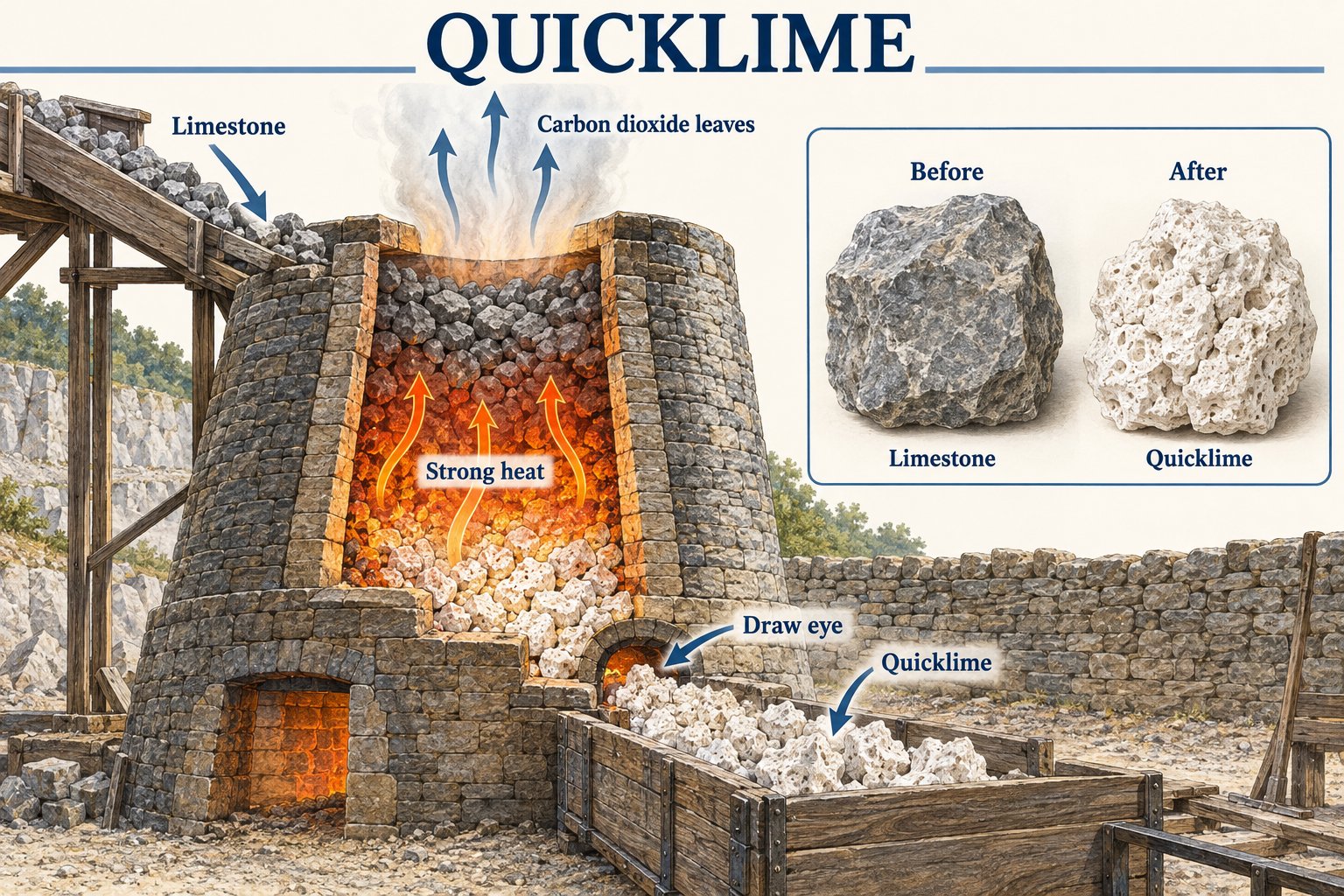
Historical usage
Quicklime's value in Britain was overwhelmingly agricultural rather than industrial for most of its history: spread on fields, it neutralised acid soil and turned unproductive bog-land into workable cropland, a use so dominant that it eclipsed lime's role in mortar and construction on these islands. Widespread farm use only became economically possible once cheap coal for burning it was available in coalfield areas from the late 13th century, with documented agricultural liming by 1523. Because burnt quicklime was far lighter and more valuable per tonne to transport than the raw limestone it came from, kilns clustered at small coastal ports so it could be shipped efficiently -- many surviving kilns around the British coast were built for exactly this reason. Industrialisation broadened its uses into iron and steel production, papermaking, sugar refining and the chemical industry, driving a shift from small local kilns towards larger dedicated works.
How it worked
Quicklime is produced by calcining (strongly heating) limestone or chalk in a kiln, driving off carbon dioxide and leaving calcium oxide behind; slaking it with water then produces calcium hydroxide (slaked lime) for use in mortar, plaster or as an agricultural dressing.
Why it was used
Its causticity and reactivity were exactly what made it useful: as an agricultural dressing it neutralised acid soils no untreated material could; in mortar, slaking and then re-absorbing carbon dioxide from the air let it set hard over time; industrially, its strong alkalinity suited it to steelmaking, papermaking and chemical processes needing a cheap, powerful base.
Risks & limitations
Quicklime is severely caustic, causing chemical burns to skin and eyes on contact through the same alkaline reaction that made it agriculturally useful, worsened by the heat released when it meets moisture -- including the moisture in skin or eyes. Burns are frequently not felt until hours after exposure, by which point significant tissue damage has already occurred, and eye contact carries a real risk of permanent scarring or blindness.
Related terminology
Lime Kiln, Magnesian Limestone
Mines associated with this term
5 examples chosen from 10 linked records — the term page is not an index.
- Charlestown Limeworks — Fife (well documented example)
Named in this record’s geology: “…complex. Burning that limestone drove off carbon dioxide to leave quicklime, the product the whole enterprise existed to make and ship.” - Harpur Hill Quarry — Derbyshire (well documented example)
Named 5 times in this record, first in the summary: “…from suspended calcium carbonate, and caustic at pH 11.3 from quicklime leaching out of the old burning waste.” - Amberley Chalk Pits — West Sussex (well documented example)
Named twice in this record, first in the geology: “…good lime: heated hard enough it gives off carbon dioxide and leaves quicklime behind.” - Cherry Hinton Pit — Cambridgeshire (well documented example)
Named in this record’s history: “…building stone the pits were a major source of lime for mortar and quicklime for agriculture, and from about 1895 until about 1956 chalk and lime…” - Hillcarr Sough — Derbyshire (well documented example)
Named in this record’s history: “…an ephemeral 'pudding' or 'pie' kiln, most likely built to produce quicklime for mortar inside the sough's underground sections, since…”
Sources
- (secondary) Is Lime Harmful to Humans? The Health Risks Explained — Biology Insights
- (secondary) Lime burning — Wikipedia
Record created: 29 August 2026 · Last researched: 29 August 2026