 MineArchive
Harpur Hill Quarry
| Also known as | Hoffman Quarry, The Blue Lagoon |
|---|---|
| Location | Harpur Hill, south of Buxton, Derbyshire — 53.2336, -1.9043 (exact) |
| Commodity | Limestone |
| Type | Quarry |
| Worked | c. 1835–c. 1952 |
| Maximum depth | Surface quarrying; no depth figure applies. Part of the abandoned pit has flooded to a lake averaging about 2 m deep. |
| Operators | Buxton Lime Firms Ltd. (1835–1918), Imperial Chemical Industries (1926–1952) |
Overview
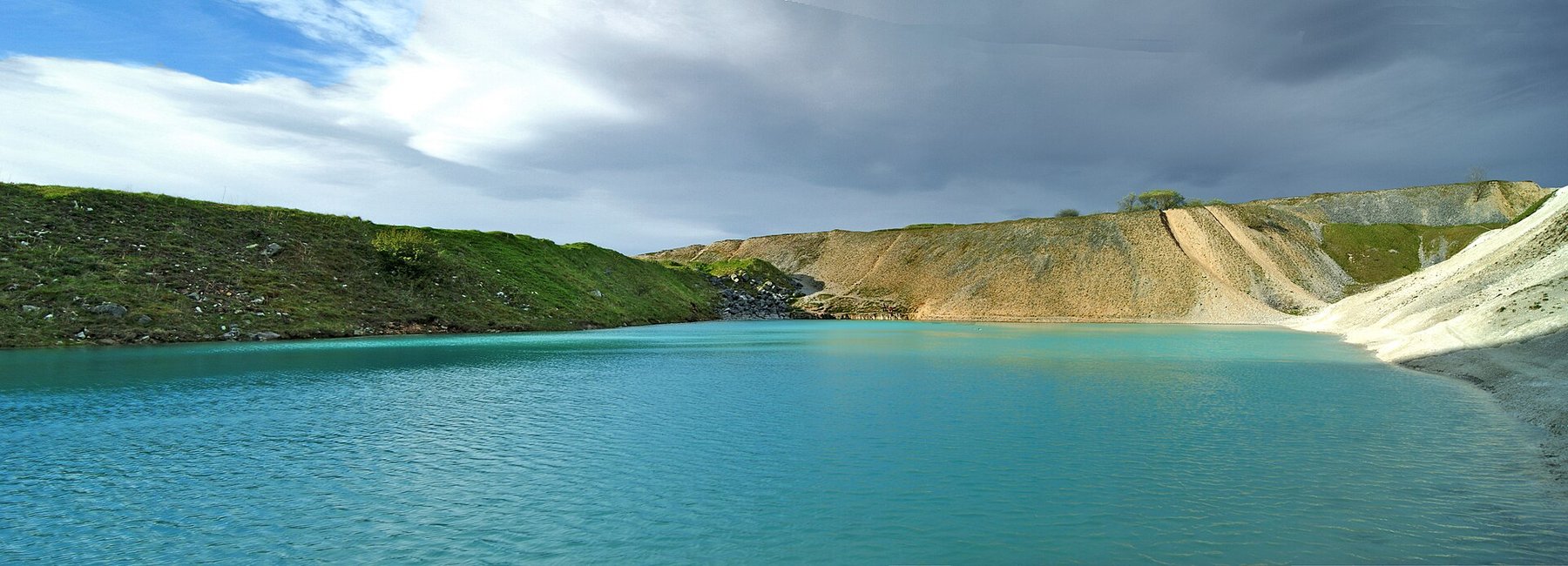
A limestone quarry south of Buxton, worked for lime burning from about 1835 to 1952 under Buxton Lime Firms, Brunner Mond and then ICI. In 1938 the RAF took the site over, and during the Second World War it was the largest chemical weapons store in the country. Its flooded pit is now the 'Blue Lagoon' — turquoise from suspended calcium carbonate, and caustic at pH 11.3 from quicklime leaching out of the old burning waste.
History
Small-scale lime burning had been carried on near Harpur Hill since at least the 1600s, at first around Grin Low near Poole's Cavern to the north, calcining the local Bee Low Limestones to make quicklime. Large-scale production began beside the quarry around 1835, first in larger shaft kilns and then in a multi-chambered Hoffmann kiln, under Buxton Lime Firms Ltd — which became Brunner Mond in 1918 and ICI in 1926. Large volumes of solid waste from the burning were tipped nearby, leaving spoil heaps carrying traces of quicklime and ash from the coal used in the process.
The Royal Air Force took the site in 1938 for a chemical weapons depot. Bad weather delayed construction and it did not open until 1940, but during the war RAF Harpur Hill was the largest chemical weapons store in the country, covering some 500 acres. After the war an unexploded ordnance disposal unit — an 'X station' — occupied the site, storing and disarming captured German chemical weapons and V-rocket warheads. Disposal was done by burning mustard gas and phosgene with bleach on the surrounding hills; it produced great quantities of smoke, destroyed the agents only partially, let some mustard gas escape as vapour and killed much of the nearby vegetation. An RAF mountain rescue team was also based here, attending air crashes across Derbyshire. The depot closed in 1960.
Lime production had ended around 1952, and the Hoffmann kiln was demolished in 1980 to clear ground for an industrial estate.
Geology
The quarry works the Carboniferous limestone of the Derbyshire Peak, principally the Bee Low Limestones, burnt on site to drive off carbon dioxide and leave quicklime. It is that same chemistry that makes the site's afterlife: water percolating through the tipped lime waste leaches calcium hydroxide and turns strongly alkaline, and the fine calcium carbonate precipitating in the flooded pit scatters light to give the lagoon its colour.
Geological setting: Sedimentary Beds and Seams (well documented example)
Workings
Open limestone quarrying with lime burning alongside — larger shaft kilns from about 1835 and later a multi-chambered Hoffmann kiln, demolished in 1980. Extensive tips of lime-burning waste surround the site. The wartime depot added storage across some 500 acres, including tunnels driven for the purpose.
Closure
Large-scale lime production ended around 1952. The RAF depot that had occupied the site since 1938 closed in 1960, and the Hoffmann kiln was demolished in 1980 for an industrial estate.
What remains
The site is vacant. A small part of the abandoned quarry has flooded — officially Hoffman Quarry, known to visitors as the Blue Lagoon — first filling around 2005. Its water carries dissolved caustic quicklime at a pH of 11.3, against bleach at 12.3, and its vivid blue comes from light scattering off finely dispersed calcium carbonate. Signs warn that the water can cause skin and eye irritation, stomach problems and fungal infections, and that the quarry holds car wrecks, dead animals and rubbish; the water is also extremely cold. It has nonetheless drawn visitors from across the country. Around 750 local people petitioned for the quarry to be drained, but the water was judged too toxic to release without risking local supplies. High Peak Borough Council has instead dyed the lake black repeatedly — in 2013, 2016 and twice in 2020 — to deter swimmers; the practice stopped in 2024 but the council announced it would resume after a surge of visitors during the May 2026 heatwave.
Quarry faces, extensive lime-waste spoil heaps and the flooded Hoffman Quarry lagoon; the Hoffmann kiln itself was demolished in 1980, and tunnels from the wartime depot survive.
Redevelopment
Part of the ground was cleared for an industrial estate after the Hoffmann kiln came down in 1980; the quarry itself is vacant.
Related mines
- Tunstead Quarry — Both Buxton limestone quarries worked by the same succession of owners: Buxton Lime Firms Ltd., formed in the 1891 amalgamation, and then Imperial Chemical Industries, which absorbed that company through Brunner, Mond and Company in 1926 and opened Tunstead three years later.
Nearby mines
- Cowdale Quarry — 1.4 miles (2.3 km) NE
- Dowlow Works — 2.9 miles (4.7 km) SE
- Goyt's Moss Colliery — 3.2 miles (5.1 km) W
- Tunstead Quarry — 3.4 miles (5.5 km) NE
- Danebower Colliery — 3.5 miles (5.6 km) W, Cheshire
Straight-line distance, within 9 miles (15 km). Show on the map.
The flooded quarry, widely known as the Blue Lagoon, holds strongly caustic water at about pH 11.3 and is signed against entry; it has also been the site of a fatal incident and of serious injuries during a rope rescue exercise.
Recorded claims
Individual factual claims, each attached to the source(s) that support it below. Where sources disagree, both are kept.
- Large-scale lime production ran beside the quarry from about 1835 to about 1952, using larger shaft kilns and then a multi-chambered Hoffmann kiln, under Buxton Lime Firms Ltd, Brunner Mond from 1918 and ICI from 1926. 1
- Small-scale lime burning had taken place near Harpur Hill since at least the 1600s, initially around Grin Low near Poole's Cavern, calcining the Bee Low Limestones. 1
- The RAF took the site in 1938 for a chemical weapons depot; delayed by weather, it opened in 1940 and became the largest such depot in the country, covering some 500 acres. 1,2
- After the war an RAF unexploded ordnance disposal unit stored and disarmed captured German chemical weapons and V-rocket warheads here, burning mustard gas and phosgene with bleach on the surrounding hills — a method that produced heavy smoke, destroyed the agents only partially, released some mustard gas as vapour and killed much nearby vegetation. The depot closed in 1960. 1,2
- Part of the abandoned quarry flooded from about 2005 to form a lake whose water carries dissolved caustic quicklime at pH 11.3 and takes its vivid blue from light scattering off finely dispersed calcium carbonate. 1
- High Peak Borough Council dyed the lake black in 2013, 2016 and twice in 2020 to deter swimmers; the practice stopped in 2024 but was to resume after a surge of visitors during the May 2026 heatwave. 1
- Around 750 local people petitioned for the quarry to be drained and closed off, but the water was judged too toxic to drain without risking contamination of local water supplies. 1
- The Hoffmann lime kiln was demolished in 1980 to create space for an industrial estate. 1
Photographs & further reading
A recent photographic account of the tunnels and surrounding ground left by the quarry and the depot.
View sourceThe quarry's wartime second life as the country's largest chemical weapons depot, and the partially-successful business of burning captured German agents on the hills afterwards.
View sourceSources
- (secondary) Harpur Hill Quarry — Wikipedia
- (secondary) RAF Harpur Hill — Wikipedia
- (observational) Harpur Hill Tunnel and environs, Derbyshire, 2026 — 28DaysLater
Record created: 3 September 2026 · Last researched: 3 September 2026