 MineArchive
Cowdale Quarry
| Also known as | Cowdale Lime Works, Staden Quarry |
|---|---|
| Location | Cowdale, King Sterndale, near Buxton, Derbyshire — 53.2493, -1.8828 (approximate) |
| Commodity | Limestone |
| Type | Quarry |
| Worked | 1898–1948 |
| Maximum depth | An open quarry with faces of about 10–20 m; there were no underground workings. |
| Operators | New Buxton Lime Company (1898–1908), Buxton Lime Firms Ltd. (1908–1919), Imperial Chemical Industries (1926–1955) |
Overview
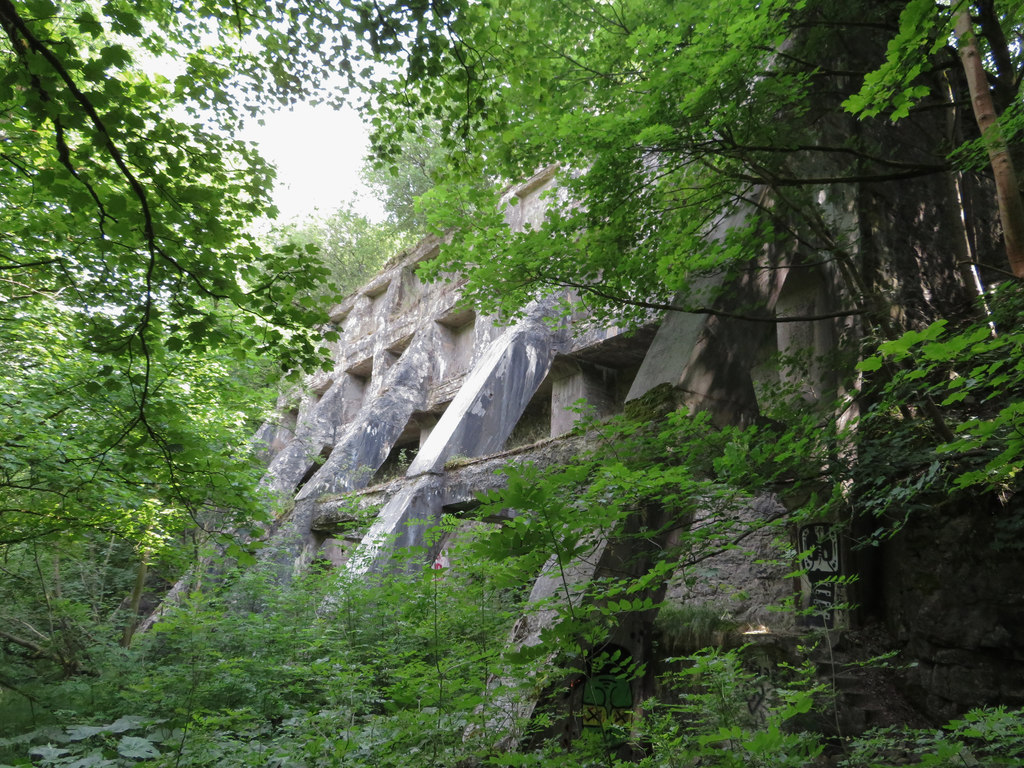
A limestone quarry and lime works in Ashwood Dale east of Buxton, opened in 1898 and swallowed a decade later by the Buxton Lime Firms combine. Its four stone shaft kilns, fifty feet high above the railway sidings and propped by massive concrete buttresses, are thought to have been the last traditional coal-fired shaft kilns working in Derbyshire when they stopped in 1954.
History
The Carboniferous limestone around Buxton had been quarried and burnt for lime since post-medieval times, and the arrival of the main railways in the 1860s brought a rush of new quarries into the dales. Cowdale lime works and quarry was opened by the New Buxton Lime Company in 1898 — listed in the Derbyshire industrial archaeology gazetteer as 'Staden Quarry' — with a row of four traditional stone-built shaft kilns standing about fifty feet above the bed of the railway sidings on the south side of Ashwood Dale. A date of about 1870 is also recorded for the kilns, but neither the quarry nor the kilns appear on the first or second edition Ordnance Survey maps, and it is thought that they went up with the quarry in 1898. Buxton Lime Firms, the combine formed in 1891 by thirteen competing quarry owners to control the price of stone and lime from their seventeen quarries, took Cowdale over in 1908, and in 1909 built the three concrete buildings that stand near the main road — a gatehouse, a power house and a lower cabin — in a most unusual neo-Egyptian style, probably extending the kilns at the same time. The concrete buttresses that hold up the kiln bank followed, in the 1920s or, on another account, in late 1931 after the face of the bank began to fall forward. Brunner Mond bought the combine in 1919 and the works passed with it into Imperial Chemical Industries on that company's formation in 1926. The quarry itself stopped working in 1948 and was used to store stone until the site closed in 1955; the kilns are believed to have been the last traditional coal-fired shaft kilns in use in Derbyshire, burning until 1954. The site was scheduled in 2011.
Geology
The quarry works the Carboniferous limestone of the Peak District, cut into the southern side of Ashwood Dale where the beds stand in faces between ten and twenty metres high above the quarry floor. The stone was burnt on site for lime rather than dressed for building.
Workings
The quarry basin is cut into the hillside above the River Wye, with the processing plant ranged along its northern edge: the kilns, hoppers and gatehouses sit on terraces cut into the steep rock face and were linked by rail track-beds, so that the whole sequence of extraction and processing can still be read across the site. Four large draw kilns of the traditional shaft type form the kiln bank, charged from above and drawn at the base to the level of the railway sidings that ran along the foot of the dale; a level terrace below the plant carries the line of the tramway and sidings. Spoil heaps spread across the northern and eastern parts of the site.
Closure
Active quarrying ended in 1948 and the basin was used for storing stone until the site closed in 1955, the kilns having burnt their last in 1954. The tramlines and a number of outbuildings were taken away in the later 20th century and the works left to decay.
What remains
The standing, buried and earthwork remains are a scheduled monument, first scheduled in 2011, and the site has stood unoccupied since closure. The kiln bank with its concrete buttresses survives among trees, along with the concrete gatehouse, power house and lower cabin; visitors' accounts from 2014 to 2025 describe the structures as heavily overgrown, graffitied and decaying, with the quarry basin now open pasture.
The four-kiln bank and its concrete buttresses, hoppers, the rail track-bed terraces, the neo-Egyptian gatehouse, power house and lower cabin, retaining walls and spoil heaps.
Redevelopment
None built. The quarry floor is pasture and a bottling plant was proposed for the basin in a planning application of 2009, which is why the site's archaeology was assessed in 2010.
Nearby mines
- Harpur Hill Quarry — 2.3 km SW
- Tunstead Quarry — 3.2 km NE
- Dowlow Works — 5.2 km SE
- Goyt's Moss Colliery — 6.5 km W
- Maury Mine and Sough — 6.8 km E
Straight-line distance, within 15 km. Show on the map.
What's uncertain
Points where sources disagree or the record could not be settled; both accounts are kept. All open questions in the archive.
- The concrete buttresses supporting the lime kilns were probably built in the 1920s. (disputed) 1
- Massive concrete buttresses were added in late 1931, after the face of the kiln bank began to fall forward. (disputed) 3
Recorded claims
Individual factual claims, each attached to the source(s) that support it below. Where sources disagree, both are kept.
- The Cowdale lime works and quarry was opened by the New Buxton Lime Company in 1898 and listed in the Derbyshire industrial archaeology gazetteer as 'Staden Quarry'. 1
- The four traditional stone shaft kilns stand about fifty feet high above the bed of the railway sidings on the south side of Ashwood Dale. 1
- Cowdale quarry became part of Buxton Lime Firms in 1908, and the concrete gatehouse, power house and lower cabin near the main road were built by the combine in 1909 in an unusual neo-Egyptian style. 1,2
- The concrete buttresses supporting the lime kilns were probably built in the 1920s. (disputed) 1
- Massive concrete buttresses were added in late 1931, after the face of the kiln bank began to fall forward. (disputed) 3
- The quarry ceased active working in 1948 and was used to store stone until the site closed in 1955; the kilns are believed to have been the last traditional coal-fired shaft kilns in use in Derbyshire, in 1954. 1
Photographs & further reading
The archaeological assessment written for a planning application on the site, with the documented history of the quarry, its kilns and the concrete buildings.
View sourceAn account of the Buxton quarries and their combines, giving the formation of Buxton Lime Firms in 1891, its acquisition of Cowdale in 1908 and the later ICI Lime Division.
View sourceSources
- (primary) Cowdale Quarry, Buxton, Derbyshire: Cultural Heritage (Archaeological Research Services report 2010/43) — Archaeological Research Services Ltd for High Peak Borough Council
- (secondary) Buxton lime industry — Wikipedia
- (primary) Cowdale Quarry limestone extraction and processing site 540m north east of Staden Manor, King Sterndale (List entry 1399726) — Historic England
- (observational) Cowdale Lime Works, Buxton, Derbyshire, April 2025 — 28DaysLater
Record created: 22 September 2026 · Last researched: 22 September 2026