 MineArchive
Terrace
| Category | Mine Workings & Access |
|---|
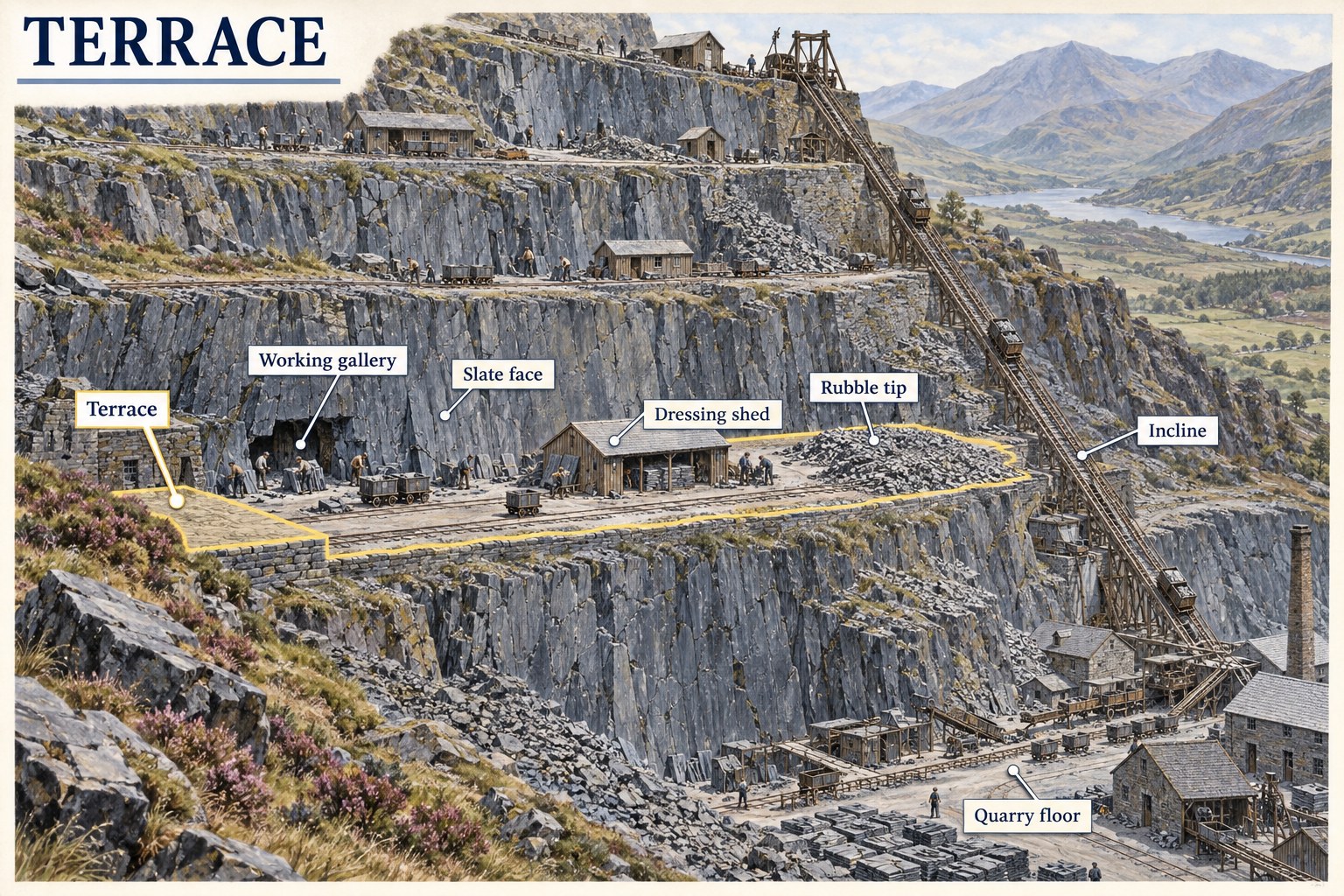
A stepped, roughly level working platform cut into an open quarry's hillside face, one of a stacked sequence rising up the slope, each carrying its own working gallery, rubble tips and processing sheds.
Historical usage
A feature of open hard-rock and slate quarrying wherever a quarry was cut back up a hillside rather than down into a single pit -- most fully developed in the Welsh slate industry from the late 18th century, where Penrhyn Quarry eventually rose in over 20 stacked terraces, and later copied at smaller quarries including Gorseddau. Penrhyn was not the only quarry to reach this scale: Dinorwig, on the far side of the Ogwen watershed, developed over 30 terraces of its own, each linked to its own rubble tip.
How it worked
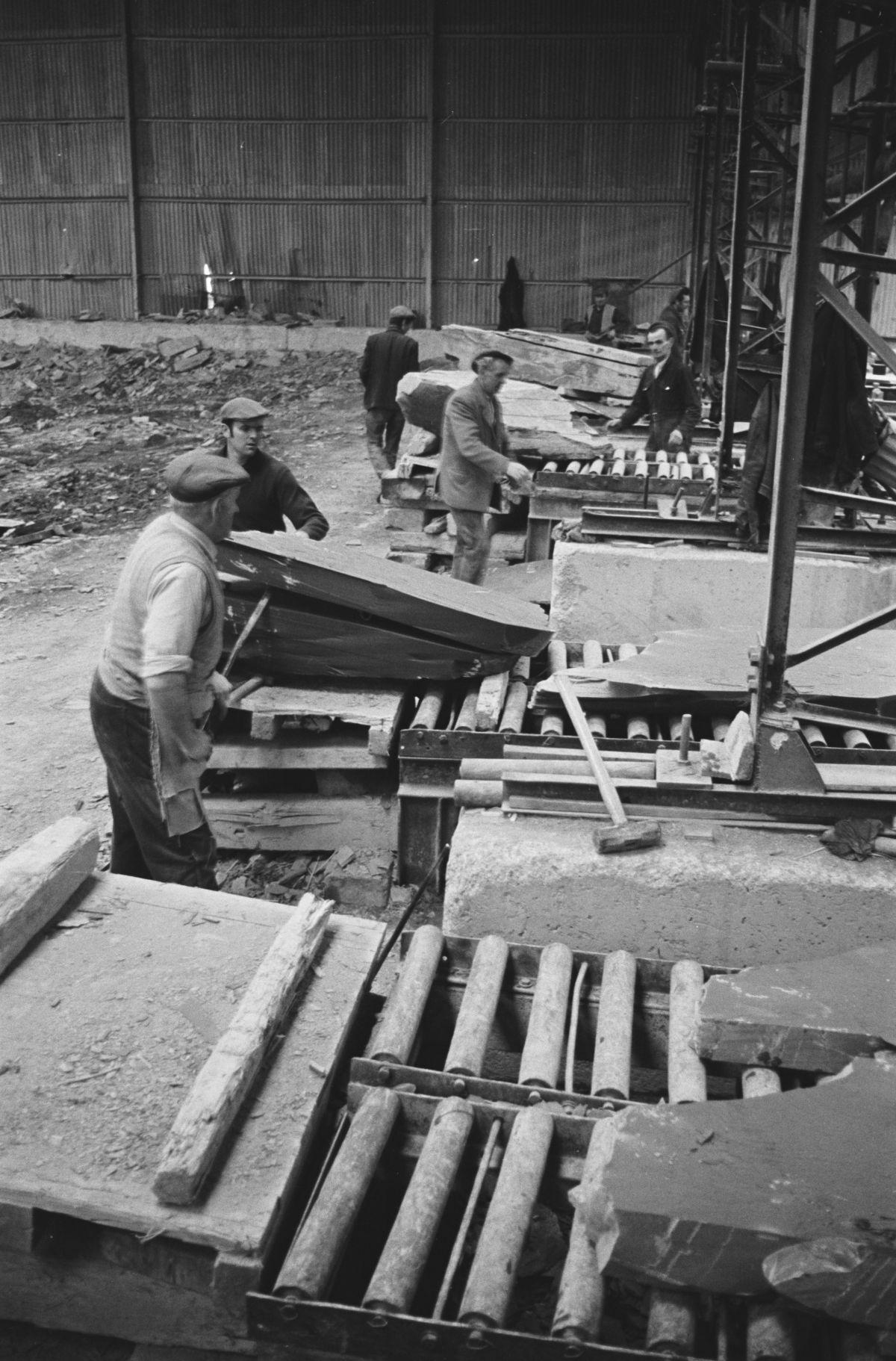
Rather than deepening one working face, a quarry's terraces stepped upward (or, worked in the opposite direction, cut downward) one above another, each terrace between roughly 9 and 21 metres deep at Penrhyn. Every terrace carried its own gallery where the rock face was actually worked, together with its own spoil/rubble tips and, in slate quarries, its own trimming or dressing sheds; a system of inclines linked the terraces to each other and down to the mills or railway at the base, so worked stone did not have to be hauled by hand from level to level.
Why it was used
Terracing let a quarry expose and work far more rock face simultaneously than a single pit ever could, while keeping each level's spoil and processing separate and giving every terrace its own safe, roughly level working surface rather than an unstable single deep face.
Risks & limitations
Each terrace was still an exposed, open working edge -- men worked roped to the rock on many of these terraces well into the 20th century, and a terrace's spoil tips and structures had to be actively managed so they did not slip or encroach on the terrace or terraces below.
Regional variation
The term applies to open quarrying generally, not only slate -- but it is in the Welsh slate industry that it reached its most developed, most extensively documented form, and the stepped terraced hillsides of that industry are now protected as part of the Slate Landscape of Northwest Wales UNESCO World Heritage Site.
Related terminology
Mines associated with this term
5 examples chosen from 50 linked records — the term page is not an index.
- Combe Down Stone Mines — Somerset (well documented example)
Named in this record’s surface remains: “De Montalt Place, Ralph Allen's terrace of quarrymen's cottages, still stands above ground, along with…” - Dorothea Quarry — Gwynedd (well documented example)
Named in this record’s surface remains: “…alongside pit edges, spoil runs, dressing sheds, offices and terraces of quarrymen's housing.” - Glenariff Iron Ore Mines — County Antrim (well documented example)
Named twice in this record, first in the current condition: “…pier foundations in the sea at Red Bay, a former workers' housing terrace beside the coast road, ruined engine-shed remains, and traces of the…” - Greetwell Ironstone Mines — Lincolnshire (well documented example)
Named in this record’s current condition: “…left by the ore working as softened by vegetation, with long level terraces marking the courses of the narrow gauge tramways, and noted that the…” - Nant Gwrtheyrn Quarries — Gwynedd (well documented example)
Named in this record’s history: “…returning with goods the valley could not otherwise get. A terrace of small houses went up soon after the quarry opened. In 1878, as…”
Disasters associated with this term
Included only where MineArchive's own research gives a reasonable evidential basis, with the nature of the relationship stated — not every disaster where this term might plausibly apply.
- Arkwright Town Methane Evacuation, 1988 (contextual relationship)
Named in this record’s summary: “…workings of Arkwright Colliery was found at explosive levels in the terraces of Arkwright Town six months after the pit closed; 110 people from…” - Usworth Colliery Explosion, 1885 (contextual relationship)
Named in this record’s narrative: “…the disaster meant in a colliery village can be read in a single terrace. Robert Richardson of 51 Railway Terrace, thirty-nine years old, was…”
Sources
- (secondary) Dinorwig Slate Quarry Mountain Landscape — Llechi Cymru / Wales Slate
- (secondary) Penrhyn Slate Quarry and Bethesda, and the Ogwen Valley to Port Penrhyn — Llechi Cymru / Wales Slate
- (secondary) Penrhyn quarry — Wikipedia
- (secondary) The Slate Industry of North and Mid Wales: Penrhyn Quarry — Penmorfa (Slate Industry of North and Mid Wales)
Record created: 31 August 2026 · Last researched: 1 September 2026