 MineArchive
Glenariff Iron Ore Mines
| Location | Cloughcor, Glenariff, County Antrim — 55.0500, -6.0700 (approximate) |
|---|---|
| Commodity | Iron |
| Type | Iron |
| Worked | 1873–1881 |
| Operators | Glenariff Iron Ore and Harbour Company (1873–1885) |
Overview
Iron ore workings high in Glenariff, one of the Glens of Antrim, connected to the coast by Ireland's first 3ft narrow-gauge railway — completed in 1873 to carry ore four miles down to Red Bay Pier for shipment to ironworks in Scotland, Wales and Cumbria, before the whole enterprise collapsed into bankruptcy within little over a decade.
History
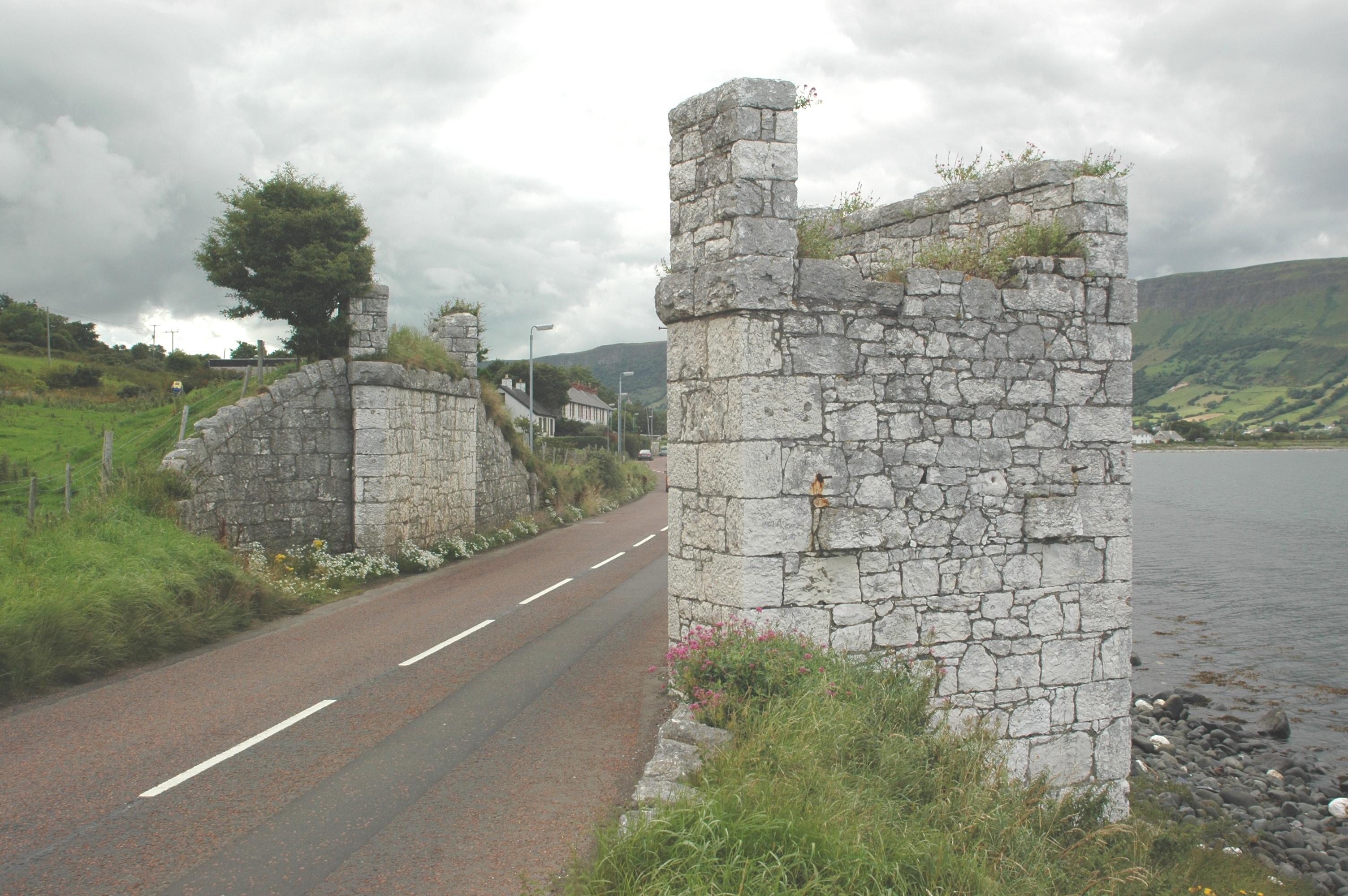
By the mid-19th century the Antrim hills had become the most productive iron ore mining district in Ireland, and workings at Cloughcor, high in Glenariff, were developed to feed that trade. To get the ore down to the coast, the Glenariff Iron Ore and Harbour Company built a purpose-made line from the mines to a new pier at Red Bay, completing both in 1873 — at 3ft gauge, the first narrow-gauge railway built anywhere in Ireland, running for about four miles down the glen and crossing the coast road on a limestone-and-wrought-iron bridge that survives today as the 'White Arch'. Two 2-4-0T tank locomotives built by Robert Stephenson & Company worked the line, hauling wagons built by the Ashbury Railway Carriage and Iron Company, with a company-built vertical-boiler shunter also pressed into service; horses took over for the final haul onto Red Bay Pier itself, where the ore was shovelled by hand down wooden chutes into waiting schooners bound for smelters in Scotland, south Wales and Cumbria.
The venture struggled almost from the start. Sources differ on the precise sequence — Wikipedia's account has ore production faltering as early as 1875 under insufficient output, labour shortages and depressed prices, while the Glens of Antrim Historical Society's local account has mining continuing to 1881 — but both agree the company could not make the enterprise pay: by around 1884 it had defaulted on its ground rent to the Earl of Antrim, and the business was sold in a bankruptcy sale in 1885. The locomotives and wagons were bought up by the Londonderry and Lough Swilly Railway. The abandoned line's rails were not lifted until 1890, and even then only after roughly three miles of track were stolen overnight.
Geology
The ore worked at Glenariff belonged to the same interbasaltic iron ore horizon exploited across the Antrim plateau — a band of iron-rich laterite formed by deep tropical weathering of basalt lava flows during pauses in Palaeogene volcanic activity, later exposed by erosion of the glens cut down through the plateau's basalt cap.
Workings
Ore was worked from open surface pits at Cloughcor, at the head of Glenariff, rather than by deep shaft mining, and hauled down to Red Bay by the dedicated narrow-gauge railway — the mining and transport infrastructure were built and operated as a single integrated enterprise by the Glenariff Iron Ore and Harbour Company.
Closure
Mining had ended by the early 1880s amid insufficient output and falling ore prices, and the Glenariff Iron Ore and Harbour Company was sold in a bankruptcy sale in 1885; the railway's rails lay in place until 1890, when they were finally lifted for scrap.
What remains
The White Arch — the limestone-piered, wrought-iron bridge that once carried the mine railway across the Antrim Coast Road at Waterfoot — survives as the most visible relic of the enterprise, alongside concrete pier foundations in the sea at Red Bay, a former workers' housing terrace beside the coast road, ruined engine-shed remains, and traces of the railway formation still visible up the hillside.
The White Arch bridge piers, remains of Red Bay Pier, a workers' cottage terrace and sections of the old railway trackbed survive; the section of the Glens of Antrim Way / greenway route between Ballymena and Cushendall follows part of the old railway alignment.
Nearby mines
- Tievebulliagh Axe Factory — 2.9 miles (4.7 km) NW
- Carnlough Limestone Quarries — 4.3 miles (7.0 km) SE
- Glenravel Iron and Bauxite Mines — 5.4 miles (8.8 km) SW
Straight-line distance, within 9 miles (15 km). Show on the map.
What's uncertain
Points where sources disagree or the record could not be settled; both accounts are kept. All open questions in the archive.
- Sources disagree on the exact closure date: Wikipedia gives 1875, when insufficient ore output, labour shortages and depressed prices halted production; the Glens of Antrim Historical Society gives 1881. Both agree the company was sold in a bankruptcy sale in 1885 after defaulting on its ground rent to the Earl of Antrim. (disputed) 1,2
Recorded claims
Individual factual claims, each attached to the source(s) that support it below. Where sources disagree, both are kept.
- The Glenariff Iron Ore and Harbour Company completed a 3ft-gauge railway of about four miles and a new pier at Red Bay in 1873, the first narrow-gauge railway built in Ireland, using two Robert Stephenson & Company tank locomotives and wagons from the Ashbury Railway Carriage and Iron Company. 1,2
- Sources disagree on the exact closure date: Wikipedia gives 1875, when insufficient ore output, labour shortages and depressed prices halted production; the Glens of Antrim Historical Society gives 1881. Both agree the company was sold in a bankruptcy sale in 1885 after defaulting on its ground rent to the Earl of Antrim. (disputed) 1,2
- The White Arch — limestone piers and a wrought-iron bridge carrying the mine railway across the Antrim Coast Road at Waterfoot — survives today alongside pier foundations, a workers' housing terrace and former engine-shed ruins. 2
Sources
- (secondary) Glenariff Iron Ore and Harbour Company — Wikipedia
- (secondary) What's that? – The White Arch and Glenariff Railway — Glens of Antrim Historical Society
Record created: 26 August 2026 · Last researched: 26 August 2026