 MineArchive
Glenravel Iron and Bauxite Mines
| Also known as | Glenravel Mine, Cargan Iron Mines, Skerry Mines, Antrim Iron Ore Mines |
|---|---|
| Location | Glenravel, Cargan and Newtowncrommelin, Glens of Antrim, County Antrim — 55.0087, -6.1870 (approximate) |
| Commodities | Iron, Bauxite |
| Type | Ironstone |
| Worked | From 1866–31 December 1945 (final bauxite closure) |
| Operators | James Fisher (1866–1913), Antrim Iron Ore Company (1868–1913) |
Overview
A remote Antrim glen that briefly became one of the busiest mining districts in Ireland — seven hundred men and six hundred horses at its 1870s peak — worked twice more for a second mineral hiding in the same rock, once out of scientific curiosity and once because Britain needed aluminium for aircraft.
History
James Fisher, a mining entrepreneur already active in north-west England, was introduced to the iron-bearing rock of Glenravel by the local priest, Father William John Macauley, and given permission to work it by the landlord Edward Benn. Fisher began outcrop mining at the Gullets on the slopes of Slievenanee in 1866, shipping 18,000 tons of ore to England within six months at around £1 a ton. The first proper underground working, Glenravel Mine itself, opened in Legegrane townland in January 1867, and the industry grew fast enough to create its own mining village, Fisherstown, later renamed Cargan. By 1873 around 700 men and 600 horses worked the district's mines, and other operators followed Fisher in, notably Silas Evans's Antrim Iron Ore Company. A tramway from the Gullets to Parkmore in 1867 and a narrow-gauge railway reaching Cargan in 1875 and Retreat in 1876 gave the ore a route to the port at Larne. Professor John F. Hodges identified a second, entirely different mineral in the same ground in 1871: bauxite, formed as a weathered crust on the basalt between lava flows. Some workings, including Tuftarney and Evishnacrow, eventually converted entirely to bauxite; Evishnacrow continued until 1923. Iron production declined from the early 1880s as the British iron industry slumped and the richest ore was worked out, and Fisher's original mines closed on 29 October 1913. A last, brief bauxite revival came during the Second World War, when Britain's need for aircraft aluminium reopened new bauxite workings at Newtowncrommelin (the Skerry Mines) in 1941; these closed in early 1944, and all mining in the district ended for good on 31 December 1945.
Geology
Glenravel's iron occurs as a pisolitic ore — small, rounded, pea-like grains — averaging about 14 inches thick and running as much as 60 per cent iron in Fisher's best seams, formed within an interbasaltic horizon between successive lava flows of the Antrim plateau. The same interbasaltic weathering that concentrated the iron also, under the right tropical conditions, produced bauxite from the basalt itself — the two minerals are products of the same geological process at different stages of weathering, which is why one district could be worked twice over for two completely different commodities.
Geological setting: Laterite and Residual Weathering Deposits (well documented example)
Workings
Ore was won by the room-and-pillar method, in seams cramped enough that miners often worked lying down, using picks and shovels rather than powered machinery. Roof support was unusually cheap here: solid basalt overlying the ore needed so little timbering that it cost around a penny a ton against a shilling a ton in comparable English mines. Over seven hundred adits and shafts have been recorded across the wider district. No smelting was ever done locally — ore was carried out by tramway and then narrow-gauge railway to Larne for shipment, mostly to smelters in England, and Antrim ore was generally mixed with richer imported ore rather than smelted alone.
Closure
Iron mining declined from the 1880s as cheaper, richer ore became available elsewhere and the local seams grew harder to work profitably; Fisher's mines closed in 1913 and Evishnacrow's bauxite workings in 1923. A further, short-lived bauxite revival for wartime aluminium ran from 1941 to 1944, with all mining in the district ceasing on 31 December 1945.
What remains
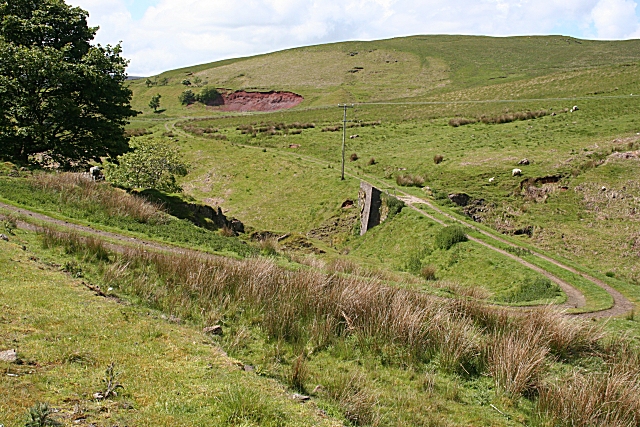
The workings survive as a landscape of overgrown pits, spoil and the trackbed of the old mineral railway rather than as any single dramatic ruin; the route of the narrow-gauge line past Evishnacrow, following the hillside where mine workings are still visible in the distance, is a well-known local walking track. Over five million tonnes of iron ore and around a quarter of a million tonnes of bauxite were extracted from the district in total.
Overgrown mine pits and spoil heaps scattered across the Glenravel, Cargan and Newtowncrommelin district, and the trackbed of the former mineral railway between the mines and Retreat.
Redevelopment
None — the district remains agricultural land and open hillside, with the old railway trackbed used as a walking route.
Nearby mines
- Tievebulliagh Axe Factory — 5.1 miles (8.2 km) NE
- Glenariff Iron Ore Mines — 5.4 miles (8.8 km) NE
- Carnlough Limestone Quarries — 7.2 miles (11.5 km) E
Straight-line distance, within 9 miles (15 km). Show on the map.
Recorded claims
Individual factual claims, each attached to the source(s) that support it below. Where sources disagree, both are kept.
- James Fisher began outcrop mining at the Gullets in 1866, shipping 18,000 tons of ore in six months; the first underground mine, Glenravel Mine, opened in Legegrane townland in January 1867. 1
- By 1873 around 700 men and 600 horses worked the district; ore was won by room-and-pillar mining and carried out by tramway from 1867 and narrow-gauge railway from 1875-76 to Larne for shipment. 1
- Professor John F. Hodges identified bauxite in the same ground in 1871, formed as an interbasaltic weathering crust alongside the pisolitic iron ore — two minerals produced by the same tropical weathering process at different stages. 1,2
- Iron mining declined from the 1880s and Fisher's mines closed in 1913; a wartime bauxite revival at Newtowncrommelin ran 1941-44, and all mining in the district ceased on 31 December 1945. 1
- Over five million tonnes of iron ore and around a quarter of a million tonnes of bauxite were extracted from the district in total, across more than seven hundred recorded adits and shafts. 1
Sources
- (primary) The Iron Mines of Glenravel — Glens of Antrim Historical Society
- (secondary) Mid-Antrim Iron and Bauxite Mines — geology and industrial history — Belfast Geologists' Society
Record created: 24 August 2026 · Last researched: 24 August 2026