 MineArchive
Laterite and Residual Weathering Deposits
| Category | Formation Processes |
|---|
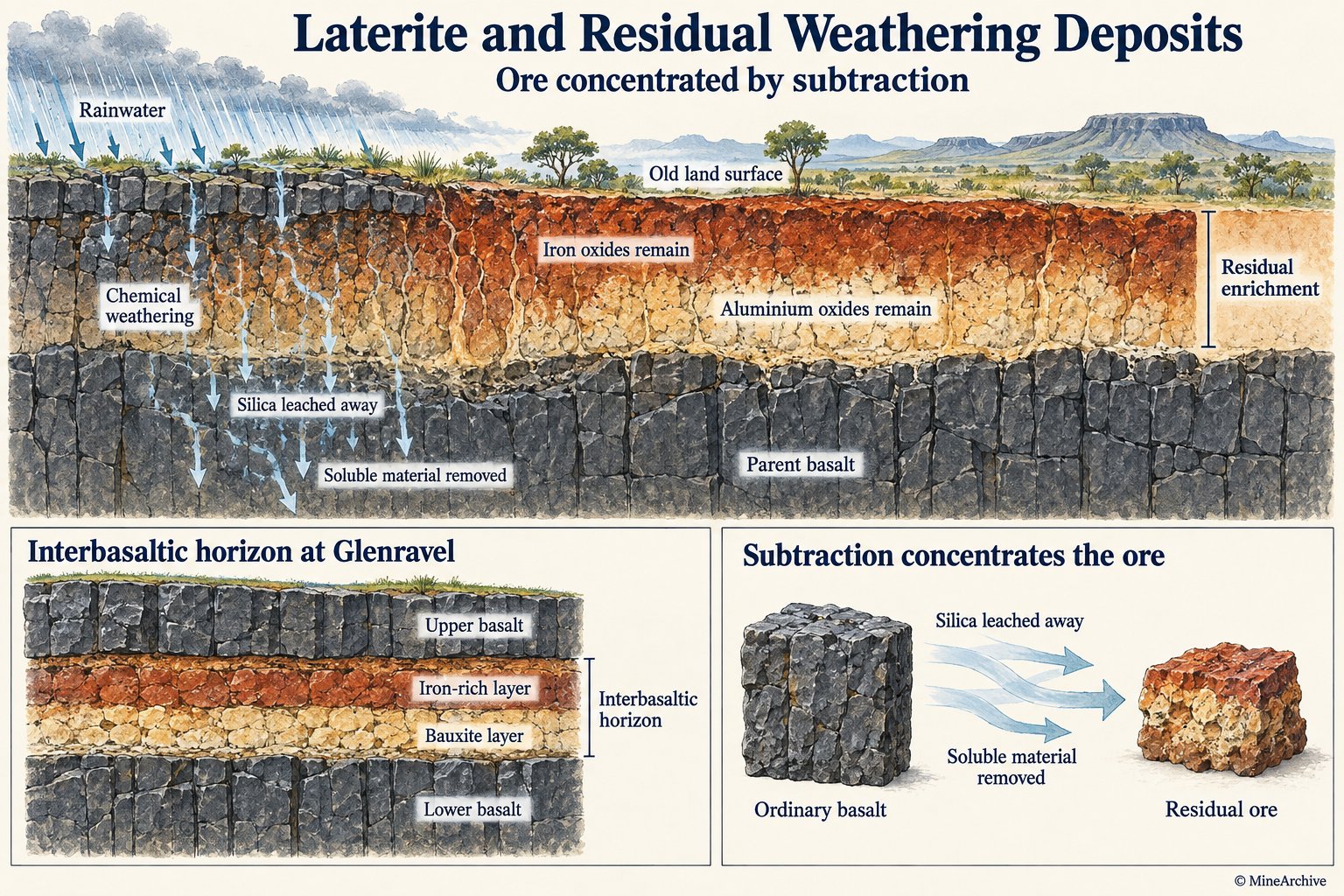
An ore body formed not by anything being added to a rock, but by long chemical weathering taking almost everything else away — leaving the least soluble elements (iron and aluminium oxides, in Britain's case) concentrated in place as a residual weathered horizon, or laterite.
How it forms
Under a hot, wet climate, rainwater percolating through exposed rock breaks down its original minerals — feldspar, pyroxene, olivine — into clay minerals and free iron and aluminium oxides. Silica, comparatively soluble, is progressively leached out of the weathering profile and carried away in solution, most effectively during a pronounced dry season, while the far less soluble iron and aluminium oxides are left behind and further concentrated as they're locally remobilised and redeposited during the wet season. Given enough time, and a landscape stable enough not to simply erode the weathered material away before it can develop, this leaching builds a horizon strongly enriched in iron and/or aluminium relative to the parent rock. At Glenravel, this happened directly on the basalt lava flows of the Antrim Lava Group, during a pause in volcanic activity long enough — between the Lower and Upper Basalt eruptions — for a full weathering profile, the Interbasaltic Formation, to develop before being buried again by the next flow.
Why minerals concentrate here
Weathering doesn't add new metal to a rock the way a hydrothermal fluid does — it simply removes almost everything else, dissolving away the more soluble elements and carrying them off in solution, while the far less soluble iron and aluminium oxides are left behind in ever-increasing relative concentration. Enough weathering, over enough time, can turn an ordinary rock — basalt is not an especially iron- or aluminium-rich starting material — into a workable ore purely by subtraction rather than addition.
Typical shape of the deposit
A roughly flat-lying, blanket-like horizon following the old weathered land surface, rather than a vein or bed with a geometry of its own — its thickness and quality depend entirely on how long and how completely that particular surface was exposed before burial. At Glenravel specifically, iron and bauxite formed as two separate zones within the same interbasaltic horizon, with the iron-enriched layer sitting above the bauxite: the miners' No. 1 or pisolitic ore, averaging about 14 inches thick, lay on top of the No. 2 ore, a ferruginous bauxite about 5 feet thick known locally as 'pavement'.
What this means for mining
Because the ore forms a broadly flat blanket following the old land surface rather than a narrow vein, it could be worked much like a sedimentary bed — following the horizon rather than chasing an unpredictable line underground. But a residual profile's own internal layering still matters: at Glenravel, iron and bauxite were, in effect, two separate thin seams stacked within the same horizon rather than one uniform ore body, and were worked at different times, by different operators, as each mineral's market value dictated, rather than as a single continuous operation.
Associated commodities
Bauxite (Glenravel's aluminous laterite ore, in the same weathering profile as the iron.), Iron (Glenravel's ferruginous laterite ore.)
Diagrams
MineArchive examples
Included only where MineArchive's own research gives a reasonable evidential basis — not every mine where this geology might plausibly apply.
- Glenravel Iron and Bauxite Mines — County Antrim (well documented example)
The mine's own geology field already describes the interbasaltic weathering profile and the iron-above-bauxite sequence directly.
See all 1 linked mine.
Sources
- (primary) Antrim Lava Group, Palaeogene extrusive igneous rocks, Northern Ireland — British Geological Survey (Earthwise)
- (primary) The Iron Mines of Glenravel — Glens of Antrim Historical Society
- (secondary) Lateritization and Bauxitization Events — ResearchGate (academic)
Record created: 25 August 2026 · Last researched: 25 August 2026