 MineArchive
Tievebulliagh Axe Factory
| Also known as | Tievebulliagh, Tievebulliagh porcellanite quarry |
|---|---|
| Location | Foot of the eastern scree of Tievebulliagh, townland of Cloghs, about 4-5 km west-south-west of Cushendall, Glens of Antrim, County Antrim — 55.0746, -6.1307 (approximate) |
| Commodity | Porcellanite |
| Type | Quarry |
| Worked | Neolithic, c. 3800 BC (axes dated 3800-2500 BC)–c. 2500 BC (end of Neolithic axe production) |
| Maximum depth | Surface quarrying at the base of the crag and scree; the porcellanite block extends somewhat below the upper scree. |
Overview
A Neolithic quarry and axe-making site at the foot of Tievebulliagh, a 402-metre hill near Cushendall in the Glens of Antrim, where a small block of porcellanite, baked by a volcanic plug, was quarried and roughed out into axes. Over 10,000 axes of Antrim porcellanite from here and Rathlin Island are known, the largest number from any identified source in the British Isles, and they travelled from the Outer Hebrides to the south coast of England. It was the first Neolithic axe factory to be recognised in the British Isles.
History
Stone-axe makers came to Tievebulliagh for a rock found almost nowhere else: porcellanite, a hard, fine-grained stone that takes a keen edge and a high polish and, unlike flint, does not flake easily. They quarried it at the foot of the eastern scree and roughed out axes, adzes and chisels on the spot; flakes, rejects and part-finished axes lie around the hill, but no finished axes have been found there, and the grinding and polishing were done elsewhere. The axes were probably made for felling trees and clearing land for crops, and some later took on a ceremonial role: the Malone hoard of 19 large polished axes of Tievebulliagh or Rathlin porcellanite, some set upright in the ground, was found in south Belfast and is in the Ulster Museum. Antrim porcellanite axes are the commonest Neolithic axes from an identifiable source in Britain. They reached south-west Ireland, north-east Scotland and the Outer Hebrides, and a few crossed to Kent, Dorset and Wessex; one was found with skeletons at Old Sarum near Salisbury in 1881. The only other source is at Brockley on Rathlin Island. The site compares with the Langdale axe industry in the Lake District and the quarries at Penmaenmawr in North Wales. The Ballymena antiquary William James Knowles excavated the factory, and E.M. Jope and colleagues surveyed Tievebulliagh and Rathlin in 1952. Tievebulliagh became the pioneer site for studying how the heat of the volcanic plugs transformed the lateritic Interbasaltic Bed into porcellanite. The axe factory and a Bronze Age cairn on the summit are scheduled historic monuments, and the crags are an Area of Special Scientific Interest.
Geology
An inclined disc-shaped dolerite plug, dipping 45 degrees east, cuts the Lower Basalts. A detached block of the lateritic Interbasaltic Bed, about 8 by 1.7 m, slid down the vent wall into the molten dolerite and was baked into porcellanite, a mullite-cordierite-corundum-spinel hornfels. It lies at the base of the cliff, with three small outcrops higher on the south-east slope.
Workings
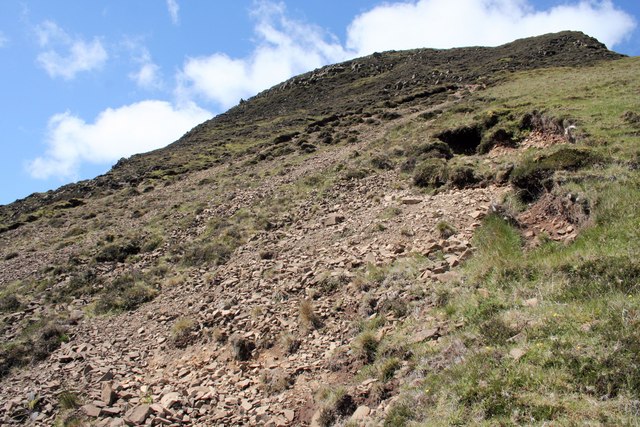
Quarrying of the porcellanite outcrop and scree at the foot of the crags; hummocky ground below the main scree may be Neolithic spoil heaps.
Closure
Worked in the Neolithic; sources give 3800-2500 BC for the axes, while a geological site summary says the factory was established about 3,000 years ago.
What remains
Open hillside and scree, an Area of Special Scientific Interest and scheduled monument. Visible artefacts have long been collected, but porcellanite flakes still emerge where the grassed scree is disturbed; a later gravel pit cuts the main scree.
Porcellanite outcrop, flake-strewn scree and possible spoil hummocks at the foot of the scree; a Bronze Age cairn on the summit.
Redevelopment
None; upland grazing and open hillside.
Related mines
- Brockley Porcellanite Quarry — The only two sources of Neolithic porcellanite axes, whose products cannot reliably be told apart.
- Tardree Quarry — Both Antrim interbasaltic sites where the ESCR records tridymite: in cavities at Tardree, in baked rock at Tievebulliagh.
Nearby mines
- Glenariff Iron Ore Mines — 4.7 km SE
- Glenravel Iron and Bauxite Mines — 8.2 km SW
- Carnlough Limestone Quarries — 11.5 km SE
Straight-line distance, within 15 km. Show on the map.
People
- William James Knowles (1832–1927) · author — Ballymena land agent and antiquary who excavated the Tievebulliagh axe factory and published accounts of it.
What's uncertain
Points where sources disagree or the record could not be settled; both accounts are kept. All open questions in the archive.
- The axes are dated 3800-2500 BC. (disputed) 3
- The Earth Science Conservation Review summary says Neolithic people established the factory 'somewhere around 3,000 years ago'. (disputed) 2
Recorded claims
Individual factual claims, each attached to the source(s) that support it below. Where sources disagree, both are kept.
- Tievebulliagh is nationally and internationally famous as the source of refined Neolithic stone axes made from a rare rock type. 1,2
- Over 10,000 axes of Antrim porcellanite are known, the largest number from an identified source in the British Isles. 2,3
- Axes were roughed out at the site and finished elsewhere; flakes, rejects and part-finished axes are found around the hill but no finished axes. 1,3
- Axes from Tievebulliagh or Rathlin have been found from the Outer Hebrides and north of Scotland to Dorset and Kent. 1,2
- The axes are dated 3800-2500 BC. (disputed) 3
- The Earth Science Conservation Review summary says Neolithic people established the factory 'somewhere around 3,000 years ago'. (disputed) 2
- The porcellanite is an isolated 8 by 1.7 m block of the Interbasaltic Bed that subsided down the wall of an inclined dolerite plug and was thermally metamorphosed. 2
- The round cairn and Neolithic axe factory are scheduled historic monuments in the townland of Cloghs. 1
- William James Knowles excavated the axe factory at Tievebulliagh. 4
- The Malone hoard of 19 polished porcellanite axes, from Tievebulliagh or Rathlin, was found on the Malone Road, Belfast, and is in the Ulster Museum. 1
- Porcellanite was among the rocks exploited, and in some cases exported, for Neolithic polished stone axes in Northern Ireland. 5
Photographs & further reading
Geological site summary explaining how the porcellanite formed and the site's archaeological importance.
View sourceThe hill, its geology, the axe quarry, the Malone hoard and the scheduled monuments.
View sourceA Tievebulliagh or Rathlin porcellanite axe found at Old Sarum, with notes on the trade in Antrim axes.
View sourceSources
- (secondary) Tievebulliagh — Wikipedia
- (secondary) Tievebulliagh - Palaeogene (Earth Science Conservation Review site summary) — National Museums NI, Habitas (Enlander, Dempster & Doughty 2026)
- (secondary) Porcellanite Axe (find) — Stratford sub Castle local history (Kerry O'Connor, 2021)
- (secondary) William James Knowles — Wikipedia
- (secondary) The influence of people in Northern Ireland — British Geological Survey / GSNI (Earthwise)
Record created: 18 September 2026 · Last researched: 18 September 2026