 MineArchive
Brockley Porcellanite Quarry
| Location | Brockley, townland of Ballygill Middle, Rathlin Island, County Antrim — 55.3019, -6.2401 (approximate) |
|---|---|
| Commodity | Porcellanite |
| Type | Quarry |
| Worked | Neolithic, c. 3800 BC–c. 2500 BC (end of Neolithic axe production) |
| Maximum depth | Unknown; a shallow quarry or cave-like working in the outcrop. |
Overview
A Neolithic quarry at Brockley, in the townland of Ballygill Middle on Rathlin Island, where porcellanite was dug and roughed out into stone axes that were shipped to the mainland to be finished. It is the only source of porcellanite axes besides Tievebulliagh on the Antrim mainland, and the two sites' products, which cannot reliably be told apart, were the most important Irish stone axe sources of their time.
History
Rathlin had people from at least the Mesolithic, and in the Neolithic islanders worked a deposit of porcellanite, an exceptionally hard, fine-grained stone formed where volcanic heat baked older rock, at Brockley, a cluster of houses in Ballygill Middle. They chipped pieces into the rough shape of axes and other tools, which were taken off the island to be ground and polished elsewhere; some finished porcellanite, and flint blades, have also been found on Rathlin itself. Axes from Brockley and Tievebulliagh were traded across Ireland and into Britain, from the Outer Hebrides to the south coast of England, and more than 10,000 are known from the two Antrim sources; the Malone hoard of 19 polished axes from Belfast is of Tievebulliagh or Brockley stone. The two sources cannot reliably be told apart. A coastal survey of Rathlin reported by the Irish Times, which also recorded 81 of the island's later kelp kilns, noted that 'Rathlin is very well known in archaeological terms because of its porcellanite factory'.
Geology
Porcellanite, a very hard, fine-grained rock formed by contact metamorphism of the lateritic Interbasaltic Bed by volcanic intrusions, as at Tievebulliagh.
Workings
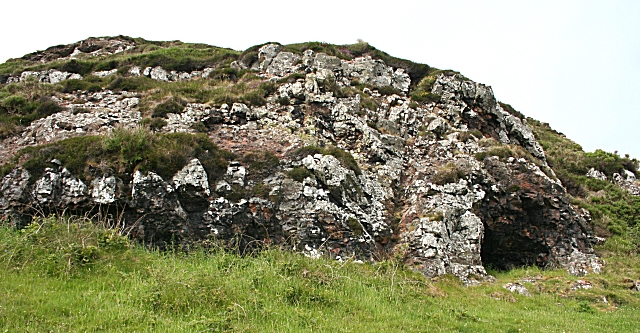
A quarry in the porcellanite outcrop, with a hollow that looks like a cave; axes were roughed out on site and finished elsewhere.
Closure
Worked in the Neolithic; the Antrim porcellanite axes are dated 3800-2500 BC. No later working is recorded.
What remains
The worked outcrop and its cave-like hollow survive in open ground on Rathlin.
The quarried outcrop; porcellanite debris.
Redevelopment
None.
Related mines
- Tievebulliagh Axe Factory — The only two sources of Neolithic porcellanite axes, whose products cannot reliably be told apart.
Nearby mines
- Ballycastle Coal Mines — 10.7 km S
Straight-line distance, within 15 km. Show on the map.
What's uncertain
Points where sources disagree or the record could not be settled; both accounts are kept. All open questions in the archive.
- The Irish Times summary of the survey puts the stone-tool factory at about 7,000 years ago. (uncertain) 2
Recorded claims
Individual factual claims, each attached to the source(s) that support it below. Where sources disagree, both are kept.
- A Neolithic stone axe factory of porcellanite is at Brockley, a cluster of houses in the townland of Ballygill Middle, Rathlin Island. 1
- The products of the Brockley and Tievebulliagh factories cannot be reliably distinguished; they were the most important Irish stone axe sources of their time. 1
- Islanders chipped the porcellanite into the rough shape of tools, then shipped them off to be finished elsewhere. 2
- The Malone hoard of 19 polished axes is of porcellanite from Tievebulliagh or Brockley on Rathlin Island. 3
- More than 10,000 axes of porcellanite from Tievebulliagh or Rathlin are known, found across Ireland and Britain. 4,5
- The Irish Times summary of the survey puts the stone-tool factory at about 7,000 years ago. (uncertain) 2
Photographs & further reading
The island's history, including the Brockley axe factory in Ballygill Middle.
View sourceReport on a coastal survey of Rathlin, its porcellanite factory and kelp kilns.
View sourceSources
- (secondary) Rathlin Island — Wikipedia
- (secondary) How ancient islanders worked Rathlin's volcanic rock — The Irish Times
- (secondary) Tievebulliagh — Wikipedia
- (secondary) Porcellanite Axe (find) — Stratford sub Castle local history (Kerry O'Connor, 2021)
- (observational) Axe Factory (D1151) — Geograph (Anne Burgess)
Record created: 18 September 2026 · Last researched: 18 September 2026