 MineArchive
Ballycastle Coal Mines
| Also known as | Craigfad Mine |
|---|---|
| Location | Ballycastle, County Antrim — 55.2058, -6.2436 (approximate) |
| Commodity | Coal |
| Type | Coal |
| Worked | 16th century (earliest working)–1967 (Craigfad Mine, final closure) |
| Operators | Hugh Boyd (1736–?) |
Overview
Small coal seams worked along dramatic County Antrim sea cliffs for centuries, the last area of commercial coal extraction anywhere in Northern Ireland.
History
Coal has been worked around Ballycastle since at least the 16th century, with organised export beginning by the 1730s. In 1736 the entrepreneur Hugh Boyd acquired the rights to the Ballycastle coal mines and, with substantial backing from the Irish parliament, developed the town around them, adding a glass furnace, an iron foundry, salt pans, a brewery and a tannery. Annual coal exports in the mine's most active period ran to 10,000-15,000 tons, drawn from coal measures around four miles long and a mile and a half wide. Workings exploited the coastline directly, with adits driven south into the cliff face to follow the coal seams' northerly tilt, and railroads were eventually used to bring coal out of the workings — but the parallel cliff-face mines proved difficult to ventilate, and strong tides repeatedly silted up the harbour used to ship the coal out, limiting the field's success despite real investment in contemporary technology. The last working pit, Craigfad Mine, closed in 1967, bringing to an end the final area of commercial coal extraction anywhere in Northern Ireland.
Geology
The Ballycastle coalfield's seams outcrop directly in the sea cliffs of the North Antrim coast, tilted northward, within coal measures roughly four miles long and a mile and a half wide.
Workings
Coal was worked via adits driven south from the cliff face into the tilted seams, with railroads later used to bring coal out to the harbour for shipping.
Closure
The final working pit, Craigfad Mine, closed in 1967, ending commercial coal extraction in Northern Ireland altogether.
What remains
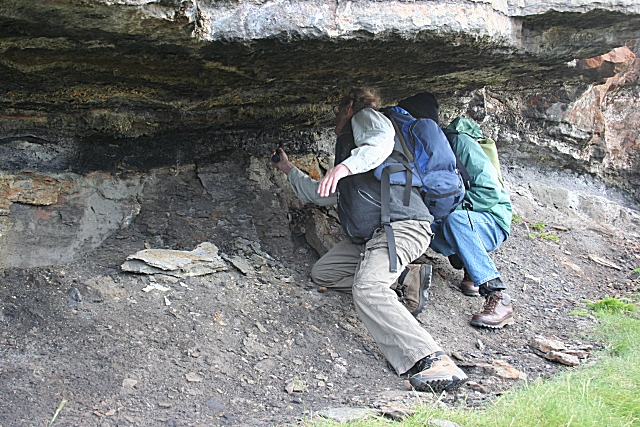
Old adit entrances and mining remains survive in and around the sea cliffs near Ballycastle.
Adit entrances and associated mining remains in the coastal cliffs near Ballycastle.
Nearby mines
- Brockley Porcellanite Quarry — 6.6 miles (10.7 km) N
Straight-line distance, within 9 miles (15 km). Show on the map.
Old adits are cut directly into unstable sea cliffs; this entry describes history and general location only, not an access guide.
Recorded claims
Individual factual claims, each attached to the source(s) that support it below. Where sources disagree, both are kept.
- Coal has been worked around Ballycastle since at least the 16th century, with organised export from the 1730s; Hugh Boyd acquired the mining rights in 1736 and developed the town around them with Irish parliament backing. 1,2
- Coal seams outcropping in the sea cliffs were worked by adits driven south to follow their northerly tilt, but the parallel cliff-face workings proved difficult to ventilate, and strong tides repeatedly silted up the shipping harbour. 3
- The last working pit, Craigfad Mine, closed in 1967, marking the end of commercial coal extraction anywhere in Northern Ireland. 1
Photographs & further reading
The Earth Science Conservation Review summary of the coalfield, describing the strata the seams sit in along the County Antrim coast.
View sourceA nineteenth-century account of the collieries reprinted at Library Ireland, covering the organised working and export of the coal.
View sourceSources
- (secondary) Ballycastle Coalfield — Northern Mine Research Society
- (secondary) Ballycastle Collieries, County Antrim — Library Ireland
- (secondary) Ballycastle Coalfield — Earth Science Conservation Review
- (observational) Coal Seam, near Ballycastle (Geograph 470247) — Geograph Britain and Ireland, Anne Burgess
Record created: 21 August 2026 · Last researched: 11 September 2026