 MineArchive
Gallery System
| Category | Mine Workings & Access |
|---|
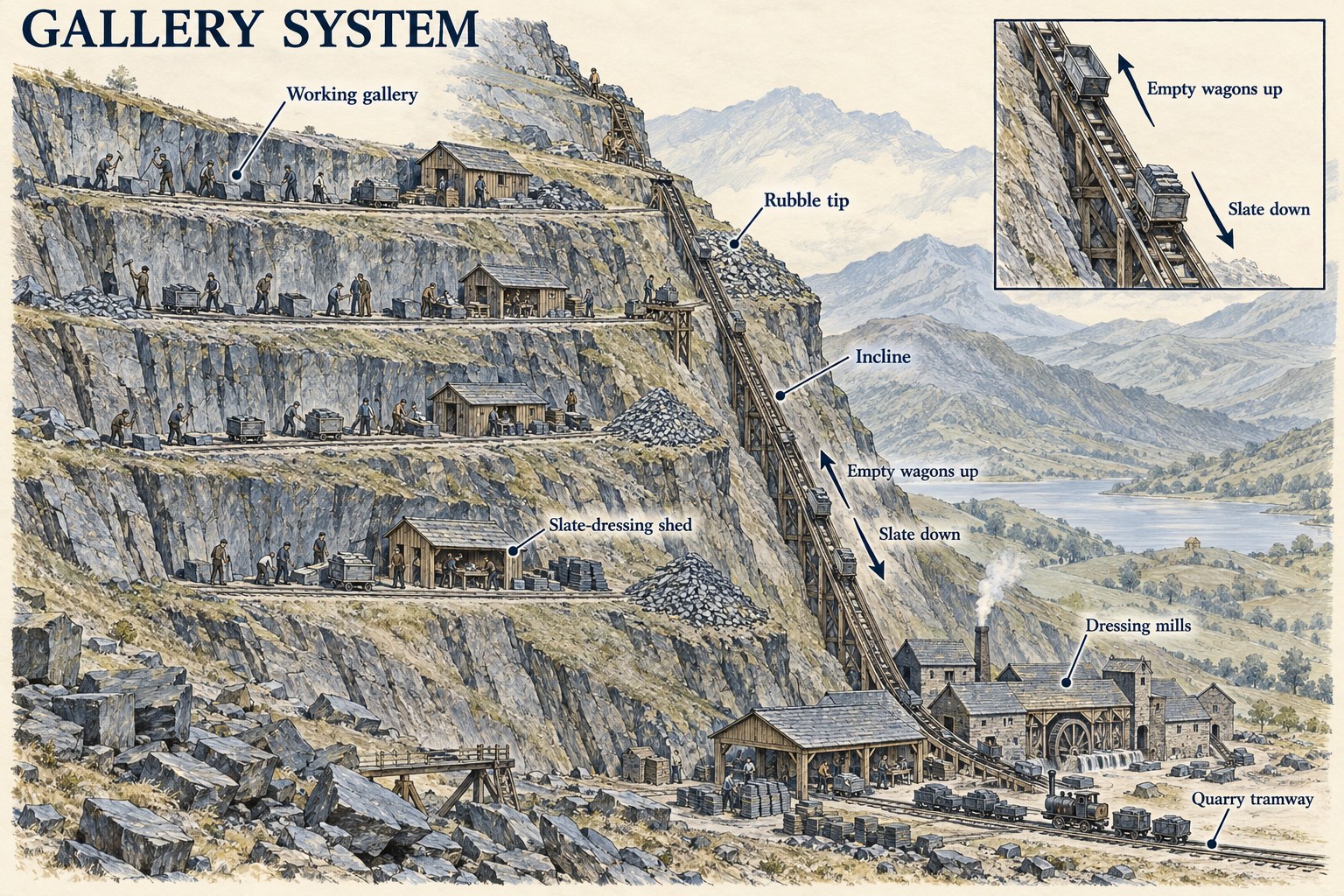
A method of working an open slate quarry as a series of stepped horizontal terraces climbing a hillside, each one a working gallery in its own right, connected to the dressing mills below by inclines.
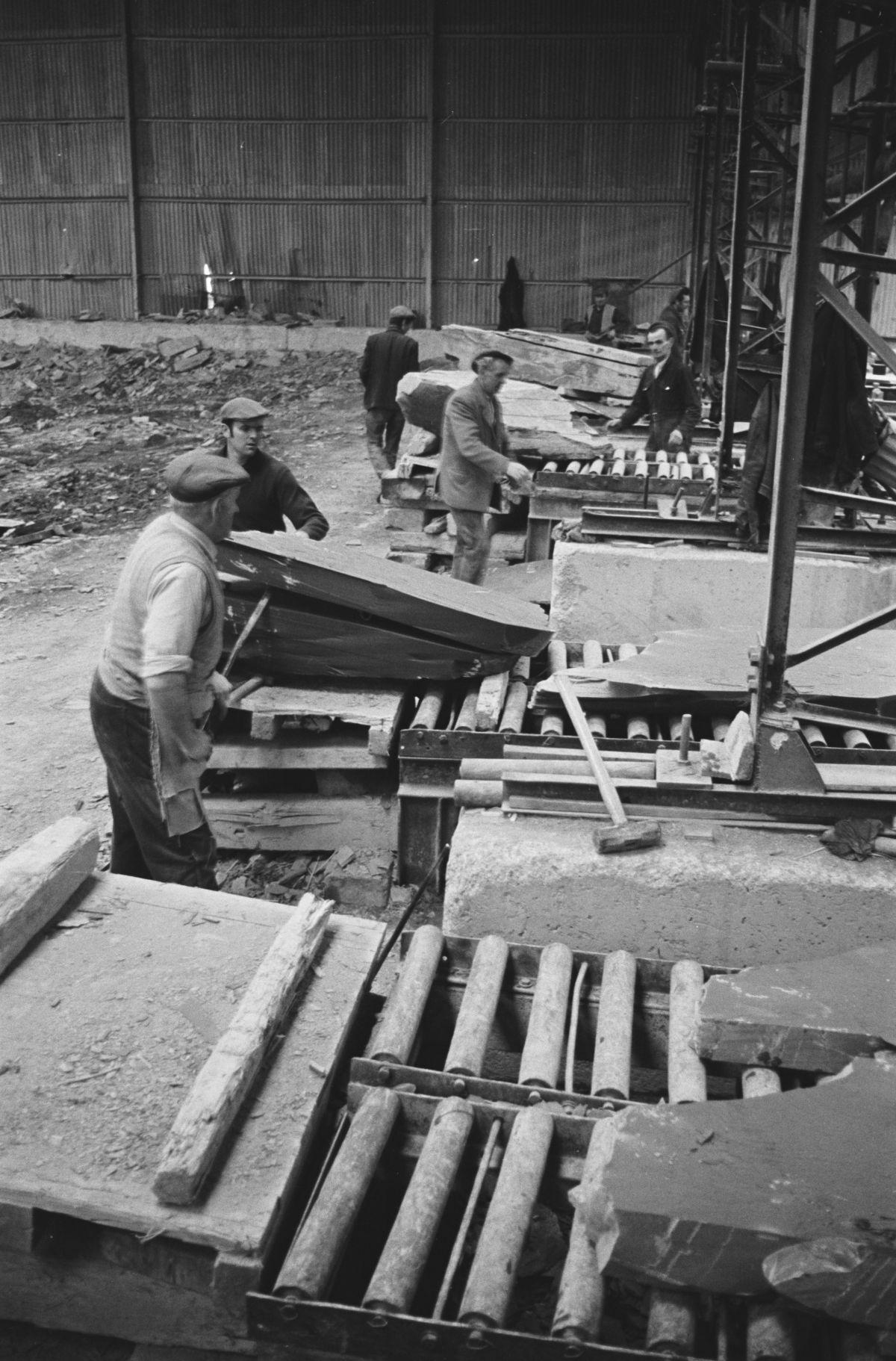
Historical usage
Introduced at Penrhyn Quarry, Bethesda, early in the ownership of the Pennant family (from the 1780s), and in wide use there and elsewhere in the Welsh slate industry by the early 19th century. Over 20 galleries were eventually in use at Penrhyn alone, and the same principle was adopted at Dinorwic and later smaller quarries, including Gorseddau.
How it worked
The quarry face was cut back in a sequence of level terraces rather than as a single deep pit, each terrace between roughly 9 and 21 metres (30-70 feet) deep. Large numbers of men could then work the same vein simultaneously at different heights, each gallery with its own rubble tips and often its own slate-dressing sheds. Wagons brought worked slate down, and empty wagons back up, via an incline connecting each gallery to the dressing mills and, ultimately, the quarry's own tramway or railway system at the base.
Why it was used
Working several galleries at once let a quarry put far more men on a single vein than a single working face ever could, while the incline network moved material down to the mills without needing to haul it back up by hand -- the combination is what let quarries the size of Penrhyn and Dinorwic reach production levels and workforces (Penrhyn alone employed close to 3,000 men by the late 19th century) that a single-pit working could never have supported.
Risks & limitations
Every gallery still relied on men working in the open, roped to the rock face, using handheld wedges and crowbars to bring slate down -- the system organised the scale of the operation, but did nothing to make the underlying work itself any less exposed or dangerous than slate quarrying always was.
Regional variation
Specific to open-quarry slate working in North Wales; the equivalent organising principle underground (a horizontal working reached from a shaft) is a Level, a genuinely different thing worked below ground rather than up an open hillside.
Related terminology
Mines associated with this term
Included only where MineArchive's own research gives a reasonable evidential basis — not every mine where this might plausibly apply.
- Gorseddau Quarry — Gwynedd (well documented example)
Named twice in this record, first in the history: “…Henry Tobias Tschudy von Uster. The quarry was laid out on the gallery system pioneered at Penrhyn, with a spinal counterbalance incline linking a…” - Penmachno Quarry — Conwy (well documented example)
The quarry was unusual in working as both a gallery quarry and an underground one. - Winspit — Dorset (well documented example)
Named in this record’s surface remains: “Disused quarry buildings and extensive gallery systems survive in the cliff face, along with visible cart rutways.”
Sources
- (observational) Penrhyn Slate Quarry (1534240) — National Library of Wales (Geoff Charles collection), via Wikimedia Commons
- (secondary) Penrhyn quarry — Wikipedia
- (secondary) The Slate Industry of North and Mid Wales: Penrhyn Quarry — Penmorfa (Slate Industry of North and Mid Wales)
.jpg)
Record created: 31 August 2026 · Last researched: 31 August 2026