 MineArchive
Winspit
| Location | Near Worth Matravers, Isle of Purbeck, Dorset — 50.5848, -2.0342 (exact) |
|---|---|
| Commodity | Freestone |
| Type | Quarry |
| Worked | 1719–1953 (surface working ceased c. 1940) |
| Operators | Company of Marblers of Corfe Castle |
Overview
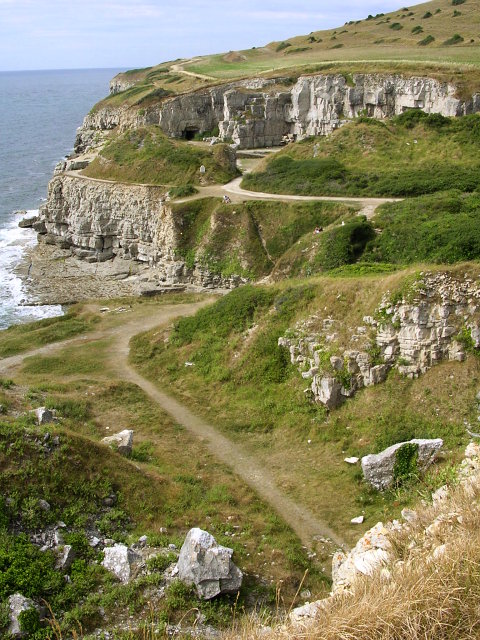
Winspit, on the Isle of Purbeck cliffs, was quarried for Portland Stone from 1719 until 1953, its underground galleries later repurposed for wartime coastal defence and, since, as a location for Doctor Who, Blake's 7 and Star Wars.
History
Winspit lies on the cliffs near Worth Matravers on the Isle of Purbeck, Dorset, stone working there beginning in 1719. Quarrymen worked the Under Freestone, a fine, cream-coloured oolitic limestone bed around 6 feet thick prized for items such as sinks and curbstones, accessed through horizontal galleries driven into the cliff and supported by limestone pillars; waste rock (the Under Picking Cap) and other Portland Stone members, including the House Cap -- in which giant Titanites ammonites are embedded -- were also worked. Stone was hauled to loading cranes on man-hauled carts along rutways cut into the rock, then shipped out by sailing barge; Winspit stone was used, among other buildings, in the construction of Allhallows School. Quarrying at Winspit continued, providing stone for London buildings, until around 1940, with the west quarry's large underground gallery worked until 1953. During the Second World War the site was used for naval and air defences. After the war its caves were opened to the public, and the site has since been used as a filming location, including for Doctor Who ('The Underwater Menace' and 'Destiny of the Daleks'), Blake's 7, the 1978 film Jubilee, John Carter (2012) and Star Wars spin-off Andor, filmed there in 2021. In March 2022 the National Trust purchased the surrounding 350-acre Weston Farm estate, including Winspit.
Geology
Part of the Purbeck Group, a sequence of Late Jurassic to Early Cretaceous limestones deposited in shallow tropical lagoons around 145 million years ago; the site exposes the full Portland Freestone succession, including the Shrimp Bed, the Titanites Bed, the Pond Freestone and a Chert Vein.
Workings
Worked the Under Freestone, a 6-foot oolitic limestone bed, via horizontal galleries driven into the cliff face and supported by limestone pillars; stone was moved on man-hauled carts along rock-cut rutways to loading cranes and shipped out by sailing barge.
Closure
The site is abandoned and hazardous, with highly fractured stone, unstable overhanging faces and collapsed gallery roofs.
What remains
The site is abandoned and hazardous, with highly fractured stone, unstable overhanging faces, collapsed gallery roofs in places and loose debris presenting rockfall risk; many caves have been closed to the public for safety and to protect roosting bats.
Disused quarry buildings and extensive gallery systems survive in the cliff face, along with visible cart rutways.
Redevelopment
Now owned by the National Trust as part of the Weston Farm estate (acquired March 2022), managed for public access, bat conservation and its continued use as a film and television location.
Nearby mines
- Purbeck Marble Quarries — 1.6 miles (2.5 km) NE
- Norman's Quarry — 2.0 miles (3.2 km) NE
- Tilly Whim Caves — 3.4 miles (5.5 km) E
- Kimmeridge Oil Shale Workings — 4.6 miles (7.3 km) NW
- Furzebrook and Norden Ball Clay Pits — 4.8 miles (7.8 km) NW
Straight-line distance, within 9 miles (15 km). Show on the map.
Recorded claims
Individual factual claims, each attached to the source(s) that support it below. Where sources disagree, both are kept.
- The quarry worked the Under Freestone, a fine cream-coloured oolitic limestone bed around 6 feet thick, exposing the full Portland Freestone succession including the Shrimp Bed, the Titanites Bed (in which giant Titanites ammonites are embedded in the House Cap), the Pond Freestone and a Chert Vein. 1
- Stone was worked through horizontal galleries supported by limestone pillars and hauled on man-hauled carts along rutways cut into the rock to loading cranes, from where it was shipped out by sailing barge; the western quarry's large underground gallery was worked until 1953. 1
- Since the Second World War, when the site was used for naval and air defences, Winspit has been used as a filming location for Doctor Who ('The Underwater Menace' and 'Destiny of the Daleks'), Blake's 7, the 1978 film Jubilee, John Carter (2012) and the Star Wars series Andor (filmed 2021). 2
- Purbeck's stone quarries, including Winspit, were traditionally worked not by a single incorporated company but by freemen operating under the rules of the Company of Marblers of Corfe Castle, a guild whose earliest surviving bylaws (renewed 1651) state they were themselves drawn from older records, with a further Articles of Agreement dated 1697. 3
Photographs & further reading
Sources
- (secondary) Winspit and Seacombe, Isle of Purbeck — Wessex Coast Geology (Ian West, University of Southampton)
- (secondary) Winspit — Wikipedia
- (primary) Four documents related to the Stone Merchants and Marblers of Corfe Castle, Dorset — GENUKI (transcribing the 1651 Bylaws of the Marblers of Corfe Castle)
Record created: 2 September 2026 · Last researched: 2 September 2026