 MineArchive
Purbeck Marble Quarries
| Also known as | Purbeck marble quarrs, Langton Matravers quarries |
|---|---|
| Location | Acton and Langton Matravers, Isle of Purbeck, Dorset — 50.6053, -2.0183 (approximate) |
| Commodity | Limestone |
| Type | Quarry |
| Worked | From the Roman period–1990s |
| Maximum depth | Shafts up to about 38 m (125 ft) |
Overview
Not a single mine but a medieval industry — narrow shafts and galleries dug beneath the hills above Langton Matravers for a fossil-rich limestone that takes a mirror polish, and that found its way into nearly every cathedral in southern England.
History
Purbeck marble was worked by the Romans and again, on a much larger scale, through the Middle Ages, when demand for polished decorative stonework peaked between the 12th and 14th centuries. Salisbury Cathedral alone is said to have taken some 3,000 marble shafts and columns from quarries near Dunshay, close to Corfe Castle, and the stone appears in Canterbury Cathedral, Westminster Abbey and most other major English cathedrals built in that period. The Great Fire of London in 1666 created fresh demand for durable Purbeck paving stone, and quarrying continued through the 18th and 19th centuries at its commercial peak. As accessible surface stone was worked out, quarrymen developed the 'quarr' system of underground working, sinking shafts to reach deeper beds. One well-recorded example, Norman's Quarry northeast of Acton, was sunk in the early 20th century by the Norman family and worked until the Second World War; its winding gear and quarr houses have since been restored as an example of a typical quarr. Purbeck marble ceased commercial extraction in the 1990s, though small quantities have been quarried since for restoration and conservation work on the buildings it originally supplied.
Geology
Purbeck marble is not a true metamorphic marble but a Late Jurassic to Early Cretaceous freshwater limestone, part of the Purbeck Group laid down around 145 million years ago in shallow lagoons. It is distinguished from ordinary Purbeck building stone by being packed with the tiny fossil shells of the freshwater snail Viviparus, which give it a mottled, almost marble-like appearance and let it take a fine polish once cut and ground — a decorative quality that ordinary limestone lacks.
Geological setting: Sedimentary Beds and Seams (well documented example)
Workings
Early quarrying was shallow open-cast work along the outcrop. As the shallow beds were worked out, quarrymen sank vertical shafts — the 'quarrs' — up to about 125 feet deep, with horizontal galleries driven out from the shaft bottom to follow the marble bed. Stone was raised in wagons or baskets on a rope worked by a capstan winch, itself usually turned by a horse or donkey walking in a circle at the surface. At the coast, clifftop quarries lowered finished stone directly into waiting ships using wooden cranes called whims.
Closure
Commercial Purbeck marble extraction ended in the 1990s as demand for a decorative stone of this kind had long since fallen away; some working continues on a very small scale for conservation projects.
What remains
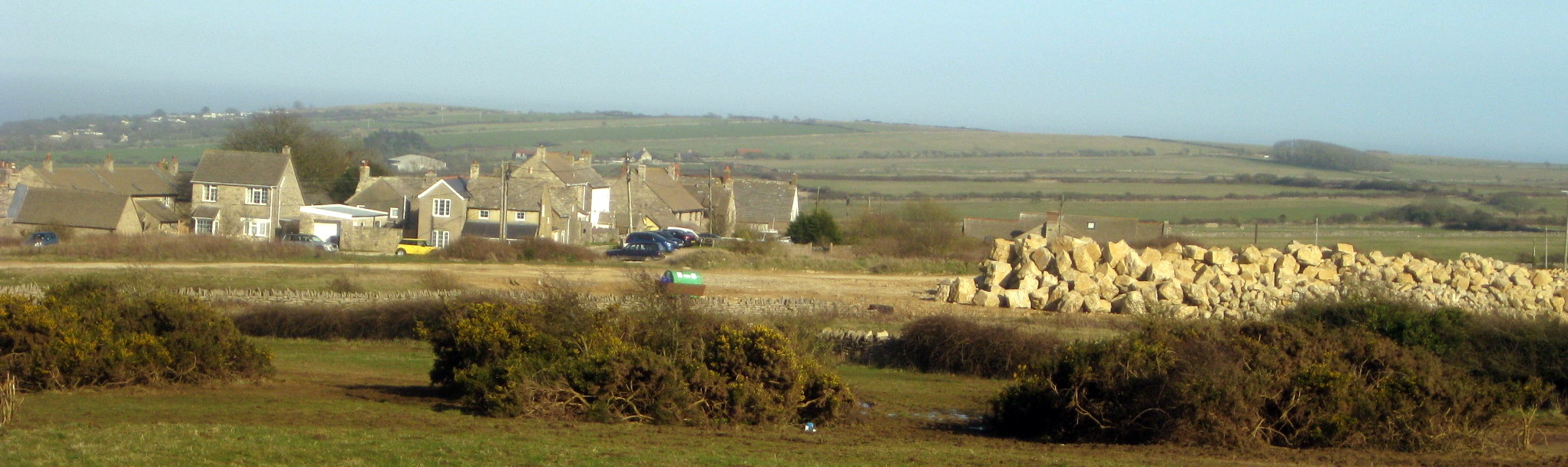
Numerous disused quarr entrances survive as low arches and overgrown spoil heaps in the hillside north of Langton Matravers, many visible from the Priest's Way footpath. Norman's Quarry, restored with its quarr houses, capstan and inclined shaft intact, is kept as a public example of how the system worked; most other quarrs are inaccessible or collapsed.
Quarr house ruins, overgrown spoil heaps and shaft entrances scattered across the hillside, with Norman's Quarry preserved as a restored, interpretable example.
Redevelopment
None beyond the restoration of Norman's Quarry as a heritage site; the wider quarr landscape remains as found.
Related mines
- Norman's Quarry — Norman's is one of the Purbeck quarrs of the Acton and Langton Matravers ground that the Purbeck Marble Quarries record covers, and is named on it as a well-recorded example of the type.
Nearby mines
- Norman's Quarry — 0.4 miles (0.6 km) NE
- Winspit — 1.6 miles (2.5 km) SW
- Tilly Whim Caves — 2.8 miles (4.5 km) E
- Furzebrook and Norden Ball Clay Pits — 4.1 miles (6.6 km) NW
- Kimmeridge Oil Shale Workings — 4.9 miles (7.8 km) W
Straight-line distance, within 9 miles (15 km). Show on the map.
Recorded claims
Individual factual claims, each attached to the source(s) that support it below. Where sources disagree, both are kept.
- Purbeck marble was worked by the Romans and, on a much larger scale, through the Middle Ages, with demand peaking between the 12th and 14th centuries; Salisbury Cathedral alone is said to have taken about 3,000 marble shafts and columns from quarries near Dunshay. 1
- Purbeck marble is a Late Jurassic to Early Cretaceous freshwater limestone packed with fossil shells of the snail Viviparus, which give it a mottled appearance and let it take a polish — distinguishing it from ordinary Purbeck building stone. 1
- As shallow beds were exhausted, quarrymen sank vertical shafts up to about 125 ft deep with horizontal galleries at the bottom, raising stone by capstan winch usually turned by a horse or donkey. 1
- Norman's Quarry, northeast of Acton, was sunk in the early 20th century and worked until the Second World War; it survives restored, with its quarr houses, capstan and inclined shaft intact, as an interpretative example of a typical quarr. 2
- Commercial Purbeck marble extraction ended in the 1990s, with only small-scale conservation quarrying continuing since. 1
Sources
- (secondary) Purbeck Stone and Quarrying in the Isle of Purbeck — Virtual Swanage
- (primary) Norman's Quarry, Langton Matravers — Dorset Historic Environment Record — Dorset Council Historic Environment Record
Record created: 24 August 2026 · Last researched: 24 August 2026