 MineArchive
Capstan
| Also known as | Crab (North East England), Ground Crab (North East England) |
|---|---|
| Category | Structures & Machinery |
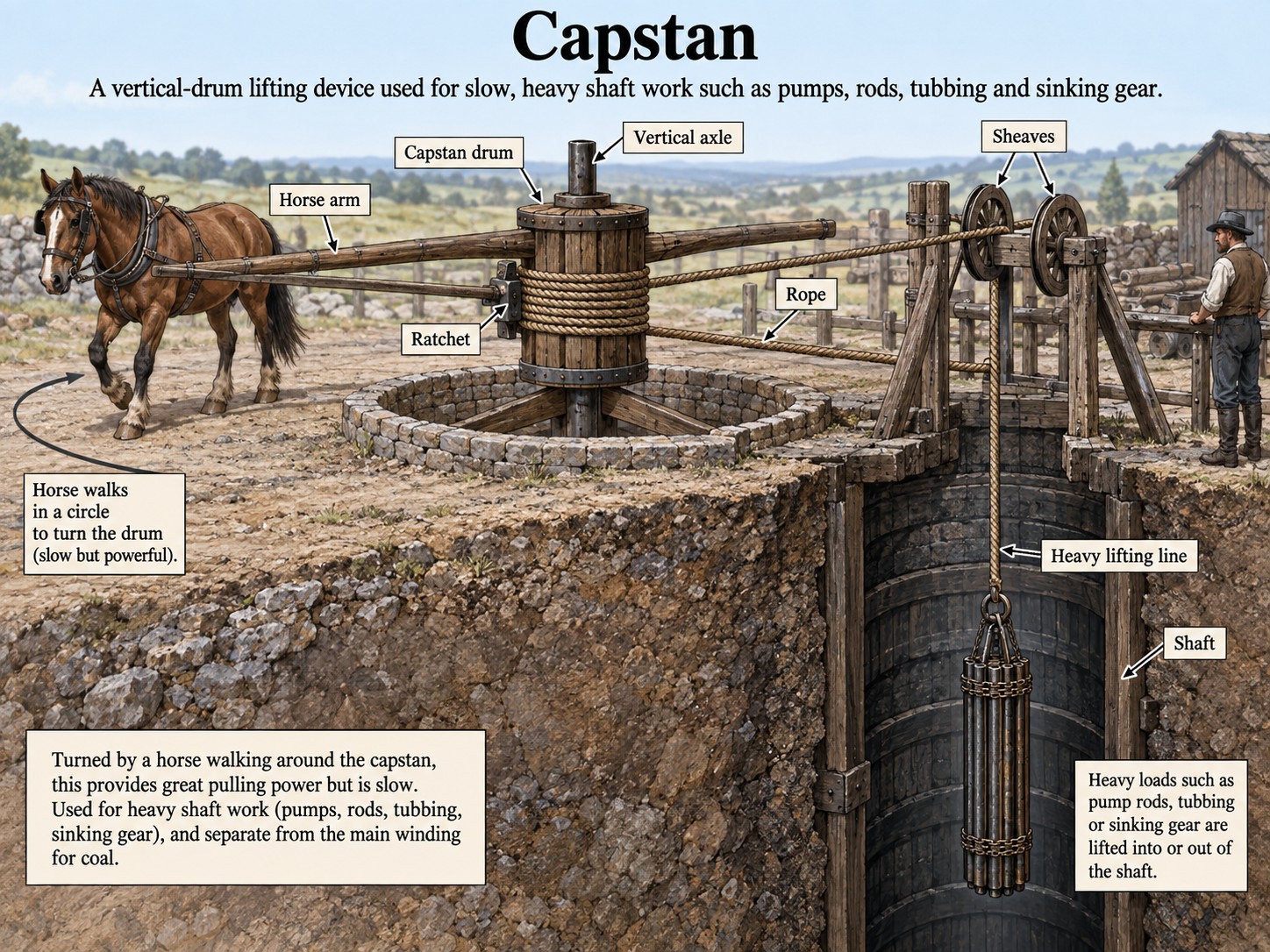
A drum on a vertical axle, worked by hand, horse or engine, used at a mine for heavy lifting in the shaft — pumps, pump rods, tubbing and sinking gear — as distinct from the winding engine that raised the coal.
Historical usage
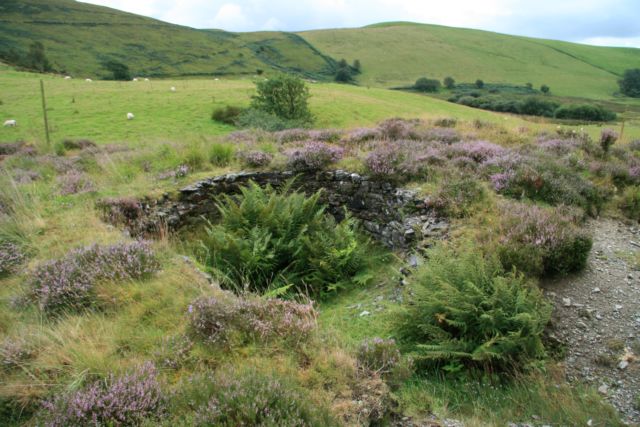
Greenwell's glossary of the northern coal trade gives the North East word: a crab is 'a species of capstan, worked usually by horses, for the purpose of raising or lowering heavy weights, such as pumps, spears, &c., in a shaft', and ground crabs were used in sinking for lowering the sinking set of pumps as the pit was deepened. The rope it worked was the crab rope, and the movable stage on which men repaired a shaft — the cradle — usually hung from it. Metal mines used the same thing for the same purpose: a masonry-lined capstan pit survives beside Skinner's Shaft at Cwmsymlog in Ceredigion, where the capstan raised and lowered pump rods and pipes in a shaft 130 fathoms deep.
How it worked
The drum stood over or beside the shaft mouth, often set in a shallow lined pit, with arms for men or horses to walk round it and a ratchet to hold the load. The rope ran from the drum over sheaves at the shaft head and down to whatever was being lifted. Because the load was heavy and slow rather than fast and light, the capstan was geared for pull rather than speed, and its work was measured in the weight it could hold rather than in tons an hour.
Why it was used
A winding engine is built to lift a cage quickly and repeatedly; it is the wrong tool for hanging a column of pump spears, lowering a length of tubbing or holding a stage of men steady halfway down a shaft. The capstan gave a mine a second, slower lifting line that could be rigged where it was needed and worked independently of the winding.
Risks & limitations
Everything about capstan work happened over an open shaft. When four sinkers at Auckland Park Colliery went to one side of a half cradle in 1863 to lift a cast-iron pipe against the tubbing, their weight tipped it and dropped them fifty-one fathoms; the Inspector's recommendation afterwards was that a cradle should be lashed before men move about on it, and that an iron bar standing a few inches above its edge would give a man something to catch.
Regional variation
In Northumberland and Durham the capstan is a crab, and a ground crab is the one used in sinking. The word capstan itself is general engineering rather than mining vocabulary, which is why Barrowman's Scotch glossary — which deliberately excludes machinery names not peculiar to Scotland — leaves it out, and why some glossaries fold it into the whim. The distinction worth keeping is one of purpose: a whim winds coal or ore, a capstan lifts the gear.
Related terminology
Pumping Engine, Shaft Sinking, Whim, Winding Rope
Mines associated with this term
5 examples chosen from 14 linked records — the term page is not an index.
- Cefn Coed Colliery — Neath Port Talbot (well documented example)
Named in this record’s surface remains: “…engines. Both headframes and the engine house range with its steam capstan engine are listed.” - Derwent Lead Mines — County Durham (well documented example)
Named 3 times in this record, first in the workings: “…now capped with concrete and an iron plate carrying a small hand capstan. When a branch railway reached Sikehead across the moors, cheap coal…” - Ecton Copper Mines — Staffordshire (well documented example)
Named in this record’s workings: “…1807), an underground ore canal built 1773–1784, and a horse-powered capstan and balance-cone winding arrangement.” - Millclose Mine — Derbyshire (well documented example)
Named in this record’s current condition: “…thick — along with winding house and boiler house foundations, a capstan site, and extensively reworked spoil hillocks; the site was…” - Poynton Collieries — Cheshire (well documented example)
Named twice in this record, first in the current condition: “…every building has since gone. The Lady Pit winding engine house and capstan house survive and have been restored and converted to offices —…”
Disasters associated with this term
5 examples chosen from 12 linked records, most direct relationship first.
- Auckland Park Colliery Shaft Accident, 1863 (contextual relationship)
Named twice in this record, first in the cause: “The cradle was suspended in the shaft by four chains from a capstan or crab rope. Several of the seven men on it had to go to one side…” - Barrow Colliery shaft accident, 1874 (contextual relationship)
Named 5 times in this record, first in the summary: “…being sunk for the new Barrow pits at Bryncethin, after a cast-iron crab winch failed.” - Brynmally Colliery inrush, 1856 (contextual relationship)
Named in this record’s rescue and recovery: “…the pumping apparatus failed, and while it was being repaired the capstan chain fell on the head of the pitman Robert Kendrick, who left a…” - Cowpen Colliery shaft accident, 1841 (contextual relationship)
Named 5 times in this record, first in the summary: “…and rubbish broke from the shaft side on to the hanging cradle. The crab holding it ran wild and the cradle smashed down on the brattice,…” - Cwmneol Colliery shaft accident, 1883 (contextual relationship)
Named 3 times in this record, first in the summary: “…of the Powell Duffryn Company's Cwmneol pit at Cwmaman when the crab lowering their bucket ran wild. They fell some 150 yards into five…”
Sources
- (primary) G. C. Greenwell, A Glossary of Terms used in the Coal Trade of Northumberland and Durham (first published 1849; 1888 edition) — G. C. Greenwell, colliery viewer; digitised by the Internet Archive
- (secondary) Mining Glossary — Mining History Association
Record created: 4 September 2026 · Last researched: 4 September 2026