 MineArchive
Tubbing
| Also known as | Cast Iron Tubbing |
|---|---|
| Category | Mine Workings & Access |
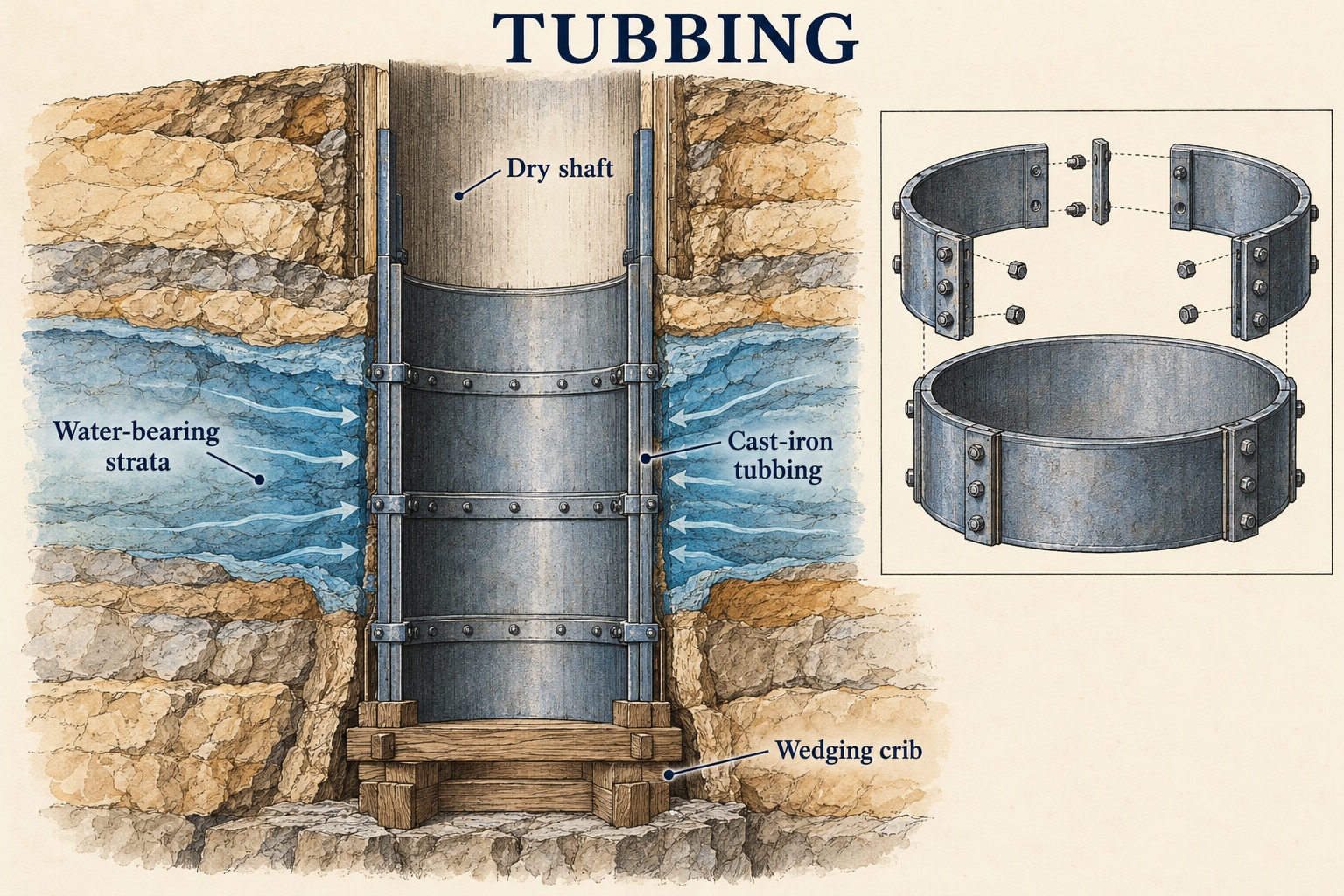
A watertight lining of cast-iron rings built up inside a shaft where it passes through water-bearing strata, each ring made of flanged segments wedged tight against the rock and the whole column seated on a wedging crib, so that the water is held back behind the iron instead of running into the pit.
Historical usage
The cast-iron form belongs to the winning of the concealed coalfield of east Durham. At Hetton in 1820 William Coulson's team of sinkers, after others had failed, drove a shaft through the Magnesian Limestone and below it met water flowing at up to 150 litres a second. Coulson held it back by improving the traditional iron tubbing with four wedging cribs, with piping to drain off the water and vents to ease the gas pressure, and reached the High Main and Hutton seams; the East Durham coalfield and its large collieries of hundreds of men followed. His son William's Crossgate Foundry in Durham made iron tubbing and was absorbed in 1866 into the Grange Iron Company. By 1906 both shafts at Wingate Grange were cased with cast-iron tubbing through the limestone, and at Pleasley in Derbyshire, where the sinkers met feeders of up to 1,000 gallons a minute in the Magnesian Limestone and the upper Coal Measures, the shafts were lined the same way.
How it worked
The shaft is sunk to a bed of sound, dry rock, widened there and the bed levelled, and on it is laid the wedging crib, a ring of cast-iron segments with half-inch deal sheeting between them and deal packed behind, wedged tight with wooden wedges driven both behind and into the joints. On the crib the tubbing is built up ring by ring. At Pleasley the English type had ten segments to a ring, held by wooden wedges between the back of the tubbing and the rock and thin wood sheeting in the vertical and horizontal joints, the plates three-quarters of an inch thick at the top and an inch and three-quarters lower down where the pressure was greater. At Lumpsey ironstone mine in 1881 nearly sixty fathoms of tubbing were put in through feeders of about 1,700 gallons a minute, the plates thickening from three-quarters to one inch by twenty-fathom stages, with a ring crib carrying a gutter to catch water running down the walls, single and double cribs fitted with escape valves for the air behind the iron, and a wooden plug in the centre of every segment that could be bored out to tap the water behind it.
Why it was used
Where a shaft had to pass through water-bearing rock, pumping the feeder for the life of the pit was ruinous and sometimes impossible. Tubbing shut the water out at its source and left the pumps for the workings. It made the shafts through the Magnesian Limestone of east Durham and north Derbyshire possible, and the Cleveland ironstone sinkings of the 1880s depended on it.
Risks & limitations
Tubbing holds only where the cribs seat in sound ground: at Lumpsey one or two of the cribs failed to hold the water because the shaft had been sunk on a fault. The iron must be thick enough for the head of water behind it, which is why plates were cast thicker with depth, and the air trapped behind the rings must be let out through valves. Water still runs down the shaft walls into the gutter of the ring crib and must be collected and pumped. A tubbed shaft is also specialist work to repair: after the Wingate Grange explosion of 1906 the owners called in F. Coulson, an expert in sinking, to restore the shafts.
Regional variation
The Durham sinkers made the method, and English tubbing of segmental rings wedged against the rock is the British form. Glossaries of the Midland coalfields define tubbing more widely as any wood, steel or cast-iron lining used in water-bearing strata.
Related terminology
Fault, Pumping Engine, Shaft, Shaft Sinking
Mines associated with this term
5 examples chosen from 26 linked records — the term page is not an index.
- Bullcroft Colliery — South Yorkshire (well documented example)
Named 3 times in this record, first in the history: “…1910, failed. A second was started in February 1911 after iron tubbing had been installed in the shafts, and this succeeded; sinking…” - Calverton Colliery — Nottinghamshire (well documented example)
Named in this record’s history: “…Board sank No. 2 shaft from January 1946 to June 1950, freezing and tubbing it, and on 24 September 1952 Lord Leathers officially opened…” - Williamthorpe Colliery — Derbyshire (well documented example)
Named 3 times in this record, first in the summary: “…water left by older workings and were lined with nineteen-foot iron tubbing to hold it back. Completed in 1905 after four years of sinking, it…” - Askern Main Colliery — South Yorkshire (well documented example)
Named in this record’s history: “…shafts, which were taken through waterlogged ground using tubbing. The Barnsley seam horizon was reached at 515 metres, though here…” - Bamfurlong Colliery — Greater Manchester (well documented example)
Named twice in this record, first in the history: “…and 16 feet across, meant to finish at 18 feet, with four rings of cast-iron tubbing put in to hold back quicksand — and were sunk first to the Wigan…”
Disasters associated with this term
Included only where MineArchive's own research gives a reasonable evidential basis, with the nature of the relationship stated — not every disaster where this term might plausibly apply.
- Auckland Park Colliery Shaft Accident, 1863 (contextual relationship)
Named 3 times in this record, first in the summary: “…Seven men were on it, connecting cast-iron pipes to the tubbing; several went to one side to lift a heavy pipe, their weight tipped…” - Byers Green Colliery shaft accident, 1873 (contextual relationship)
Named in this record’s narrative: “…Seven men stood on a cradle hung in the shaft to wedge the tubbing, the watertight lining: a circular platform almost as wide as the…” - Douglas Bank Colliery shaft collapse, 1865 (contextual relationship)
Named in this record’s narrative: “…each 16 feet across. They were lined in brick, with 22 yards of cast-iron tubbing where they passed through old flooded workings in the Ince Seven…” - Rufford Colliery Water Barrel Disaster (1913) (contextual relationship)
Named in this record’s narrative: “…156 yards down the shaft onto a scaffold where men were installing tubbing. The fall extinguished every light in the shaft and gave the men…” - Shakespeare Colliery inrush, 1897 (contextual relationship)
Named in this record’s narrative: “…to the company's money troubles. No. 2 was eventually lined with cast-iron tubbing as it was sunk, which dealt with the water.”
Sources
- (secondary) Lumpsey Ironstone Mine (British Mining No. 28) — Northern Mine Research Society
- (secondary) Pit Terminology — Healey Hero
- (secondary) Pleasley Colliery: tubbing — Pleasley Colliery (J. S. Thatcher)
- (secondary) William Coulson (mining engineer) — Wikipedia
- (secondary) Wingate Grange Colliery Explosion – Wingate – 1906 — Northern Mine Research Society
Record created: 18 October 2026 · Last researched: 18 October 2026