 MineArchive
Rufford Colliery Water Barrel Disaster (1913)
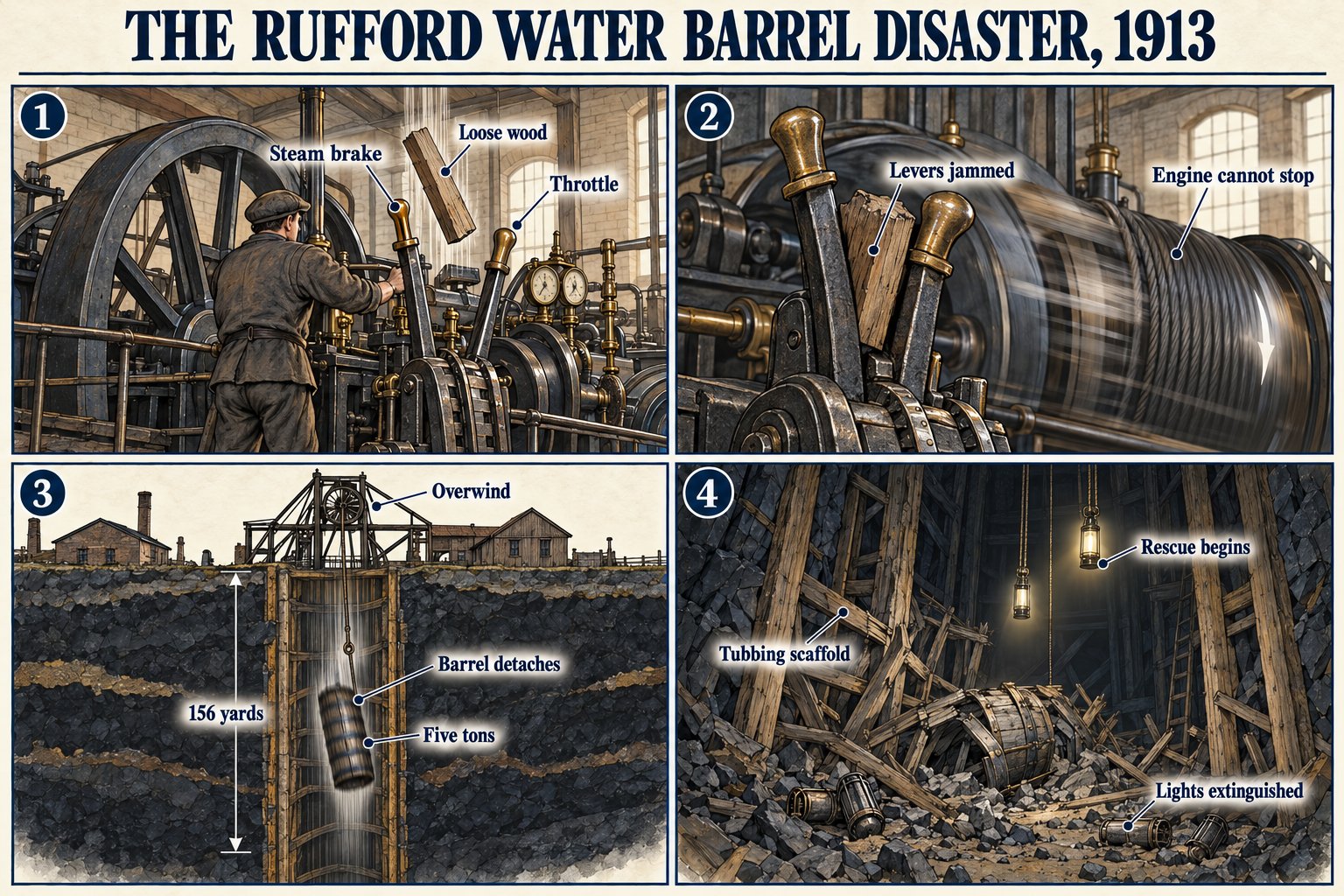
A jammed brake lever caused a runaway winding engine to drop a five-ton water barrel some 156 yards down the sinking shaft onto a scaffold of workers below.
| Date | 8 February 1913 |
|---|---|
| Mine | Rufford Colliery |
| Region | Nottinghamshire |
| Type | Winding / Shaft Accident |
| Fatalities | 14 (Fourteen men were killed outright; a further injured man died five days later, though it is unclear from the sources whether this fifteenth death is already counted within the figure of 14.) |
| Context | During active mining |
Cause
A piece of wood fell between the levers controlling the winding engine's steam brake and throttle, preventing the engineman stopping the engine before it overwound and detached the water barrel.
What happened
On 8 February 1913, during the sinking of Rufford Colliery's shaft, a piece of wood fell between the levers controlling the winding engine's steam brake and throttle. Unable to stop the engine in time, the engineman could not prevent it overwinding, and a water barrel weighing around five tons detached and plunged some 156 yards down the shaft onto a scaffold where men were installing tubbing. The fall extinguished every light in the shaft and gave the men below no chance to escape. Fourteen men were killed outright: Frederick Paddon (36), James Wigman (43), Frank Dagnall (27), Andrew Dagnall (37), Herbert Woodward (25), John Knowles (33), William Hollings (22), Walter Storey (38), Henry Scott (47), Jesse Hart (26), John Tomlinson (40), Joseph Bettney (41), Thomas Gordon (32) and Patrick Mulligan (33). Four more men -- George Kemp, Samuel Overton, Tom Tennant and Tom Bradley -- were injured; one of them died five days later of his injuries.
Legal & regulatory aftermath
In the House of Commons on 14 February 1913, Sir Arthur Markham raised the disaster's cause and urged that electric lamps and rope escape ladders be fitted in sinking shafts, arguing these measures could have saved the men's lives. Home Secretary Reginald McKenna acknowledged the value of raising the case and promised full consideration of the suggestions once a formal inquiry had reported.
Recorded claims
Individual factual claims, each attached to the source(s) that support it below. Where sources disagree, both are kept.
- A jammed brake lever caused the winding engine to overwind on 8 February 1913, dropping a five-ton water barrel some 156 yards onto a sinking scaffold; fourteen men were killed outright, named as Frederick Paddon, James Wigman, Frank and Andrew Dagnall, Herbert Woodward, John Knowles, William Hollings, Walter Storey, Henry Scott, Jesse Hart, John Tomlinson, Joseph Bettney, Thomas Gordon and Patrick Mulligan, with a further injured man dying five days later. 1
- Sir Arthur Markham raised the disaster in the House of Commons on 14 February 1913, urging electric lighting and rope escape ladders in sinking shafts; the Home Secretary promised full consideration once a formal inquiry had reported. 2
Related terminology
Mining terms this disaster is structurally linked to, with the nature of the relationship.
- Colliery (contextual relationship)
Named in this record’s narrative: “On 8 February 1913, during the sinking of Rufford Colliery's shaft, a piece of wood fell between the levers controlling the…” - Ladders (contextual relationship)
Named in this record’s aftermath: “…the disaster's cause and urged that electric lamps and rope escape ladders be fitted in sinking shafts, arguing these measures could have saved…” - Shaft (contextual relationship)
Named 4 times in this record, first in the summary: “…to drop a five-ton water barrel some 156 yards down the sinking shaft onto a scaffold of workers below.” - Shaft Sinking (contextual relationship)
Named 4 times in this record, first in the summary: “…engine to drop a five-ton water barrel some 156 yards down the sinking shaft onto a scaffold of workers below.” - Winding Engine (contextual relationship)
Named 3 times in this record, first in the summary: “A jammed brake lever caused a runaway winding engine to drop a five-ton water barrel some 156 yards down the sinking…”
Sources
- (secondary) Rufford Colliery Shaft Accident - Mansfield - 1913 (Northern Mine Research Society) — Northern Mine Research Society
- (primary) RUFFORD COLLIERY DISASTER (Hansard, 14 February 1913) — Hansard, House of Commons
- (secondary) Rufford Colliery — Wikipedia
Record created: 31 August 2026 · Last researched: 31 August 2026