 MineArchive
Magnesian Limestone
| Also known as | Zechstein Group, Dolomite rock, Raisby Formation, Cadeby Formation, Lower Magnesian Limestone, Upper Magnesian Limestone |
|---|---|
| Category | Commodities |
The suite of Permian carbonate rocks that runs from Nottingham north through Yorkshire into County Durham, where it forms the coastal cliffs between Hartlepool and South Shields. Much of it is dolomite rather than ordinary limestone, and it has long been Britain's main source of dolomite rock.

Historical usage
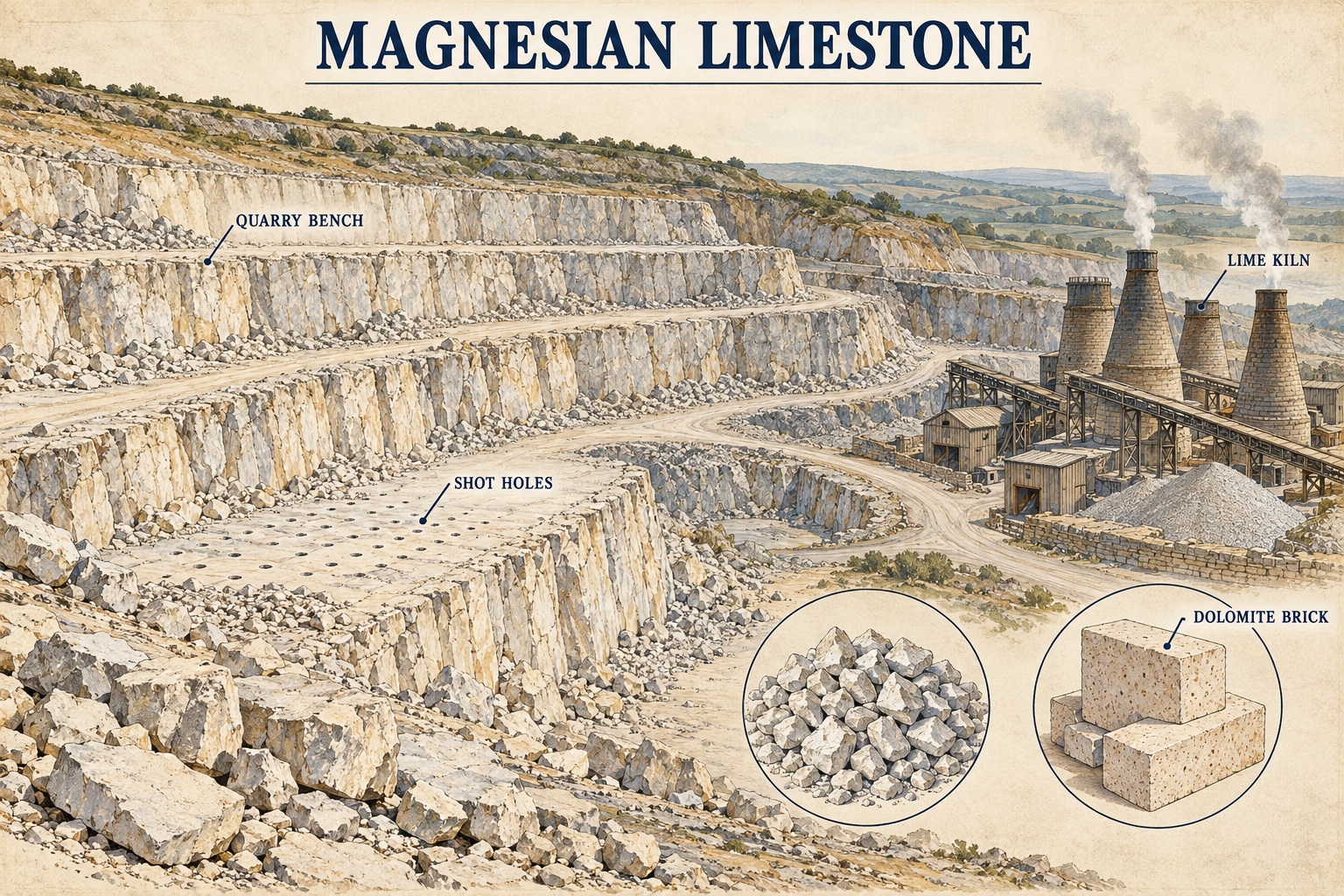
The escarpment has been quarried for building stone, agricultural lime, roadstone and furnace flux for centuries, and from the nineteenth century on an industrial scale for refractory brick, which needs the magnesia. Raisby, Marsden, Thrislington and their neighbours worked it in quarries employing hundreds of men, and the collieries of east Durham had to sink through it to reach the coal beneath — which is why the rock turns up in the records of pits that never sold a ton of stone.
The term itself has been retired from formal use, though it is still everywhere in both popular and scientific writing on the geology of northern England. The rocks are now placed in the Zechstein Group. In the south of the outcrop the old Lower Magnesian Limestone is the Cadeby Formation and the Upper is the Brotherton Formation; in the north the Lower is the Raisby Formation, named from Raisby Hill Quarry near Coxhoe, and the Middle is the Ford Formation.
How it worked
Worked almost entirely by open quarrying in benches, the faces reaching well over a hundred feet in the larger workings, with gunpowder shots in vertical holes bringing the stone down. Some of the returns also record substantial numbers working below ground. Burnt in kilns it gives lime; crushed it gives aggregate and agricultural lime; calcined and pressed it gives the dolomite brick that lines a steel furnace.
Why it was used
Its magnesia content is the point. Dolomite resists heat and chemical attack in ways ordinary limestone does not, which is what made it the refractory stone of the British steel industry, and its resistance to acid is why it was used for statuary in antiquity. Pieces of dolomite found in the ruins of Rome are thought to have come from Magnesia in Greece, which is where the name comes from.
Risks & limitations
The rock is not uniform. Raisby Quarries are known in the literature precisely because the Raisby Formation there carries a thick mass of ordinary limestone where dolomite would be expected, and diagenetic breccias run through part of the sequence. Quarrying it was dangerous work in the days before benching was regulated: thirteen men died at Raisby Hill between 1900 and 1951, mostly in falls from the faces or struck by stone thrown from shots.
Regional variation
The outcrop is a narrow belt running north from Nottinghamshire through South and West Yorkshire into Durham and out to the coast. The Durham Province has its own formation names, the Raisby, Ford, Roker and Seaham, while the Yorkshire and Nottinghamshire end has the Cadeby, Edlington and Brotherton.
Related terminology
Anhydrite, Lime Kiln, Limestone, Quicklime
Mines associated with this term
5 examples chosen from 30 linked records — the term page is not an index.
- Trimdon Grange Colliery — County Durham (well documented example)
Named in this record’s geology: “…Durham Coal Measures, close to where they pass beneath the Permian Magnesian Limestone escarpment. The colliery worked an unusually long list of named…” - Bishop Middleham Colliery — County Durham (well documented example)
Named in this record’s geology: “…coalfield, where the Coal Measures pass eastward beneath the Permian magnesian limestone that gives Bishop Middleham its quarries. The seams named in the…” - Eppleton Colliery — Tyne and Wear (well documented example)
Named in this record’s geology: “…East Durham coalfield, where the productive measures lie beneath the Magnesian Limestone and the pits had to be sunk through it — the engineering problem…” - Glapwell Colliery — Derbyshire (well documented example)
Named in this record’s geology: “…coalfield, where the Coal Measures dip east beneath the Permian Magnesian Limestone; the village sits on the western edge of that limestone, overlooking…” - Harton Colliery — Tyne and Wear (well documented example)
Named in this record’s geology: “Durham coalfield beneath the Magnesian Limestone and a fault requiring 474 feet of tubbing: the Bensham (reached at…”
Disasters associated with this term
Included only where MineArchive's own research gives a reasonable evidential basis, with the nature of the relationship stated — not every disaster where this term might plausibly apply.
- Wingate Grange Colliery explosion, 1906 (contextual relationship)
Named in this record’s narrative: “…edge of the Northern coalfield, where the measures pass under the Magnesian Limestone; five seams had been proved workable and about 1,200 people were…”
Sources
- (primary) Raisby Quarries, Geological Conservation Review site account — Joint Nature Conservation Committee
- (secondary) Magnesian Limestone — Wikipedia
- (secondary) Zechstein — Wikipedia
Record created: 11 September 2026 · Last researched: 11 September 2026